
Official paper · included in Plus & Pro

CAT 2025 Slot 3 Question Paper with Solutions

68 questions in 120 minutes, in three timed sections. Below: how the paper is built, the topics each section tested, and a solved sample from every section. Take the whole paper in the simulator to get your Score Waterfall, Topic ROI Map and Strategic IQ.

Paper structure and topics

VARC

Verbal Ability & Reading Comprehension

24 questions · 20 MCQ · 4 TITA

  • Reading Comprehension · 16
  • Verbal Ability · 8

DILR

Data Interpretation & Logical Reasoning

22 questions · 11 MCQ · 11 TITA

  • Data Interpretation · 13
  • Logical Reasoning · 9

QA

Quantitative Ability

22 questions · 14 MCQ · 8 TITA

  • Arithmetic · 9
  • Algebra · 7
  • Geometry · 3
  • Number System · 2
  • Modern Math · 1

Sample questions with solutions

13 of the 68 questions: the first passage, the first DILR set and the first QA questions of the paper.

VARC · Verbal Ability & Reading Comprehension

Passage

Once a society accepts a secular mode of creativity, within which the creator replaces God, imaginative transactions assume a self-conscious form. The tribal imagination, on the other hand, is still to a large extent dreamlike and hallucinatory. It admits fusion between various planes of existence and levels of time in a natural and artless manner. In tribal stories, oceans fly in the sky as birds, mountains swim in water as fish, animals speak as humans and stars grow like plants. Spatial order and temporal sequence do not restrict the narrative. This is not to say that tribal creations have no conventions or rules, but simply that they admit the principle of association between emotion and the narrative motif. Thus stars, seas, mountains, trees, men and animals can be angry, sad or happy.

It might be said that tribal artists work more on the basis of their racial and sensory memory than on the basis of a cultivated imagination. In order to understand this distinction, we must understand the difference between imagination and memory. In the animate world, consciousness meets two immediate material realities: space and time. We put meaning into space by perceiving it in terms of images. The image-making faculty is a genetic gift to the human mind—this power of imagination helps us understand the space that envelops us. With regard to time, we make connections with the help of memory; one remembers being the same person today as one was yesterday.

The tribal mind has a more acute sense of time than the sense of space. Somewhere along the history of human civilization, tribal communities seem to have realized that domination over territorial space was not their lot. Thus, they seem to have turned almost obsessively to gaining domination over time. This urge is substantiated in their ritual of conversing with their dead ancestors: year after year, tribals in many parts of India worship terracotta or carved-wood objects representing their ancestors, aspiring to enter a trance in which they can converse with the dead. Over the centuries, an amazingly sharp memory has helped tribals classify material and natural objects into a highly complex system of knowledge. . . .

One of the main characteristics of the tribal arts is their distinct manner of constructing space and imagery, which might be described as ‘hallucinatory’. In both oral and visual forms of representation, tribal artists seem to interpret verbal or pictorial space as demarcated by an extremely flexible ‘frame’. The boundaries between art and non-art become almost invisible. A tribal epic can begin its narration from a trivial everyday event; tribal paintings merge with living space as if the two were one and the same. And within the narrative itself, or within the painted imagery, there is no deliberate attempt to follow a sequence. The episodes retold and the images created take on the apparently chaotic shapes of dreams. In a way, the syntax of language and the grammar of painting are the same, as if literature were painted words and painting were a song of images.

Question 1 · MCQ

All of the following, if true, would weaken the passage’s claims about the hallucinatory tribal imagination EXCEPT that:
  1. A.
    tribal stories depict the natural world in accordance with rational scientific knowledge.
  2. B.
    tribal narratives exhibit a chronological beginning, middle, and end.
  3. C.
    shamanic rituals involving conversing with the dead often feature in tribal stories.
    ✓ Correct
  4. D.
    tribal art excludes the depiction of the mundane reality of everyday life and objects.
Solution
The passage describes tribal imagination as hallucinatory, admitting fusion between planes of existence and levels of time, and not restricted by spatial or temporal sequence. Options 1, 2, and 4 contradict those claims: rational scientific depiction, chronological structure, and exclusion of mundane reality all weaken the hallucinatory characterization. Option 3 is consistent with the passage, which mentions tribal rituals of conversing with the dead as part of their urge to dominate time. Hence, option 3 does not weaken.
Question 2 · MCQ

On the basis of the passage, which one of the following explains the main difference between imagination and memory?
  1. A.
    Imagination needs to be cultivated whereas memory is more intuitive because it is racial and sensory.
  2. B.
    Imagination helps humans make sense of space while memory helps them understand time.
    ✓ Correct
  3. C.
    Tribal groups value memory over imagination when it comes to creating art and literature.
  4. D.
    Imagination is a genetic gift to humans whereas memory is central to human consciousness.
Solution
The passage explicitly distinguishes the two faculties by associating them with space and time: imagination helps humans make sense of the space around them, while memory helps them form connections across time. The text states, 'We put meaning into space by perceiving it in terms of images' and 'With regard to time, we make connections with the help of memory.' Option 2 captures this central difference.

Question 3 · MCQ

Non-human living forms exhibit human emotions in tribal narratives because tribal narratives:
  1. A.
    are rudimentary and underdeveloped.
  2. B.
    have a self-conscious form.
  3. C.
    accommodate existential fluidity.
    ✓ Correct
  4. D.
    abandon all rules and regulations.
Solution
The passage says tribal imagination 'admits fusion between various planes of existence and levels of time' and works on 'the principle of association between emotion and the narrative motif.' This existential fluidity allows non-human forms to exhibit human emotions. Option 3 captures that idea. Option 4 is incorrect because the passage explicitly says tribal creations are not without conventions or rules.

Question 4 · MCQ

Which one of the following best explains why tribals in India worship their dead ancestors?
  1. A.
    Tribals show respect to their ancestors through terracotta and carved-wood objects.
  2. B.
    For tribals, conversing with the dead becomes a way of seeking control over time.
    ✓ Correct
  3. C.
    Tribals possess a sophisticated knowledge system that is based on memory.
  4. D.
    Tribals seek territorial domination over the spaces that they inhabit.
Solution
The passage states that tribal communities turned 'almost obsessively to gaining domination over time,' and this urge is substantiated by their ritual of conversing with dead ancestors. The worship of terracotta or carved-wood ancestor figures is thus a means of seeking control over time, not merely showing respect or seeking territorial domination.

DILR · Data Interpretation & Logical Reasoning

Set

Read the information given below and answer the question that follows.

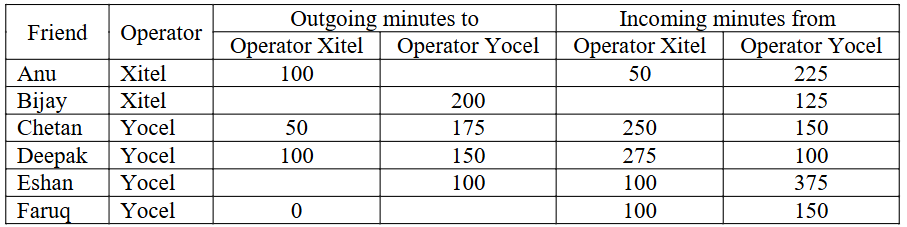
Anu, Bijay, Chetan, Deepak, Eshan, and Faruq are six friends. Each of them uses a mobile number from exactly one of the two mobile operators - Xitel and Yocel. During the last month, the six friends made several calls to each other. Each call was made by one of these six friends to another. The table below summarizes the number of minutes of calls that each of the six made to (outgoing minutes) and received from (incoming minutes) these friends, grouped by the operators. Some of the entries are missing.

[Table: Summarizes outgoing and incoming minutes for friends Anu, Bijay, Chetan, Deepak, Eshan, and Faruq across operators Xitel and Yocel]

It is known that the duration of calls from Faruq to Eshan was 200 minutes. Also, there were no calls from:
i. Bijay to Eshan,
ii. Chetan to Anu and Chetan to Deepak,
iii. Deepak to Bijay and Deepak to Faruq,
iv. Eshan to Chetan and Eshan to Deepak.
DILR set, figure 1

Question 1 · TITA (type in the answer)

What was the duration of calls (in minutes) from Bijay to Anu?

Answer: 50

Solution
Anu's incoming minutes from Operator Xitel = 50.
The only Xitel users are Anu and Bijay. Since Anu cannot receive calls from herself, the 50 incoming Xitel minutes must be from Bijay.
Therefore, duration of calls from Bijay to Anu = 50 minutes.

Question 2 · TITA (type in the answer)

What was the total duration of calls (in minutes) made by Anu to friends having mobile numbers from Operator Yocel?

Answer: 525

Solution
Let Xitel users be Anu and Bijay, and Yocel users be Chetan, Deepak, Eshan, and Faruq.

Total outgoing minutes from Xitel users to Yocel users = Anu's outgoing to Yocel + Bijay's outgoing to Yocel.
Bijay's outgoing to Yocel = 200.

Total incoming minutes from Xitel for Yocel users:
Chetan 250 + Deepak 275 + Eshan 100 + Faruq 100 = 725.

These two totals must be equal:
Anu's outgoing to Yocel + 200 = 725.
So, Anu's outgoing to Yocel = 525 minutes.

Question 3 · TITA (type in the answer)

What was the total duration of calls (in minutes) made by Faruq to friends having mobile numbers from Operator Yocel?

Answer: 350

Solution
Let X → Y denote minutes called from X to Y.
Given F → E = 200.

Deepak's incoming-Y row: C → D + E → D + F → D = 100. No C → D and no E → D, so F → D = 100.

Eshan's outgoing-Y row: E → C + E → D + E → F = 100. No E → C and no E → D, so E → F = 100.

Faruq's incoming-Y row: C → F + D → F + E → F = 150. No D → F, so C → F = 50.

Chetan's outgoing-Y row: C → D + C → E + C → F = 175. No C → D, so C → E = 125.

Eshan's incoming-Y row: C → E + D → E + F → E = 375; substituting 125 and 200 gives D → E = 50.

Deepak's outgoing-Y row: D → C + D → E + D → F = 150. No D → F, so D → C = 100.

Chetan's incoming-Y row: D → C + E → C + F → C = 150. No E → C, so F → C = 50.

Therefore Faruq's outgoing calls to Yocel friends = F → C + F → D + F → E = 50 + 100 + 200 = 350.

Question 4 · MCQ

What was the duration of calls (in minutes) from Deepak to Chetan?
  1. A.
    100
    ✓ Correct
  2. B.
    0
  3. C.
    125
  4. D.
    50
Solution
From the set's derived values:
F → D = 100, E → F = 100, C → F = 50.

Then C → E = 125 from Chetan's outgoing-Y row.

Eshan's incoming-Y row: 125 + D → E + 200 = 375, so D → E = 50.

Deepak's outgoing-Y row: D → C + D → E + D → F = 150. No D → F, so D → C + 50 = 150.

Hence D → C = 100, which is option 1.

QA · Quantitative Ability

Question 1 · MCQ

If \(\left( x^2 + \frac{1}{x^2} \right) = 25\) and \(x > 0\), then the value of \(\left( x^7 + \frac{1}{x^7} \right)\) is
  1. A.
    44850 \(\sqrt{3}\)
  2. B.
    44853 \(\sqrt{3}\)
    ✓ Correct
  3. C.
    44859 \(\sqrt{3}\)
  4. D.
    44856 \(\sqrt{3}\)
Solution
Let \(a=x+\frac{1}{x}\).
Given \(x^2+\frac{1}{x^2}=25\), we get \(a^2-2=25\), so \(a=3\sqrt{3}\) since \(x>0\).
Let \(S_n=x^n+\frac{1}{x^n}\).
Use \(S_{m+n}=S_mS_n-S_{m-n}\).
\(S_1=3\sqrt{3}\), \(S_2=25\).
\(S_3=S_1S_2-S_1=3\sqrt{3}(24)=72\sqrt{3}\).
\(S_4=S_2^2-2=623\).
\(S_7=S_4S_3-S_1=623(72\sqrt{3})-3\sqrt{3}=44853\sqrt{3}\).
Answer: option 2.

Question 2 · MCQ

For real values of \(x\), the range of the function \(f(x) = \frac{2x - 3}{2x^2 - 4x - 6}\) is
  1. A.
    \((-\infty, \frac{1}{8}] \cup [1, \infty)\)
  2. B.
    \((-\infty, \frac{1}{4}] \cup [1, \infty)\)
  3. C.
    \((-\infty, \frac{1}{4}] \cup [\frac{1}{2}, \infty)\)
  4. D.
    \((-\infty, \frac{1}{8}] \cup [\frac{1}{2}, \infty)\)
    ✓ Correct
Solution
Let \(y=\frac{2x-3}{2x^2+4x-6}\).
The denominator is zero at \(x=-3,1\).

Cross-multiply:
\(2yx^2+(4y-2)x+(3-6y)=0\).

For real \(x\), the discriminant must be non-negative:
\((4y-2)^2-8y(3-6y)\ge 0\)
\(16y^2-16y+4-24y+48y^2\ge 0\)
\(16y^2-10y+1\ge 0\).

This holds for \(y\le \frac18\) or \(y\ge \frac12\).
Hence the range is \((-\infty,\frac18]\cup[\frac12,\infty)\).

Question 3 · MCQ

For a 4-digit number (greater than 1000), sum of the digits in the thousands, hundreds, and tens places is 15. Sum of the digits in the hundreds, tens, and units places is 16. Also, the digit in the tens place is 6 more than the digit in the units place. The difference between the largest and smallest possible value of the number is
  1. A.
    811
    ✓ Correct
  2. B.
    4078
  3. C.
    735
  4. D.
    3289
Solution
Let the digits be \(a,b,c,d\) from thousands to units.
Given:
\(a+b+c=15\)
\(b+c+d=16\)
\(c=d+6\)

Subtracting the first equation from the second:
\(d-a=1 \Rightarrow d=a+1\).

Since \(c=d+6\) and \(c\le9\), we get \(d\le3\). With \(a\ge1\), the valid cases are:
\(d\)\(a\)\(c\)\(b\)Number
21861682
32942493
Difference = \(2493-1682=811\).

Answer: option 1.

Question 4 · MCQ

Teams A, B, and C consist of five, eight, and ten members, respectively, such that every member within a team is equally productive. Working separately, teams A, B, and C can complete a certain job in 40 hours, 50 hours, and 4 hours, respectively. Two members from team A, three members from team B, and one member from team C together start the job, and the member from team C leaves after 23 hours. The number of additional member(s) from team B, that would be required to replace the member from team C, to finish the job in the next one hour, is
  1. A.
    2
    ✓ Correct
  2. B.
    4
  3. C.
    1
  4. D.
    3
Solution
Let total work be \(W\).

One member's rate:
A: \(\frac{W}{200}\), B: \(\frac{W}{400}\), C: \(\frac{W}{40}\).

Initial rate of \(2\text{A}+3\text{B}+1\text{C}\):
\(\frac{2W}{200}+\frac{3W}{400}+\frac{W}{40}=\frac{17W}{400}\).

Work done in 23 hours:
\(23\times\frac{17W}{400}=\frac{391W}{400}\).

Remaining work:
\(\frac{9W}{400}\).

After C leaves, rate of \(2\text{A}+3\text{B}\):
\(\frac{2W}{200}+\frac{3W}{400}=\frac{7W}{400}\).

Extra rate needed to finish in 1 hour:
\(\frac{9W}{400}-\frac{7W}{400}=\frac{2W}{400}\), which equals 2 members of B.

Answer: option 1.

Question 5 · MCQ

The average salary of 5 managers and 25 engineers in a company is 60000 rupees. If each of the managers received 20% salary increase while the salary of the engineers remained unchanged, the average salary of all 30 employees would have increased by 5%. The average salary, in rupees, of the engineers is
  1. A.
    50000
  2. B.
    45000
  3. C.
    40000
  4. D.
    54000
    ✓ Correct
Solution
Original total salary = \(30 \times 60000 = 18,00,000\).
After a 5% increase in average, new total = \(30 \times 63000 = 18,90,000\).
Increase = \(90,000\), which is 20% of managers' original total salary.
Managers' original total = \(\frac{90,000}{0.20} = 4,50,000\).
Engineers' total = \(18,00,000 - 4,50,000 = 13,50,000\).
Average engineer salary = \(\frac{13,50,000}{25} = 54,000\).
Correct option: 4.

The other 55 questions are in the simulator

Sit CAT 2025 Slot 3 with the real exam's timer and interface, then see where your marks went: silly slips, traps, topics that cost you time, and the questions you should have skipped. Start with the free mock test: no payment needed.

Unlock this paper