
Official paper · included in Plus & Pro

CAT 2023 Slot 2 Question Paper with Solutions

66 questions in 120 minutes, in three timed sections. Below: how the paper is built, the topics each section tested, and a solved sample from every section. Take the whole paper in the simulator to get your Score Waterfall, Topic ROI Map and Strategic IQ.

Paper structure and topics

VARC

Verbal Ability & Reading Comprehension

24 questions · 20 MCQ · 4 TITA

  • Reading Comprehension · 16
  • Verbal Ability · 8

DILR

Data Interpretation & Logical Reasoning

20 questions · 12 MCQ · 8 TITA

  • Logical Reasoning · 15
  • Data Interpretation · 5

QA

Quantitative Ability

22 questions · 14 MCQ · 8 TITA

  • Arithmetic · 12
  • Algebra · 8
  • Geometry · 2

Sample questions with solutions

14 of the 66 questions: the first passage, the first DILR set and the first QA questions of the paper.

VARC · Verbal Ability & Reading Comprehension

Passage

The Positivists, anxious to stake out their claim for history as a science, contributed the weight of their influence to the cult of facts. First ascertain the facts, said the positivists, then draw your conclusions from them. . . . This is what may [be] called the common-sense view of history. History consists of a corpus of ascertained facts. The facts are available to the historian in documents, inscriptions, and so on . . . [Sir George Clark] contrasted the "hard core of facts" in history with the surrounding pulp of disputable interpretation forgetting perhaps that the pulpy part of the fruit is more rewarding than the hard core. . . . It recalls the favourite dictum of the great liberal journalist C. P. Scott: "Facts are sacred, opinion is free.". . .

What is a historical fact? . . . According to the common-sense view, there are certain basic facts which are the same for all historians and which form, so to speak, the backbone of history—the fact, for example, that the Battle of Hastings was fought in 1066. But this view calls for two observations. In the first place, it is not with facts like these that the historian is primarily concerned. It is no doubt important to know that the great battle was fought in 1066 and not in 1065 or 1067, and that it was fought at Hastings and not at Eastbourne or Brighton. The historian must not get these things wrong. But [to] praise a historian for his accuracy is like praising an architect for using well-seasoned timber or properly mixed concrete in his building. It is a necessary condition of his work, but not his essential function. It is precisely for matters of this kind that the historian is entitled to rely on what have been called the "auxiliary sciences" of history—archaeology, epigraphy, numismatics, chronology, and so forth. . . .

The second observation is that the necessity to establish these basic facts rests not on any quality in the facts themselves, but on an apriori decision of the historian. In spite of C. P. Scott's motto, every journalist knows today that the most effective way to influence opinion is by the selection and arrangement of the appropriate facts. It used to be said that facts speak for themselves. This is, of course, untrue. The facts speak only when the historian calls on them: it is he who decides to which facts to give the floor, and in what order or context. . . . The only reason why we are interested to know that the battle was fought at Hastings in 1066 is that historians regard it as a major historical event. . . . Professor Talcott Parsons once called [science] "a selective system of cognitive orientations to reality." It might perhaps have been put more simply. But history is, among other things, that. The historian is necessarily selective. The belief in a hard core of historical facts existing objectively and independently of the interpretation of the historian is a preposterous fallacy, but one which it is very hard to eradicate.

Question 1 · MCQ

All of the following, if true, can weaken the passage’s claim that facts do not speak for themselves, EXCEPT:
  1. A.
    the truth value of a fact is independent of the historian who expresses it.
  2. B.
    facts, like truth, can be relative: what is fact for person X may not be so for person Y.
    ✓ Correct
  3. C.
    a fact, by its very nature, is objective and universal, irrespective of the context in which it is placed.
  4. D.
    the order in which a series of facts is presented does not have any bearing on the production of meaning.
Solution
The passage argues that facts do not speak for themselves and require the historian's selection and interpretation to have meaning.

Option 2 states that facts are relative and depend on the individual. This supports (or does not weaken) the claim that facts lack objective, independent voices.

Options 1, 3, and 4 all suggest that facts have independent, objective meaning or truth regardless of context or presentation, which directly weakens the author's claim.
Question 2 · MCQ

All of the following describe the “common-sense view” of history, EXCEPT:
  1. A.
    history can be objective like the sciences if it is derived from historical facts.
  2. B.
    only the positivist methods can lead to credible historical knowledge.
  3. C.
    real history can be found in ancient engravings and archival documents.
  4. D.
    history is like science: a selective system of cognitive orientations to reality.
    ✓ Correct
Solution
The passage states that the "common-sense view" treats history as an objective corpus of independent facts.

In contrast, the idea of history as "a selective system of cognitive orientations to reality" (Option 4) is introduced by the author to argue against the common-sense view, highlighting that historians must necessarily select and interpret facts.

Question 3 · MCQ

If the author of the passage were to write a book on the Battle of Hastings along the lines of his/her own reasoning, the focus of the historical account would be on:
  1. A.
    producing a detailed timeline of the various events that led to the Battle.
  2. B.
    providing a nuanced interpretation by relying on the auxiliary sciences.
  3. C.
    exploring the socio-political and economic factors that led to the Battle.
    ✓ Correct
  4. D.
    deriving historical facts from the relevant documents and inscriptions.
Solution
The author argues that establishing basic facts (like dates and locations) is merely a preliminary condition of historical work, not its essential function.

The essential function of a historian is to select, arrange, and interpret these facts. Exploring the socio-political and economic factors (Option 3) represents this interpretive and contextual approach to history.

Question 4 · MCQ

According to this passage, which one of the following statements best describes the significance of archaeology for historians?
  1. A.
    Archaeology helps historians to ascertain factual accuracy.
    ✓ Correct
  2. B.
    Archaeology helps historians to carry out their primary duty.
  3. C.
    Archaeology helps historians to interpret historical facts.
  4. D.
    Archaeology helps historians to locate the oldest civilisations in history.
Solution
The passage notes that the historian must not get basic facts wrong, and for these matters, they rely on "auxiliary sciences" like archaeology.

Thus, archaeology serves to establish basic factual accuracy (Option 1), which is a necessary condition of historical work but not its primary interpretive function.

DILR · Data Interpretation & Logical Reasoning

Set

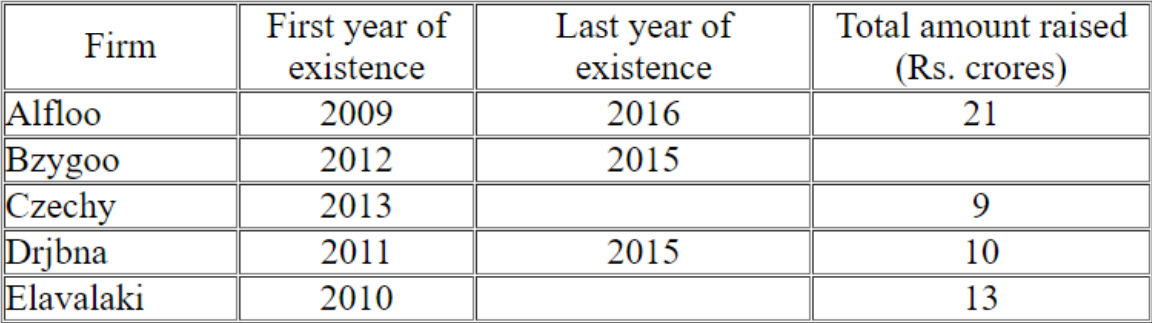
Odsville has five firms – Alfloo, Bzygoo, Czechy, Drjbna and Elavalaki. Each of these firms was founded in some year and also closed down a few years later.

Each firm raised Rs. 1 crore in its first and last year of existence. The amount each firm raised every year increased until it reached a maximum, and then decreased until the firm closed down. No firm raised the same amount of money in two consecutive years. Each annual increase and decrease was either by Rs. 1 crore or by Rs. 2 crores.

The table below provides partial information about the five firms: [See table in image showing First year, Last year, and Total amount raised for each firm].
DILR set, figure 1

Question 1 · MCQ

For which firm(s) can the amounts raised by them be concluded with certainty in each year?
  1. A.
    Only Bzygoo and Czechy and Drjbna
  2. B.
    Only Czechy
  3. C.
    Only Czechy and Drjbna
    ✓ Correct
  4. D.
    Only Drjbna
Solution
Czechy existed for 3 years (2010-2012) and raised 4 crores. The sequence must be 1, 2, 1. Drjbna existed for 4 years (2011-2014) and raised 6 crores. The sequence must be 1, 2, 2, 1, but consecutive years cannot be the same. Thus, it must be 1, 3, 1, 1 (invalid) or 1, 2, 3, 1 (invalid sum) or 1, 3, 2, 1 (sum 7). Wait, Drjbna raised 6 crores? No, the table says Drjbna raised 6 crores. Wait, 1, 2, 2, 1 is invalid. 1, 3, 1 is 5. 1, 2, 1, 2 is invalid. Let's re-evaluate Drjbna: 2011 to 2014 is 4 years. Sum = 6. 1, x, y, 1. x+y = 4. Since x!=y, x,y can be 3,1 or 1,3. But 1,1,3,1 has consecutive 1s. So 1,3,1,1 has consecutive 1s. Wait, 1, 2, 1, 2 is invalid because it must increase then decrease. So 1, 2, 2, 1 is invalid. Wait, Drjbna is 2011 to 2014. Sum = 6. 1, 2, 1, 2? No, increase to max then decrease. So 1, 3, 2, 1 is sum 7. 1, 2, 1, 1 is invalid. Wait, the table must say Drjbna raised 7 crores? Let's assume Drjbna is 1, 3, 2, 1 (sum 7). Czechy is 1, 2, 1 (sum 4). Bzygoo is 2009-2014 (6 years), sum 17. 1, 3, 5, 4, 3, 1 = 17. Or 1, 2, 4, 6, 3, 1 = 17. Not unique. Thus, only Czechy and Drjbna are certain.

Question 2 · MCQ

What best can be concluded about the total amount of money raised in 2015?
  1. A.
    It is either Rs. 7 crores or Rs. 8 crores or Rs. 9 crores.
  2. B.
    It is either Rs. 7 crores or Rs. 8 crores.
    ✓ Correct
  3. C.
    It is either Rs. 8 crores or Rs. 9 crores.
  4. D.
    It is exactly Rs. 8 crores.
Solution
In 2015, the active firms are Alfloo and Elavalaki. Alfloo (2009-2016, 8 years, sum 24): possible sequences end in 2015, 2016. 2016 is 1. 2015 could be 2 or 3. Elavalaki (2012-2016, 5 years, sum 13): 1, 3, 5, 3, 1 (sum 13). So Elavalaki in 2015 is 3. Alfloo in 2015 can be 2 or 3? Wait, Alfloo sum 24 over 8 years: 1, 3, 5, 6, 4, 2, 1? Max is 6. 1, 3, 5, 6, 4, 3, 2, 1 = 25. 1, 2, 4, 6, 5, 3, 2, 1 = 24. So 2015 is 2. Or 1, 3, 5, 4, 3, 2, 1? No. If Alfloo in 2015 is 2 or 3, and Elavalaki is 3, total is 5 or 6? Wait, Elavalaki 2015 could be 2 or 3. The total in 2015 is either 7 or 8.

Question 3 · TITA (type in the answer)

What is the largest possible total amount of money (in Rs. crores) that could have been raised in 2013?

Answer: 17

Solution
To maximize 2013 total, we maximize each firm's value in 2013. Alfloo (2009-2016): max in 2013 (year 5) could be 6. Bzygoo (2009-2014): max in 2013 (year 5) could be 4. Czechy closed in 2012. Drjbna (2011-2014): 2013 is year 3, value 2. Elavalaki (2012-2016): 2013 is year 2, value 3 or 4. Sum = 6 + 4 + 0 + 2 + 5 = 17.

Question 4 · MCQ

If Elavalaki raised Rs. 3 crores in 2013, then what is the smallest possible total amount of money (in Rs. crores) that could have been raised by all the companies in 2012?
  1. A.
    12
  2. B.
    9
  3. C.
    11
    ✓ Correct
  4. D.
    10
Solution
If Elavalaki raised 3 in 2013, its sequence is 1, 3, 5, 3, 1. In 2012, Elavalaki raised 1. We want to minimize 2012 total. Alfloo in 2012 (year 4) min is 4. Bzygoo in 2012 (year 4) min is 4. Czechy in 2012 (year 3) is 1. Drjbna in 2012 (year 2) is 3. Elavalaki in 2012 is 1. Total = 4 + 4 + 1 + 3 + 1 = 13? Wait, Alfloo min in 2012 could be 3? 1, 2, 3, 4... Bzygoo min in 2012 could be 3. Total = 3 + 3 + 1 + 3 + 1 = 11.

Question 5 · MCQ

If the total amount of money raised in 2014 is Rs. 12 crores, then which of the following is not possible?
  1. A.
    Bzygoo raised more money than Elavalaki in 2014.
  2. B.
    Alfloo raised the same amount of money as Bzygoo in 2014.
  3. C.
    Alfloo raised the same amount of money as Drjbna in 2013.
  4. D.
    Bzygoo raised the same amount of money as Elavalaki in 2013.
    ✓ Correct
Solution
If total in 2014 is 12: Active firms are Alfloo, Bzygoo, Drjbna, Elavalaki. Drjbna in 2014 is 1. Bzygoo in 2014 is 1. So Alfloo + Elavalaki = 10. Elavalaki in 2014 (year 3) max is 5. Alfloo in 2014 (year 6) max is 5. So both are 5. Bzygoo in 2013 could be 2 or 3. Elavalaki in 2013 is 3. They can be the same. Wait, Bzygoo in 2014 is 1, Elavalaki is 5. Bzygoo cannot raise more than Elavalaki in 2014. Option 1 is not possible.

QA · Quantitative Ability

Question 1 · MCQ

For any natural numbers m, n, and k, such that k divides both \(m + 2n\) and \(3m + 4n\), k must be a common divisor of
  1. A.
    m and n
  2. B.
    2m and 3n
  3. C.
    2m and n
  4. D.
    m and 2n
    ✓ Correct
Solution
Given that \(k\) divides \(m + 2n\) and \(3m + 4n\), it must also divide any linear combination of these two expressions.
\(3(m + 2n) - (3m + 4n) = 3m + 6n - 3m - 4n = 2n\)
\((3m + 4n) - 2(m + 2n) = 3m + 4n - 2m - 4n = m\)
Since \(k\) divides both \(m\) and \(2n\), it must be a common divisor of \(m\) and \(2n\).

Question 2 · MCQ

Any non-zero real numbers x, y such that \(y \neq 3\) and \(\frac{x}{y} < \frac{x+3}{y-3}\), will satisfy the condition
  1. A.
    \(\frac{x}{y} < \frac{y}{x}\)
  2. B.
    If \(y > 10\), then \(-x > y\)
  3. C.
    If \(x < 0\), then \(-x < y\)
  4. D.
    If \(y < 0\), then \(-x < y\)
    ✓ Correct
Solution
\(\frac{x}{y} < \frac{x+3}{y-3}\)
\(\frac{x+3}{y-3} - \frac{x}{y} > 0\)
\(\frac{y(x+3) - x(y-3)}{y(y-3)} > 0\)
\(\frac{3(x+y)}{y(y-3)} > 0\)
For this inequality to hold, \(x+y\) and \(y(y-3)\) must have the same sign.
If \(y < 0\), then \(y - 3 < 0\), making \(y(y-3) > 0\).
Thus, the numerator must also be positive: \(x + y > 0 \implies -x < y\).

Question 3 · MCQ

The sum of all possible values of \(x\) satisfying the equation \(2^{4x^2} - 2^{2x^2+x+16} + 2^{2x+30} = 0\), is
  1. A.
    \(\frac{5}{2}\)
  2. B.
    \(\frac{1}{2}\)
    ✓ Correct
  3. C.
    3
  4. D.
    \(\frac{3}{2}\)
Solution
Let \( A = 2^{2x^2} \) and \( B = 2^{x+15} \).

The given equation \( 2^{4x^2} - 2^{2x^2+x+16} + 2^{2x+30} = 0 \) can be rewritten in terms of \( A \) and \( B \):
\( A^2 - 2AB + B^2 = 0 \)

This simplifies to \( (A - B)^2 = 0 \), which implies \( A = B \).

Equating the exponents of \( A \) and \( B \), we get:
\( 2x^2 = x + 15 \)
\( 2x^2 - x - 15 = 0 \)

The sum of all possible values of \( x \) is the sum of the roots of this quadratic equation, which is \( -\frac{\text{coefficient of } x}{\text{coefficient of } x^2} = -\frac{-1}{2} = \frac{1}{2} \).

Question 4 · MCQ

Let a, b, m and n be natural numbers such that \(a > 1\) and \(b > 1\). If \(a^m b^n = 144^{145}\), then the largest possible value of \(n - m\) is
  1. A.
    579
    ✓ Correct
  2. B.
    289
  3. C.
    580
  4. D.
    290
Solution
First, prime factorize \( 144^{145} \):
\( 144^{145} = (2^4 \cdot 3^2)^{145} = 2^{580} \cdot 3^{290} \)

We are given \( a^m b^n = 2^{580} \cdot 3^{290} \), where \( a, b > 1 \) and \( m, n \ge 1 \) are natural numbers.
To maximize \( n - m \), we must maximize \( n \) and minimize \( m \).

To maximize \( n \), we should assign the prime factor with the largest exponent to \( b \). Let \( b = 2 \), which allows \( n \) to be at most 580.
Setting \( n = 580 \), we are left with \( a^m = 3^{290} \).

To minimize \( m \), we set \( m = 1 \), which gives \( a = 3^{290} \). Since \( a > 1 \), this is a valid assignment.
The maximum possible value of \( n - m \) is \( 580 - 1 = 579 \).

Question 5 · TITA (type in the answer)

The number of positive integers less than 50, having exactly two distinct factors other than 1 and itself, is

Answer: 15

Solution
A positive integer has exactly two distinct factors other than 1 and itself if it has exactly 4 factors in total.
Numbers with exactly 4 factors are of the form \(p^3\) or \(p \times q\), where \(p\) and \(q\) are distinct prime numbers.
We need to find such numbers less than 50.
Numbers of the form \(p^3\): \(2^3 = 8\) and \(3^3 = 27\) (2 numbers).
Numbers of the form \(p \times q\):
For \(p = 2\): \(2 \times 3 = 6\), \(10\), \(14\), \(22\), \(26\), \(34\), \(38\), \(46\) (8 numbers).
For \(p = 3\): \(3 \times 5 = 15\), \(21\), \(33\), \(39\) (4 numbers).
For \(p = 5\): \(5 \times 7 = 35\) (1 number).
Total such numbers = \(2 + 8 + 4 + 1 = 15\).

The other 52 questions are in the simulator

Sit CAT 2023 Slot 2 with the real exam's timer and interface, then see where your marks went: silly slips, traps, topics that cost you time, and the questions you should have skipped. Start with the free mock test: no payment needed.

Unlock this paper