Official paper · included in Pro

CAT 2017 Slot 2 Question Paper with Solutions

68 questions in 120 minutes, in three timed sections. Below: how the paper is built, the topics each section tested, and a solved sample from every section. Take the whole paper in the simulator to get your Score Waterfall, Topic ROI Map and Strategic IQ.

Paper structure and topics

VARC

Verbal Ability & Reading Comprehension

24 questions · 22 MCQ · 2 TITA

  • Reading Comprehension · 21
  • Verbal Ability · 3

DILR

Data Interpretation & Logical Reasoning

22 questions · 22 MCQ · 0 TITA

  • Logical Reasoning · 12
  • Data Interpretation · 8
  • Data Sufficiency · 2

QA

Quantitative Ability

22 questions · 22 MCQ · 0 TITA

  • Arithmetic · 9
  • Algebra · 7
  • Geometry · 3
  • Number System · 2
  • Modern Math · 1

Sample questions with solutions

15 of the 68 questions: the first passage, the first DILR set and the first QA questions of the paper.

VARC · Verbal Ability & Reading Comprehension

Passage

Creativity is at once our most precious resource and our most inexhaustible one. As anyone who has ever spent any time with children knows, every single human being is born creative; every human being is innately endowed with the ability to combine and recombine data, perceptions, materials and ideas, and devise new ways of thinking and doing. What fosters creativity? More than anything else: the presence of other creative people. The big myth is that creativity is the province of great individual geniuses. In fact creativity is a social process. Our biggest creative breakthroughs come when people learn from, compete with, and collaborate with other people.

Cities are the true fonts of creativity... With their diverse populations, dense social networks, and public spaces where people can meet spontaneously and serendipitously, they spark and catalyze new ideas. With their infrastructure for finance, organization and trade, they allow those ideas to be swiftly actualized.

As for what staunches creativity, that's easy, if ironic. It's the very institutions that we build to manage, exploit and perpetuate the fruits of creativity — our big bureaucracies, and sad to say, too many of our schools. Creativity is disruptive; schools and organizations are regimented, standardized and stultifying.

The education expert Sir Ken Robinson points to a 1968 study reporting on a group of 1,600 children who were tested over time for their ability to think in out-of-the-box ways. When the children were between 3 and 5 years old, 98 percent achieved positive scores. When they were 8 to 10, only 32 percent passed the same test, and only 10 percent at 13 to 15. When 280,000 25-year-olds took the test, just 2 percent passed. By the time we are adults, our creativity has been wrung out of us.

I once asked the great urbanist Jane Jacobs what makes some places more creative than others. She said, essentially, that the question was an easy one. All cities, she said, were filled with creative people; that's our default state as people. But some cities had more than their shares of leaders, people and institutions that blocked out that creativity. She called them "squelchers."

Creativity (or the lack of it) follows the same general contours of the great socio-economic divide - our rising inequality - that plagues us. According to my own estimates, roughly a third of us across the United States, and perhaps as much as half of us in our most creative cities - are able to do work which engages our creative faculties to some extent, whether as artists, musicians, writers, techies, innovators, entrepreneurs, doctors, lawyers, journalists or educators - those of us who work with our minds. That leaves a group that I term "the other 66 percent," who toil in low-wage rote and rotten jobs - if they have jobs at all - in which their creativity is subjugated, ignored or wasted.

Creativity itself is not in danger. It's flourishing is all around us in science and technology, arts and culture, in our rapidly revitalizing cities. But we still have a long way to go if we want to build a truly creative society that supports and rewards the creativity of each and every one of us.

Question 1 · MCQ

In the author's view, cities promote human creativity for all the following reasons EXCEPT that they
  1. A.
    contain spaces that enable people to meet and share new ideas.
  2. B.
    expose people to different and novel ideas, because they are home to varied groups of people.
  3. C.
    provide the financial and institutional networks that enable ideas to become reality.
  4. D.
    provide access to cultural activities that promote new and creative ways of thinking.
    ✓ Correct
Solution
The passage lists three reasons: diverse populations (B), public spaces for spontaneous meetings (A), and infrastructure for finance/organization/trade to actualize ideas (C). Cultural activities (D) are not mentioned as a reason cities spark creativity. Hence, D is the exception.

Question 2 · MCQ

The author uses 'ironic' in the third paragraph to point out that
  1. A.
    people need social contact rather than isolation to nurture their creativity
  2. B.
    institutions created to promote creativity eventually stifle it
    ✓ Correct
  3. C.
    the larger the creative population in a city, the more likely it is to be stifled
  4. D.
    large bureaucracies and institutions are the inevitable outcome of successful cities
Solution
The third paragraph notes that the institutions we build to 'manage, exploit and perpetuate the fruits of creativity'—bureaucracies and schools—actually staunch creativity. The irony is that institutions meant to foster creativity end up stifling it. So the author uses 'ironic' to highlight this paradox, matching option B.

Question 3 · MCQ

The central idea of this passage is that
  1. A.
    social interaction is necessary to nurture creativity
  2. B.
    creativity and ideas are gradually declining in all societies
  3. C.
    the creativity divide is widening in societies in line with socio-economic trends
    ✓ Correct
  4. D.
    more people should work in jobs that engage their creative faculties
Solution
The passage explicitly links the lack of creativity to the socio-economic divide: 'Creativity... follows the same general contours of the great socio-economic divide - our rising inequality.' It then presents data on the 'creative class' versus 'the other 66 percent' in rote jobs. The central idea is that a creativity divide exists and is widening with inequality, making C correct.

Question 4 · MCQ

Jane Jacobs believed that cities that are more creative
  1. A.
    have to struggle to retain their creativity
  2. B.
    have to 'squelch' unproductive people and promote creative ones
  3. C.
    have leaders and institutions that do not block creativity
    ✓ Correct
  4. D.
    typically do not start off as creative hubs
Solution
Jane Jacobs said all cities are filled with creative people, but some have more 'squelchers'—leaders and institutions that block creativity. More creative cities have fewer such blockers. Hence option (C).

Question 5 · MCQ

The 1968 study is used here to show that
  1. A.
    as they get older, children usually learn to be more creative
  2. B.
    schooling today does not encourage creative thinking in children
    ✓ Correct
  3. C.
    the more children learn, the less creative they become
  4. D.
    technology today prevents children from being creative.
Solution
The 1968 study shows a steep decline in creativity scores as children age, which the passage links to the stifling effect of regimented schooling. The study thus supports the claim that schooling does not encourage creative thinking. Option (B) captures this.

Question 6 · MCQ

The author's conclusions about the most 'creative cities' in the US (paragraph 6) are based on his assumption that
  1. A.
    people who work with their hands are not doing creative work.
    ✓ Correct
  2. B.
    more than half the population works in non-creative jobs.
  3. C.
    only artists, musicians., writers., and so on should be valued in a society.
  4. D.
    most cities ignore or waste the creativity of low-wage workers
Solution
In paragraph 6, the author divides the workforce into those who 'work with our minds' (creative) and those in 'low-wage rote and rotten jobs' (non‑creative). This division relies on the unstated assumption that manual, rote work is not creative. Option (A) aligns with this assumption.

DILR · Data Interpretation & Logical Reasoning

Set

Funky Pizzaria was required to supply pizzas to three different parties. The total number of pizzas it had to deliver was 800, 70% of which were to be delivered to Party 3 and the rest equally divided between Party 1 and Party 2.

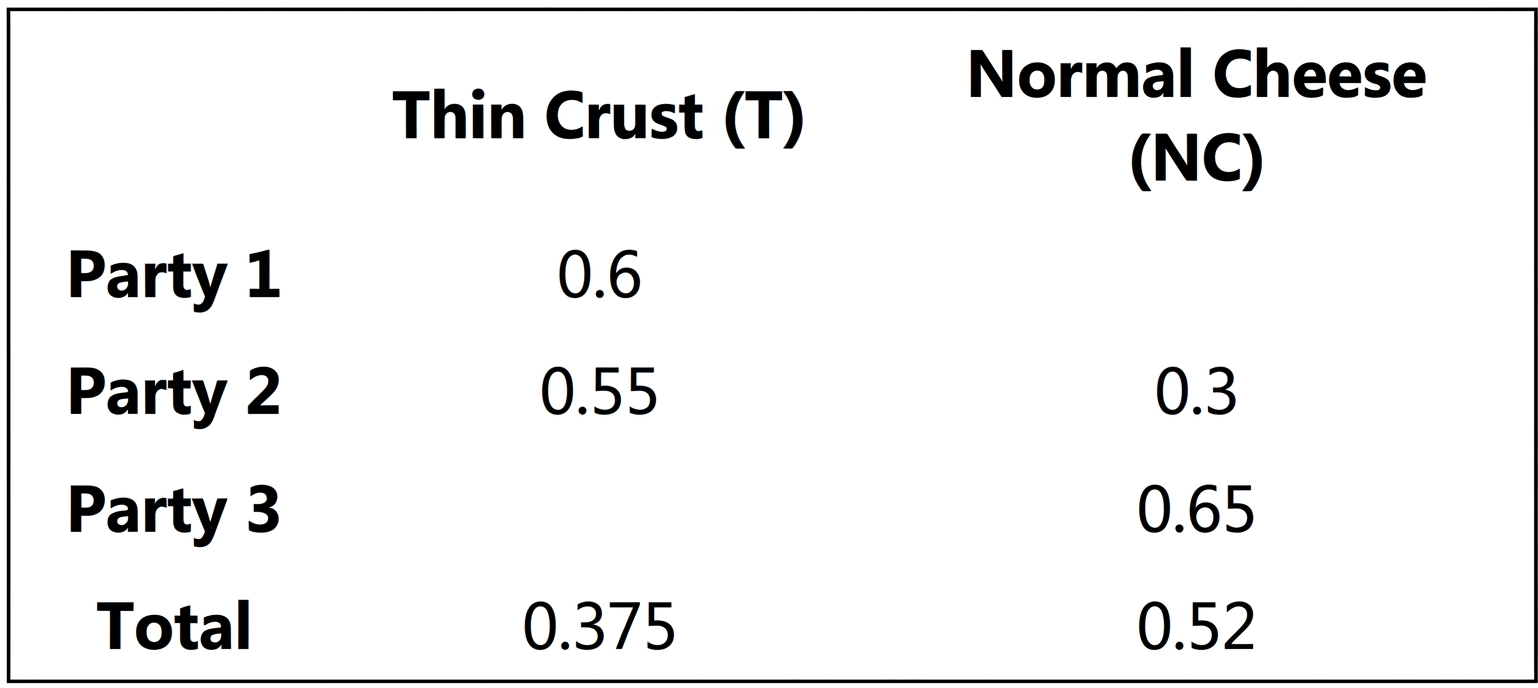
Pizzas could be of Thin Crust (T) or Deep Dish (D) variety and come in either Normal Cheese (NC) or Extra Cheese (EC) versions. Hence, there are four types of pizzas: T-NC, T-EC, D-NC and D-EC. Partial information about proportions of T and NC pizzas ordered by the three parties is given below:
DILR set, figure 1

Question 1 · MCQ

How many Thin Crust pizzas were to be delivered to Party 3?
  1. A.
    398
  2. B.
    162
    ✓ Correct
  3. C.
    196
  4. D.
    364
Solution
Total pizzas = 800.
Party 3 = 70% → 560 pizzas.
Party 1 = Party 2 = (800 − 560)/2 = 120 each.
Overall Thin Crust = 800 × 0.375 = 300.
Party 1 Thin Crust = 120 × 0.6 = 72.
Party 2 Thin Crust = 120 × 0.55 = 66.
So, Party 3 Thin Crust = 300 − 72 − 66 = 162.

Question 2 · MCQ

How many Normal Cheese pizzas were required to be delivered to Party 1?
  1. A.
    104
  2. B.
    84
  3. C.
    16
    ✓ Correct
  4. D.
    196
Solution
Total pizzas = 800.
Party 1 = 120, Party 2 = 120, Party 3 = 560.
Overall Normal Cheese = 800 × 0.52 = 416.
Party 2 NC = 120 × 0.3 = 36.
Party 3 NC = 560 × 0.65 = 364.
Therefore, Party 1 NC = 416 − 36 − 364 = 16.

Question 3 · MCQ

For Party 2, if 50% of the Normal Cheese pizzas were of Thin Crust variety, what was the difference between the numbers of T-EC and D-EC pizzas to be delivered to Party 2?
  1. A.
    18
  2. B.
    12
    ✓ Correct
  3. C.
    30
  4. D.
    24
Solution
Party 2 delivers 120 pizzas. From the table: Thin Crust (T) = 0.55 × 120 = 66, so Deep Dish (D) = 54. Normal Cheese (NC) = 0.3 × 120 = 36, so Extra Cheese (EC) = 84.

Given 50% of NC are T: T‑NC = 0.5 × 36 = 18 → D‑NC = 18.
Then T‑EC = 66 − 18 = 48, D‑EC = 54 − 18 = 36.
Difference: T‑EC − D‑EC = 48 − 36 = 12.

Question 4 · MCQ

Suppose that a T-NC pizza cost as much as a D-NC pizza, but 3/5th of the price of a D-EC pizza. A D-EC pizza costs Rs. 50 more than a T-EC pizza, and the latter costs Rs. 500.
If 25% of the Normal Cheese pizzas delivered to Party 1 were of Deep Dish variety, what was the total bill for Party 1?
  1. A.
    Rs. 59480
    ✓ Correct
  2. B.
    Rs. 59840
  3. C.
    Rs. 42520
  4. D.
    Rs. 45240
Solution
Pizza prices:
T‑EC = ₹500 (given). D‑EC = 500 + 50 = ₹550.
T‑NC = (3/5) × 550 = ₹330 = D‑NC.

Party 1 totals (from set‑up):
Total = 120, T = 72, D = 48, NC = 16, EC = 104.
Given 25% of NC are D: D‑NC = 0.25 × 16 = 4 → T‑NC = 12.
Then T‑EC = 72 − 12 = 60, D‑EC = 48 − 4 = 44.
TypeCountPrice (₹)Cost (₹)
T‑NC123303960
T‑EC6050030000
D‑NC43301320
D‑EC4455024200
Total bill = 3960 + 30000 + 1320 + 24200 = ₹59480.

QA · Quantitative Ability

Question 1 · MCQ

In a 10 km race. A, B, and C, each running at uniform speed, get the gold, silver, and bronze medals, respectively. If A beats B by 1 km and B beats C by 1 km, then by how many metres does A beat C?
  1. A.
    1900
    ✓ Correct
  2. B.
    1800
  3. C.
    1700
  4. D.
    1600
Solution
When \(A\) finishes 10 km, \(B\) has run 9 km, so \(v_A : v_B = 10 : 9\).
When \(B\) finishes 10 km, \(C\) has run 9 km, so \(v_B : v_C = 10 : 9\).
Thus \(v_A : v_C = (10 \times 10) : (9 \times 9) = 100 : 81\).
When \(A\) covers 10 km, \(C\) covers \(\frac{81}{100} \times 10 = 8.1\) km.
\(A\) beats \(C\) by \(10 - 8.1 = 1.9\) km \(= 1900\) m.

Question 2 · MCQ

Bottle 1 contains a mixture of milk and water in 7: 2 ratio and Bottle 2 contains a mixture of milk and water in 9: 4 ratio. In what ratio of volumes should the liquids in Bottle 1 and Bottle 2 be combined to obtain a mixture of milk and water in 3:1 ratio?
  1. A.
    27:14
  2. B.
    27:13
    ✓ Correct
  3. C.
    27:16
  4. D.
    27 : 18
Solution
Bottle 1: milk \(= \frac{7}{9}\), water \(= \frac{2}{9}\).
Bottle 2: milk \(= \frac{9}{13}\), water \(= \frac{4}{13}\).
Let the required volumes be \(x\) (Bottle 1) and \(y\) (Bottle 2).
Total milk \(= \frac{7}{9}x + \frac{9}{13}y\), total water \(= \frac{2}{9}x + \frac{4}{13}y\).
Given ratio milk : water \(= 3 : 1\), so
\(\frac{7}{9}x + \frac{9}{13}y = 3\left(\frac{2}{9}x + \frac{4}{13}y\right)\).
Multiply by \(117\):
\(91x + 81y = 78x + 108y\) \(\Rightarrow\) \(13x = 27y\).
Required ratio \(x : y = 27 : 13\).

Question 3 · MCQ

Arun drove from home to his hostel at 60 miles per hour. While returning home he drove half way along the same route at a speed of 25 miles per hour and then took a bypass road which increased his driving distance by 5 miles, but allowed him to drive at 50 miles per hour along this bypass road. If his return journey took 30 minutes more than his onward journey, then the total distance traveled by him is
  1. A.
    55 miles
  2. B.
    60 miles
  3. C.
    65 miles
    ✓ Correct
  4. D.
    70 miles
Solution
Let one-way distance be \(D\) miles.
Onward time: \(\frac{D}{60}\) h.
Return: first \(\frac{D}{2}\) mi at 25 mph → \(\frac{D}{50}\) h; second part \(\frac{D}{2}+5\) mi at 50 mph → \(\frac{D}{100}+\frac{1}{10}\) h.
Total return time: \(\frac{3D}{100}+0.1\) h.
Given return takes 30 min (0.5 h) more:
\(\frac{3D}{100}+0.1 = \frac{D}{60}+0.5\)
Multiply by 300: \(9D + 30 = 5D + 150 \Rightarrow 4D = 120 \Rightarrow D = 30\).
Total distance = onward + return = \(30 + (30+5) = 65\) miles.
Answer: 65 miles (Option C).

Question 4 · MCQ

Out of the shirts produced in a factory, 15% are defective, while 20% of the rest are sold in the domestic market. If the remaining 8840 shirts are left for export, then the number of shirts produced in the factory is
  1. A.
    13600
  2. B.
    13000
    ✓ Correct
  3. C.
    13400
  4. D.
    14000
Solution
Let total shirts produced = \(T\).
Defective = 15% → non‑defective = 85% of \(T = 0.85T\).
Domestic sales = 20% of non‑defective = \(0.20 \times 0.85T = 0.17T\).
Export = non‑defective − domestic = \(0.85T - 0.17T = 0.68T = 8840\).
\(T = \frac{8840}{0.68} = 13000\).
Answer: 13000 shirts (Option B).

Question 5 · MCQ

The average height of 22 toddlers increases by 2 inches when two of them leave this group. If the average height of these two toddlers is one-third the average height of the original 22, then the average height, in inches, of the remaining 20 toddlers is
  1. A.
    30
  2. B.
    28
  3. C.
    32
    ✓ Correct
  4. D.
    26
Solution
Let original average height be \(x\).
Total height of 22 toddlers: \(22x\).
After two leave, average of 20 becomes \(x+2\).
Total height of 20: \(20(x+2)\).
Average of the two who left is \(\frac{x}{3}\). Their total height: \(\frac{2x}{3}\).
Equation:
\(22x = 20(x+2) + \frac{2x}{3}\)
\(22x = 20x + 40 + \frac{2x}{3}\)
\(2x - \frac{2x}{3} = 40\)
\(\frac{4x}{3} = 40\) → \(x = 30\)
Required average of remaining 20 = \(x+2 = 32\).
Answer: 32 (Option C).

The other 53 questions are in the simulator

Sit CAT 2017 Slot 2 with the real exam's timer and interface, then see where your marks went: silly slips, traps, topics that cost you time, and the questions you should have skipped. Start with the free mock test: no payment needed.

Unlock this paper