
Official paper · included in Pro

CAT 2017 Slot 1 Question Paper with Solutions

68 questions in 120 minutes, in three timed sections. Below: how the paper is built, the topics each section tested, and a solved sample from every section. Take the whole paper in the simulator to get your Score Waterfall, Topic ROI Map and Strategic IQ.

Paper structure and topics

VARC

Verbal Ability & Reading Comprehension

24 questions · 22 MCQ · 2 TITA

  • Reading Comprehension · 21
  • Verbal Ability · 3

DILR

Data Interpretation & Logical Reasoning

22 questions · 18 MCQ · 4 TITA

  • Logical Reasoning · 14
  • Data Interpretation · 8

QA

Quantitative Ability

22 questions · 14 MCQ · 8 TITA

  • Arithmetic · 8
  • Algebra · 7
  • Geometry · 3
  • Modern Math · 2
  • Number System · 2

Sample questions with solutions

15 of the 68 questions: the first passage, the first DILR set and the first QA questions of the paper.

VARC · Verbal Ability & Reading Comprehension

Passage

Understanding where you are in the world is a basic survival skill, which is why we, like most species come hard-wired with specialized brain areas to create congnitive maps of our surroundings. Where humans are unique, though, with the possible exception of honeybees, is that we try to communicate this understanding the world with others. We have along history of doing this by drawing maps – the earliest version yet discovered were scrawled on cave walls 14,000 years ago. Human cultures have been drawing them on stone tablets, papyrus, paper and now computer screens ever since.

Given such a long history of human map-making, it perhaps surprising that is only within the last few hundred years that north has been consistently considered to be at the top. In fact, for much of human history, north almost never appeared at the top, according to Jerry Brotton, a map historian... "North was rarely put at the top for the simple fact that north is where darkness comes from," he says. "West is also very unlikely o be put at the top because west is where the sun disappears."

Confusingly, early Chinese maps seem to buck this trend. But, Brotton, says, even though they did have compasses at the time, that isn't the reason that they placed north at the top. Early Chinese compasses were actually oriented to point south, which was considered to be more desirable than deepest darkest north. But in Chinese maps, the emperor, who lived in the north of the country was always put at the top of the map, with everyone else, his loyal subjects, looking up towards him. "In Chinese culture the Emperor looks south because it's where the winds come from, it's a good direction. North is not very good but you are in a position of the subjection to the emperor, so you look up to him," says Brotton.

Given that each culture has a very different idea of who, or what, they should look upto it's perhaps not surprising that there is very little consistency in which way early maps pointed. In ancient Egyptian times the top of the world was east, the position of sunrise. Early Islamic maps favoured south at the top because most of the early Muslim cultures were north of Mecca, so they imagined looking up (south) towards it Christian maps from the same era (called Mappa Mundi) put east at the top, towards the Garden of Eden and with Jerusalem in the centre.

So when did everyone get together and decide that north was the top? It's tempting to put it down to European explorers like Christopher Columbus and Ferdinand Megellan who were navigating by the North Star. But Brotton argues that these early explorers didn't think of the world like that at all. "When Columbus describes the world it is in accordance with east being at the top," he says "Columbus says he is going towards paradise, so his mentality is from a medieval mappa mundi." We've got to remember, adds Brotton, that at the time, "no one knows what they are doing and where they are going."

Question 1 · MCQ

Which one of the following best describes what the passage is trying to do?
  1. A.
    It questions on explanation about how maps are designed.
  2. B.
    It corrects a misconception about the way maps are designed.
  3. C.
    It critiques a methodology used to create maps
  4. D.
    It explores some myths about maps
    ✓ Correct
Solution
The passage traces the long history of map-making and highlights how different cultures placed varying directions at the top—north (Chinese), east (Egyptian, Christian), south (Islamic)—based on beliefs, religion, or political hierarchy. It is not questioning an explanation, correcting a specific misconception, or critiquing a methodology. It simply explores the cultural myths and reasons that historically determined map orientation.
Question 2 · MCQ

Early maps did NOT put north at the top for all the following reasons EXCEPT
  1. A.
    North was the source of darkness
  2. B.
    South was favoured by some emperors.
    ✓ Correct
  3. C.
    East and south were more important for religious reasons for some civilisations
  4. D.
    East was considered by some civilisations to be a more positive direction
Solution
The passage gives several reasons for not putting north at the top: north was the source of darkness (A); east and south held religious significance for some civilisations (C); east was seen as a more positive direction (D). The statement about south being favoured by some emperors (B) is not a reason for omitting north; the Chinese emperor favoured south as a direction to face, but Chinese maps still placed north at the top because the emperor lived in the north and subjects looked up to him.

Question 3 · MCQ

According to the passage, early Chinese maps placed north at the top because Options:
  1. A.
    the Chinese invented the compass and were aware of magnetic north
  2. B.
    they wanted to show respect to the emperor.
    ✓ Correct
  3. C.
    the Chinese emperor appreciated the winds from the south.
  4. D.
    north was considered the most desirable direction.
Solution
The passage explicitly states that early Chinese maps put north at the top not because of the compass (contradicting A) but because the emperor lived in the north. All subjects, looking up towards the emperor, saw north at the top of the map, reflecting their respect and subordination. Thus, showing respect to the emperor was the reason. Options C and D are unsupported: the emperor appreciated southern winds but that did not determine map orientation, and north was not considered the most desirable direction.

Question 4 · MCQ

It can be inferred from the passage that European explorers like Columbus and Megellan Options:
  1. A.
    set the precedent for north-up maps.
  2. B.
    navigated by the compass.
  3. C.
    used an eastward orientation for religious reasons.
    ✓ Correct
  4. D.
    navigated with the help of early maps
Solution
The passage quotes Brotton: “When Columbus describes the world it is in accordance with east being at the top… Columbus says he is going towards paradise.” This shows Columbus used east-up orientation for religious reasons. Hence option C.

Question 5 · MCQ

Which one of the following about the northern orientation of modern maps is asserted in the passage?
  1. A.
    The biggest contributory factor was the understanding of magnetic north
  2. B.
    The biggest contributory factor was the role of European explorers
  3. C.
    The biggest contributory factor was the influence of Christian maps
  4. D.
    The biggest contributory factor is not stated in the passage
    ✓ Correct
Solution
The passage discusses various historical orientations but does not state what caused the modern north-up convention. It only dismisses the European explorers theory. Thus the biggest contributory factor is not stated. Option D.

Question 6 · MCQ

The role of natural phenomena in influencing map-making conventions is seen most clearly in
  1. A.
    early Egyptian maps
    ✓ Correct
  2. B.
    early Islamic maps
  3. C.
    early Chinese maps
  4. D.
    early Christian maps
Solution
The passage states: “In ancient Egyptian times the top of the world was east, the position of sunrise.” This is a clear case of a natural phenomenon dictating map orientation. Hence option A.

DILR · Data Interpretation & Logical Reasoning

Set

Healthy Bites is a fast food joint serving three items: burgers, fries and ice cream. It has two employees Anish and Bani who prepare the items ordered by the clients. Preparation time is 10 minutes for a burger and 2 minutes for an order of ice cream. An employee can prepare only one of these items at a time. The fries are prepared in an automatic fryer which can prepare up to 3 portions of fires at a time, and takes 5 minutes irrespective of the number of portions. The fryer does not need an employee to constantly attend to it, and we can ignore the time taken by an employee to start and stop the fryer; thus, an employee can be engaged in preparing other items while the frying is on. However fries cannot be prepared in anticipation of future orders.

Healthy Bites wishes to serve the orders as early as possible. The individual items in any order are served as and when ready; however, the order is considered to be completely served only when all the items of that order are served.

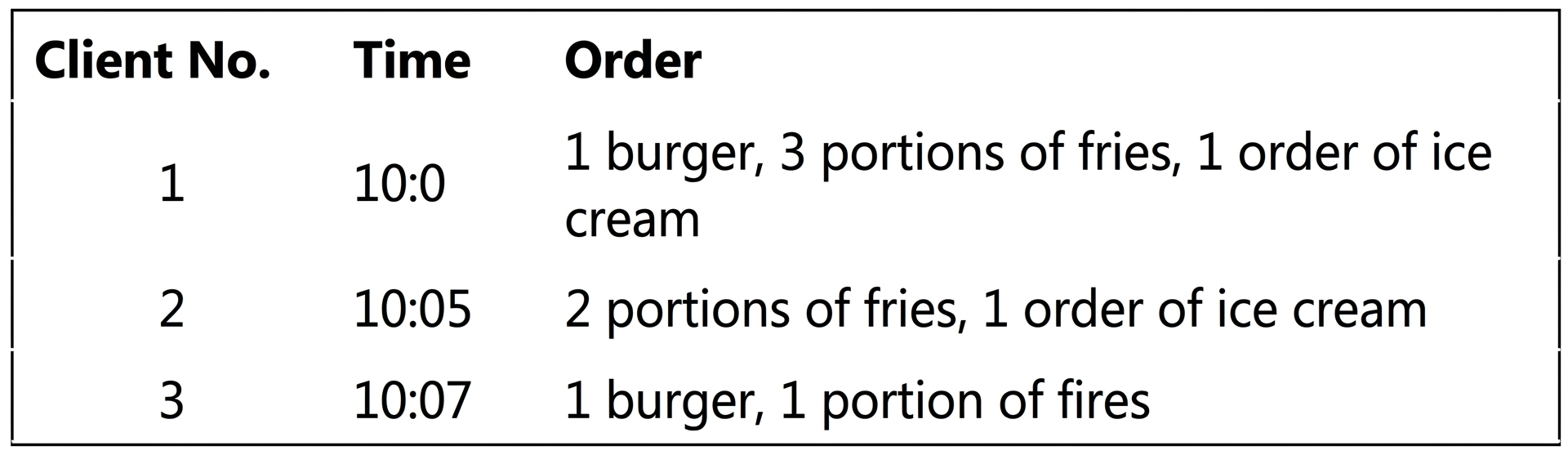
The table below gives the orders of three clients and the times at which they placed their orders

Assume that only one client's order can be processed at any given point of time. So, Anish or Bani cannot start preparing a new order while a previous order is being prepared.
DILR set, figure 1

Question 1 · MCQ

At what time is the order placed by Client 1 completely served?
  1. A.
    10:17
  2. B.
    10:10
    ✓ Correct
  3. C.
    10:15
  4. D.
    10:20
Solution
Order 1 is processed starting at 10:00. The burger takes 10 min, fries take 5 min (up to 3 portions in one batch), and ice cream takes 2 min. With two employees, one starts the burger (10:00–10:10) while the other starts the fryer (5 min, done at 10:05) and then prepares the ice cream (10:00–10:02). All items are ready by 10:10, so the order is completely served at 10:10.

Question 2 · MCQ

Assume that only one client's order can be processed at any given point of time. So, Anish or Bani cannot start preparing a new order while a previous order is being prepared.

At what time is the order placed by Client 3 completely served?
  1. A.
    10:35
  2. B.
    10:22
  3. C.
    10:25
    ✓ Correct
  4. D.
    10:17
Solution
Only one order is processed at a time. Order 1 completes at 10:10.
Order 2 starts at 10:10: 2 portions of fries (one fryer batch, 5 min) and 1 ice cream (2 min). Both run in parallel; fries finish at 10:15, ice cream at 10:12, so order 2 completes at 10:15.
Order 3 starts at 10:15: 1 burger (10 min) and 1 portion of fries (5 min). With parallel processing, burger finishes at 10:25, fries at 10:20; order 3 is complete at 10:25.
Option C (10:25) is correct.

Question 3 · MCQ

Suppose the employees are allowed to process multiple orders at a time, but the preference would be to finish orders of clients who placed their orders earlier.

At what time is the order placed by Client 2 completely served?
  1. A.
    10:10
    ✓ Correct
  2. B.
    10:12
  3. C.
    10:15
  4. D.
    10:17
Solution
With multiple orders allowed, we can start Order 2 as soon as it arrives at 10:05, even while Order 1’s burger is still being prepared.

Order 1 (10:00): Burger (10 min), Ice cream (2 min), Fries (5 min).
  • Emp A: Ice cream → 10:00–10:02
  • Emp B: Burger → 10:00–10:10
  • Fryer: Fries → 10:00–10:05
Order 1 items ready: I at 10:02, F at 10:05, B at 10:10 → completes at 10:10.

Order 2 (10:05): 2 Fries, 1 Ice cream.
At 10:05, Emp A is free (idle since 10:02). Fryer is free after Order 1 fries finish at 10:05.
  • Emp A: Ice cream → 10:05–10:07
  • Fryer: 2 Fries → 10:05–10:10
Order 2 items ready: I at 10:07, F at 10:10 → completes at 10:10.

Thus Order 2 is completely served at 10:10.

Question 4 · MCQ

Suppose the employees are allowed to process multiple orders at a time, but the preference would be to finish orders of clients who placed their orders earlier.

Also assume that the fourth client came in only at 10:35. Between 10:00 and 10:30, for how many minutes is exactly one of the employees idle?
  1. A.
    7
  2. B.
    10
    ✓ Correct
  3. C.
    15
  4. D.
    23
Solution
We schedule Orders 1–3 between 10:00 and 10:30, respecting the preference to finish earlier orders first.

Employee busy intervals:
EmployeeTask (Order)Time
AIce cream (1)10:00 – 10:02
BBurger (1)10:00 – 10:10
AIdle10:02 – 10:05
AIce cream (2)10:05 – 10:07
ABurger (3)10:07 – 10:17
BIdle10:10 – 10:30
AIdle10:17 – 10:30
Fryer: Order 1 fries 10:00–10:05, Order 2 fries 10:05–10:10, Order 3 fries 10:10–10:15 (cannot start earlier due to preference for Order 2).

Minutes when exactly one employee is idle:
  • 10:02–10:05: Emp A idle, Emp B busy → 3 min
  • 10:10–10:17: Emp B idle, Emp A busy → 7 min
Total = 10 minutes.

QA · Quantitative Ability

Question 1 · TITA (type in the answer)

Arun's present age in years is 40% of Barun's. In another few years, Arun's age will be half of Barun's. By what percentage will Barun's age increase during this period?

Answer: 20

Solution
Let Barun's present age be \(B\) years. Then Arun's present age = \(0.4B\). Suppose after \(x\) years, Arun's age becomes half of Barun's age. Then:

\[0.4B + x = \frac{1}{2}(B + x)\]

Simplify: \(0.4B + x = 0.5B + 0.5x \Rightarrow 0.5x = 0.1B \Rightarrow x = 0.2B\).

So Barun's age increases by \(0.2B\), which is \(20%\) of his present age. Thus the required percentage increase = 20%.

Question 2 · TITA (type in the answer)

A person can complete a job in 120 days. He works alone on Day 1. On Day 2, he is joined by another person who also can complete the job in exactly 120 days. On Day 3, they are joined by another person of equal efficiency. Like this, everyday a new person with the same efficiency joins the work. How many days are required to complete the job?

Answer: 15

Solution
Let the total work be 120 units (LCM of 120). Each person's daily efficiency = 1 unit.

On day \(n\), \(n\) persons work, so work done on that day = \(n\) units.

Total work after \(d\) days = \(1 + 2 + \dots + d = \frac{d(d+1)}{2}\).

For completion, \(\frac{d(d+1)}{2} \geq 120\).

Test \(d = 15\): \(\frac{15 \times 16}{2} = 120\). So exactly 120 units.

Hence the job is completed in 15 days.

Question 3 · TITA (type in the answer)

A man leaves his home and walks at a speed of 12 km per hour, reaching the railway station 10 minutes after the train had departed. If instead he had walked at a speed of 15 km per hour, he would have reached the station 10 minutes before the train's departure. The distance (in km) from his home to the railway station is

Answer: 20

Solution
Let distance be \(d\) km.
Time at 12 km/h: \(\frac{d}{12}\) h.
Time at 15 km/h: \(\frac{d}{15}\) h.
Difference in arrival: 10 min late vs 10 min early → 20 min = \(\frac{1}{3}\) h.
So \(\frac{d}{12} - \frac{d}{15} = \frac{1}{3}\).
Solve: \(d\left(\frac{5-4}{60}\right) = \frac{1}{3}\) → \(d \cdot \frac{1}{60} = \frac{1}{3}\) → \(d = 20\) km.

Question 4 · MCQ

If a seller gives a discount of 15% on retail price, she still makes a profit of 2%. Which of the following ensures that she makes a profit of 20%?
  1. A.
    Give a discount of 5% on retail price
  2. B.
    Give a discount of 2% on retail price
  3. C.
    Increase the retail price by 2%
  4. D.
    Sell at retail price
    ✓ Correct
Solution
Let CP = cost price, RP = retail price.
After 15% discount: SP = 0.85 RP = 1.02 CP → RP = \(\frac{1.02}{0.85}\) CP = 1.2 CP.
Thus RP is 20% above CP, so selling at retail price (option D) yields exactly 20% profit.
Other options yield different profit percentages.

Question 5 · MCQ

Suppose, C1, C2, C3, C4, and C5 are five companies. The profits made by C1, C2, and C3 are in the ratio 9: 10: 8 while the profits made by C2, C4, and C5 are in the ratio 18: 19: 20. If C5 has made a profit of Rs 19 crore more than C1, then the total profit (in Rs) made by all five companies is
  1. A.
    438 crore
    ✓ Correct
  2. B.
    435 crore
  3. C.
    348 crore
  4. D.
    345 crore
Solution
Let profits of C1, C2, C3 be \(9x, 10x, 8x\).
Let profits of C2, C4, C5 be \(18y, 19y, 20y\).
Equating C2: \(10x = 18y \Rightarrow x = \frac{9}{5}y\).
Given \(C5 = C1 + 19\):
\(20y = 9x + 19\)
Substitute \(x\): \(20y = 9 \cdot \frac{9}{5}y + 19 = \frac{81}{5}y + 19\)
Multiply by 5: \(100y = 81y + 95 \Rightarrow 19y = 95 \Rightarrow y = 5\)
Then \(x = 9\).
Profits: C1 = 81, C2 = 90, C3 = 72, C4 = 95, C5 = 100.
Total = 438 crore.

The other 53 questions are in the simulator

Sit CAT 2017 Slot 1 with the real exam's timer and interface, then see where your marks went: silly slips, traps, topics that cost you time, and the questions you should have skipped. Start with the free mock test: no payment needed.

Unlock this paper