Official paper · included in Pro

CAT 2003 Slot 2 Question Paper with Solutions

68 questions in 120 minutes, in three timed sections. Below: how the paper is built, the topics each section tested, and a solved sample from every section. Take the whole paper in the simulator to get your Score Waterfall, Topic ROI Map and Strategic IQ.

Paper structure and topics

VARC

Verbal Ability & Reading Comprehension

24 questions · 24 MCQ · 0 TITA

  • Reading Comprehension · 16
  • Verbal Ability · 8

DILR

Data Interpretation & Logical Reasoning

22 questions · 22 MCQ · 0 TITA

  • Logical Reasoning · 10
  • Data Interpretation · 8
  • Data Sufficiency · 4

QA

Quantitative Ability

22 questions · 22 MCQ · 0 TITA

  • Algebra · 8
  • Geometry · 5
  • Number System · 5
  • Arithmetic · 4

Sample questions with solutions

14 of the 68 questions: the first passage, the first DILR set and the first QA questions of the paper.

VARC · Verbal Ability & Reading Comprehension

Passage

Pure love of learning, of course, was a less compelling motive for those who became educated for careers other than teaching. Students of law in particular had a reputation for being materialistic careerists in an age when law was becoming known as ‘the lucrative science’ and its successful practice the best means for rapid advancement in the government of both church and state. Medicine too had its profit-making attractions. Those who did not go on to law or medicine could, if they had been well trained in the arts, gain positions at royal courts or rise in the clergy. Eloquent testimony to the profit motive behind much of 12th-century education was the lament of a student of Abelard around 1150: “Christians educate their sons . . . for gain, in order that the one brother, if he be a clerk, may help his father and mother and his other brothers, saying that a clerk will have no heir and whatever he has will be ours and the other brothers.” With the opening of positions in law, government and the church, education became a means for advancement not only in income but also in status. Most who were educated were wealthy, but in the 12th century, more often than before, many were not and were able to rise through the ranks by means of their education. The most familiar examples are Thomas Becket, who rose from a humble background to become chancellor of England and then archbishop of Canterbury, and John of Salisbury, who was born a ‘plebeian’ but because of his reputation for learning died as bishop of Chartres.

The instances of Becket and John of Salisbury bring us to the most difficult question concerning 12th-century education: To what degree was it still a clerical preserve? Despite the fact that throughout the 12th century the clergy had a monopoly of instruction, one of the outstanding medievalists of our day, R. W. Southern, refers with good reason to the institutions staffed by the clergy as ‘secular schools’. How can we make sense out of the paradox that 12th-century schools were clerical and yet ‘secular’?

Let us look at the clerical side first. Not only were all 12th-century teachers except professionals and craftsmen in church order, but in northern Europe students in schools had clerical status and looked like priests. Not that all really were priests, but by virtue of being students all were awarded the legal privileges accorded to the clergy. Furthermore, the large majority of 12th-century students, outside of the possible exception of Italy, if not already priests became so after their studies were finished. For these reasons, the term ‘cleric’ was often used to denote a man who was literate and the term ‘layman’ one who was illiterate. The English word for cleric, clerk, continued for a long time to be a synonym for student or for a man who could write, while the French word clerc even today has the connotation of intellectual.

Despite all this, 12th-century education was taking on many secular qualities in its environment, goals, and curriculum. Student life obviously became more secular when it moved out from the monasteries into the bustling towns. Most students wandered from town to town in search not only of good masters but also of worldly excitement, and as the 12th century progressed they found the best of each in Paris. More important than environment was the fact that most students, even though they entered the clergy, had secular goals. Theology was recognized as the ‘queen of the sciences’, but very few went on to it. Instead they used their study of the liberal arts as a preparation for law, medicine, government service, or advancement in the ecclesiastical hierarchy.

This being so, the curriculum of the liberal arts became more sophisticated and more divorced from religion. Teaching was still almost exclusively in Latin, and the first book most often read was the Psalter, but further education was no longer similar to that of a choir school. In particular, the discipline of rhetoric was transformed from a linguistic study into instruction in how to compose letters and documents; there was a new stress on logic; and in all the liberal arts and philosophy texts more advanced than those known in the early Middle Ages were introduced.

Along with the rise of logic came the translation of Greek and Arabic philosophical and scientific works. Most important was the translation of almost all the writings of Aristotle, as well as his sophisticated Arabic commentators, which helped to bring about an intellectual revolution based on Greek rationalism. On a more prosaic level, contact with Arabs resulted in the introduction in the 12th century of the Arabic numeral system and the concept of zero. Though most westerners first resisted this and made crude jokes about the zero as an ambitious number ‘that counts for nothing and yet wants to be counted’, the system steadily made its inroads first in Italy and then throughout Europe, thereby vastly simplifying the arts of computation and record-keeping.

Question 1 · MCQ

According to the passage, what led to the secularisation of the curriculum of the liberal arts in the 12th century?
  1. A.
    It was divorced from religion and its influences.
  2. B.
    Students used it mainly as a base for studying law and medicine.
    ✓ Correct
  3. C.
    Teaching could no longer be conducted exclusively in Latin.
  4. D.
    Arabic was introduced into the curriculum.
Solution
The passage states: 'Instead they used their study of the liberal arts as a preparation for law, medicine, government service, or advancement in the ecclesiastical hierarchy. This being so, the curriculum ... became more divorced from religion.' Thus, secularisation occurred because students used the liberal arts mainly as a foundation for professional studies (option 2). Option 1 describes the result, not the cause; Latin remained the teaching language; Arabic was introduced later but did not drive secularisation.

Question 2 · MCQ

According to the author, in the 12th century, individuals were motivated to get higher education because it
  1. A.
    was a means for material advancement and higher status.
    ✓ Correct
  2. B.
    gave people with wealth an opportunity to learn.
  3. C.
    offered a coveted place for those with a love of learning.
  4. D.
    directly added to the income levels of people.
Solution
The first paragraph notes: 'Education became a means for advancement not only in income but also in status' and cites the lament of Abelard’s student to underline the profit motive. Therefore, material advancement and higher status (option 1) was the primary motivation. Pure love of learning was a less compelling motive (option 3).

Question 3 · MCQ

According to the passage, 12th-century schools were clerical and yet secular because
  1. A.
    many teacher were craftsmen and professionals who did not form part of the church.
  2. B.
    while the students had the legal privileges accorded to the clergy and looked like priests, not all were really priests.
  3. C.
    the term ‘cleric’ denoted a literate individual rather than a strict association with the church.
  4. D.
    though the clergy had a monopoly in education, the environment, objectives and curriculum in the schools were becoming secular.
    ✓ Correct
Solution
The passage explicitly resolves the paradox: 'Despite all this, 12th‑century education was taking on many secular qualities in its environment, goals, and curriculum.' This means that while the clergy monopolised teaching, the environment, objectives, and curriculum were becoming secular. Option 4 captures this duality. Options 1–3 describe only the clerical side without the secular shift.

Question 4 · MCQ

What does the sentence ‘Christians educate their sons . . . will be ours and the other brothers’ imply?
  1. A.
    The Christian family was a close-knit unit in the 12th century.
  2. B.
    Christians educated their sons not so much for the love of learning as for material gain.
    ✓ Correct
  3. C.
    Christians believed very strongly in educating their sons in the Church.
  4. D.
    The relationship between Christian parents and their sons was exploitative in the 12th century.
Solution
The sentence is introduced as 'Eloquent testimony to the profit motive behind much of 12th‑century education.' It shows that sons were educated so they could financially support their families. This implies that education was pursued for material gain, not for the love of learning (option 2). Options 1 and 4 read too much into family dynamics; option 3 incorrectly emphasises the Church.

DILR · Data Interpretation & Logical Reasoning

Set

Answer the questions on the basis of the following information.
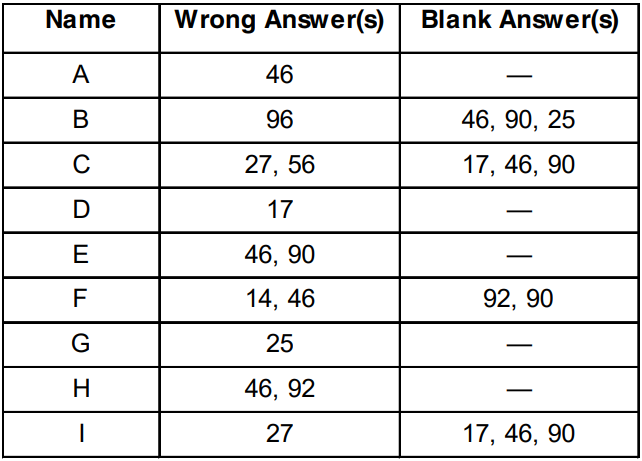
Recently, the answers of a test held nationwide were leaked to a group of unscrupulous people. The investigative agency has arrested the mastermind and nine other people A, B, C, D, E, F, G, H and I in this matter. Interrogating them, the following facts have been obtained regarding their operation. Initially the mastermind obtains the correct answer-key. All the others create their answer-key in the following manner. They obtain the answer-key from one or two people who already possess the same. These people are called his/her ‘sources’. If the person has two sources, then he/she compares the answer-keys obtained from both sources. If the key to a question from both sources is identical, it is copied, otherwise it is left blank. If the person has only one source, he/she copies the source’s answers into his/her copy. Finally, each person compulsorily replaces one of the answers (not a blank one) with a wrong answer in his/her answer key.
The paper contained 200 questions; so the investigative agency has ruled out the possibility of two or more of them introducing wrong answers to the same question. The investigative agency has a copy of the correct answer key and has tabulated the following data. These data represent question numbers.
DILR set, figure 1

Question 1 · MCQ

Which one among the following must have two sources?
  1. A.
    A
  2. B.
    B
    ✓ Correct
  3. C.
    C
  4. D.
    D
Solution
From the blanks and wrong answers, we deduce the source network:
PersonSourcesIntroduced wrong
AMastermind46
DMastermind17
GMastermind25
EA90
HA92
BE, G96
FE, H14
ID, E27
CI56
B's blanks 46,90,25 arise from disagreement between E (wrong 46,90) and G (wrong 25), so B must have two sources. Others (A, D, G, E, H, C) have exactly one source.

Question 2 · MCQ

How many people (excluding the mastermind) needed to make answer-keys before C could make his answer-key?
  1. A.
    2
  2. B.
    3
  3. C.
    4
    ✓ Correct
  4. D.
    5
Solution
C's source is I. I's sources are D and E. E's source is A. Therefore, before C, the following people (excluding mastermind) must have made their answer‑keys: A, D, E, I. That is 4 people.

Question 3 · MCQ

Both G and H were sources to
  1. A.
    F
  2. B.
    B
  3. C.
    I
  4. D.
    None of the nine
    ✓ Correct
Solution
G is a source only to B (along with E). H is a source only to F (along with E). No person has both G and H as sources.

Question 4 · MCQ

Which of the following statements is true?
  1. A.
    C introduced the wrong answer to question 27.
  2. B.
    E introduced the wrong answer to question 46.
  3. C.
    F introduced the wrong answer to question 14.
    ✓ Correct
  4. D.
    H introduced the wrong answer to question 46.
Solution
Deduce the introducer of each wrong answer by noting that a person with only one wrong answer must have introduced it (otherwise they would inherit others). Thus: A→46, D→17, G→25, I→27.
C has two wrongs and inherits 27 from I, so C introduced 56.
E inherits 46 from A and introduces 90.
F inherits 46 (sources E and H both have it) and introduces 14.
H inherits 46 from A and introduces 92.
B introduces 96.
Therefore, F introduced the wrong answer to question 14. Options 1,2,4 are false.

Question 5 · MCQ

Which of the following two groups of people had identical sources?
I. A, D and G
II. E and H
  1. A.
    Only I
  2. B.
    Only II
  3. C.
    Neither I nor II
  4. D.
    Both I and II
    ✓ Correct
Solution
From the network analysis:
PersonSource(s)
AMastermind
DMastermind
GMastermind
EA
HA
Group I (A, D, G) all have the mastermind as their only source.
Group II (E, H) both have A as their only source.
Thus both groups have identical sources.

QA · Quantitative Ability

Question 1 · MCQ

There are 12 towns grouped into four zones with three towns per zone. It is intended to connect the towns with a telephone lines such that every two towns are connected with three direct lines if they belong to the same zone, and with only one direct line otherwise. How many direct telephone lines are required?
  1. A.
    72
  2. B.
    90
    ✓ Correct
  3. C.
    96
  4. D.
    144
Solution
Same-zone pairs: 4 zones × \( \binom{3}{2} \) = 4 × 3 = 12 pairs. Cross-zone pairs: \( \binom{12}{2} - 12 = 66 - 12 = 54 \) pairs.
Total lines = 12 × 3 + 54 × 1 = 36 + 54 = 90.

Question 2 · MCQ

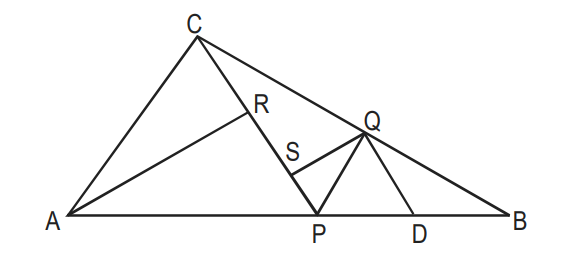
In the figure (not drawn to scale) given below, P is a point on AB such that AP : PB = 4 : 3. PQ is parallel to AC and QD is parallel to CP. In \(\triangle ARC, \angle ARC = 90^\circ\), and in \(\triangle PQS, \angle PSQ = 90^\circ\). The length of QS is 6 cm. What is the ratio of AP : PD?
Question 2, figure 1
  1. A.
    10 : 3
  2. B.
    2 : 1
  3. C.
    7 : 3
    ✓ Correct
  4. D.
    8 : 3
Solution
Given \(AP:PB=4:3\), let \(AP=4k, PB=3k\).
Since \(PQ \parallel AC\), \(\triangle BPQ \sim \triangle BAC\) with ratio \(BP/BA = 3/7\) → \(BQ/BC = 3/7\).
In \(\triangle BCP\), \(QD \parallel CP\) and \(Q \in BC, D \in BP\) → \(\triangle BQD \sim \triangle BCP\).
Hence \(BD/BP = BQ/BC = 3/7\) → \(BD = \frac{3}{7} \times 3k = \frac{9k}{7}\).
Then \(PD = BP - BD = 3k - \frac{9k}{7} = \frac{12k}{7}\).
Thus \(AP:PD = 4k : \frac{12k}{7} = 4 : \frac{12}{7} = 7:3\).

Question 3 · MCQ

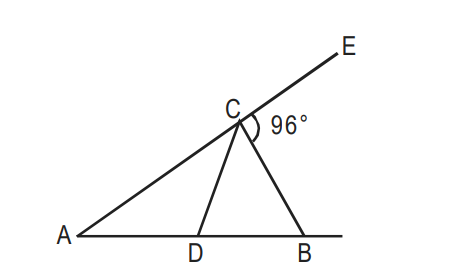
In the figure (not drawn to scale) given below, if AD = CD = BC and \(\angle BCE = 96^\circ\), how much is the value of \(\angle DBC\)?
Question 3, figure 1
  1. A.
    32°
  2. B.
    84°
  3. C.
    64°
    ✓ Correct
  4. D.
    Cannot be determined
Solution
Given \(AD = CD = BC\) and \(\angle BCE = 96^\circ\).
Since \(A, C, E\) are collinear, \(\angle BCA = 180^\circ - 96^\circ = 84^\circ\).
Let \(\angle DBC = x\). In isosceles \(\triangle BCD\) (\(BC = CD\)), \(\angle CDB = x\) and \(\angle BCD = 180^\circ - 2x\).
Let \(\angle CAD = y\). In isosceles \(\triangle ACD\) (\(AD = CD\)), \(\angle ACD = y\) and \(\angle ADC = 180^\circ - 2y\).
At point \(D\) on straight line \(AB\), \(\angle ADC + \angle CDB = 180^\circ \Rightarrow (180^\circ - 2y) + x = 180^\circ \Rightarrow x = 2y\).
At point \(C\), \(\angle BCA = \angle BCD + \angle ACD \Rightarrow 84^\circ = (180^\circ - 2x) + y\).
Substituting \(y = \frac{x}{2}\) gives \(84^\circ = 180^\circ - 2x + \frac{x}{2} \Rightarrow 3x = 192^\circ \Rightarrow x = 64^\circ\).
Thus \(\angle DBC = 64^\circ\).

Question 4 · MCQ

If both \(a\) and \(b\) belong to the set {1, 2, 3, 4}, then the number of equations of the form \(ax^2 + bx + 1 = 0\) having real roots is
  1. A.
    10
  2. B.
    7
    ✓ Correct
  3. C.
    6
  4. D.
    12
Solution
Equation: \(ax^2+bx+1=0\). Real roots \(\Rightarrow\) discriminant \(D = b^2-4a \ge 0 \Rightarrow b^2 \ge 4a\).
\(a, b \in \{1,2,3,4\}\). Total \(4\times4=16\) possible pairs.
Count pairs satisfying the condition:
\(a\)\(4a\)\(b\) must satisfy \(b^2 \ge 4a\)Valid \(b\)Count
14\(b^2 \ge 4\)2,3,43
28\(b^2 \ge 8\)3,42
312\(b^2 \ge 12\)41
416\(b^2 \ge 16\)41
Total \(= 3+2+1+1 = 7\) equations with real roots.

Question 5 · MCQ

If \(\log_{10} x - \log_{10} \sqrt{x} = 2 \log_x 10\), then the possible value of \(x\) is given by
  1. A.
    10
  2. B.
    \(\frac{1}{100}\)
    ✓ Correct
  3. C.
    \(\frac{1}{1000}\)
  4. D.
    None of these
Solution
Simplify the left side:
\(\log_{10} x - \log_{10} \sqrt{x} = \log_{10} \frac{x}{\sqrt{x}} = \log_{10} \sqrt{x} = \frac{1}{2} \log_{10} x\)
Right side: \(2 \log_x 10 = 2 \cdot \frac{1}{\log_{10} x}\)
Equation becomes \(\frac{1}{2} \log_{10} x = \frac{2}{\log_{10} x}\)
Let \(y = \log_{10} x\): \(\frac{y}{2} = \frac{2}{y} \implies y^2 = 4 \implies y = \pm 2\)
\(y = 2 \Rightarrow x = 100\); \(y = -2 \Rightarrow x = \frac{1}{100}\)
Among options, \(\frac{1}{100}\) matches option 2.

The other 54 questions are in the simulator

Sit CAT 2003 Slot 2 with the real exam's timer and interface, then see where your marks went: silly slips, traps, topics that cost you time, and the questions you should have skipped. Start with the free mock test: no payment needed.

Unlock this paper