Official paper · included in Pro

CAT 2003 Slot 1 Question Paper with Solutions

68 questions in 120 minutes, in three timed sections. Below: how the paper is built, the topics each section tested, and a solved sample from every section. Take the whole paper in the simulator to get your Score Waterfall, Topic ROI Map and Strategic IQ.

Paper structure and topics

VARC

Verbal Ability & Reading Comprehension

24 questions · 24 MCQ · 0 TITA

  • Reading Comprehension · 16
  • Verbal Ability · 8

DILR

Data Interpretation & Logical Reasoning

22 questions · 22 MCQ · 0 TITA

  • Logical Reasoning · 12
  • Data Interpretation · 10

QA

Quantitative Ability

22 questions · 22 MCQ · 0 TITA

  • Arithmetic · 12
  • Algebra · 7
  • Geometry · 3

Sample questions with solutions

13 of the 68 questions: the first passage, the first DILR set and the first QA questions of the paper.

VARC · Verbal Ability & Reading Comprehension

Passage

Right through history, imperial powers have clung to their possessions to death. Why, then, did Britain in 1947 give up the jewel in its crown, India? For many reasons. The independence struggle exposed the hollowness of the white man’s burden. Provincial self-rule since 1935 paved the way for full self-rule. Churchill resisted independence, but the Labour government of Atlee was anti-imperialist by ideology. Finally, the Royal Indian Navy mutiny in 1946 raised fears of a second Sepoy mutiny, and convinced British waverers that it was safer to withdraw gracefully. But politico-military explanations are not enough. The basis of empire was always money. The end of empire had much to do with the fact that British imperialism had ceased to be profitable. World War II left Britain victorious but deeply indebted, needing Marshall Aid and loans from the World Bank. This constituted a strong financial case for ending the no-longer profitable empire.

Empire building is expensive. The US is spending one billion dollars a day in operations in Iraq that fall well short of full scale imperialism. Through the centuries, empire building was costly, yet constantly undertaken because it promised high returns. The investment was in armies and conquest. The returns came through plunder and taxes from the conquered.

No immorality was attached to imperial loot and plunder. The biggest conquerors were typically revered (hence titles like Alexander the Great, Akbar the Great, and Peter the Great). The bigger and richer the empire, the more the plunderer was admired. This mindset gradually changed with the rise of new ideas about equality and governing for the public good, ideas that culminated in the French and American revolutions. Robert Clive was impeached for making a little money on the side, and so was Warren Hastings. The white man’s burden came up as a new moral rationale for conquest. It was supposedly for the good of the conquered. This led to much muddled hypocrisy. On the one hand, the empire needed to be profitable. On the other hand, the white man’s burden made brazen loot impossible.

An additional factor deterring loot was the 1857 Sepoy Mutiny. Though crushed, it reminded the British vividly that they were a tiny ethnic group who could not rule a gigantic subcontinent without the support of important locals. After 1857, the British stopped annexing one princely state after another, and instead treated the princes as allies. Land revenue was fixed in absolute terms, partly to prevent local unrest and partly to promote the notion of the white man’s burden. The empire proclaimed itself to be a protector of the Indian peasant against exploitation by Indian elites. This was denounced as hypocrisy by nationalists like Dadabhoy Naoroji in the \(19^{th}\) century, who complained that land taxes led to an enormous drain from India to Britain. Objective calculations by historians like Angus Maddison suggest a drain of perhaps \(1.6\%\) of Indian Gross National Product in the \(19^{th}\) century. But land revenue was more or less fixed by the Raj in absolute terms, and so its real value diminished rapidly with inflation in the \(20^{th}\) century. By World War II, India had ceased to be a profit center for the British Empire.

Historically, conquered nations paid taxes to finance fresh wars of the conqueror. India itself was asked to pay a large sum at the end of World War I to help repair Britain’s finances. But, as shown by historian Indivar Kamtekar, the independence movement led by Gandhiji changed the political landscape, and made mass taxation of India increasingly difficult. By World War II, this had become politically impossible. Far from taxing India to pay for World War II, Britain actually began paying India for its contribution of men and goods. Troops from white dominions like Australia, Canada and New Zealand were paid for entirely by these countries, but Indian costs were shared by the British government. Britain paid in the form of non-convertible sterling balances, which mounted swiftly. The conqueror was paying the conquered, undercutting the profitability on which all empire is founded. Churchill opposed this, and wanted to tax India rather than owe it money. But he was overruled by Indian hands who said India would resist payment, and paralyze the war effort. Leo Amery, Secretary of State for India, said that when you are driving in a taxi to the station to catch a life-or-death train, you do not loudly announce that you have doubts whether to pay the fare. Thus, World War II converted India from a debtor to a creditor with over one billion pounds in sterling balances. Britain, meanwhile, became the biggest debtor in the world. It’s not worth ruling over people you are afraid to tax.

Question 1 · MCQ

Why didn’t Britain tax India to finance its World War II efforts?
  1. A.
    Australia, Canada and New Zealand had offered to pay for Indian troops.
  2. B.
    India has already paid a sufficiently large sum during World War I.
  3. C.
    It was afraid that if India refused to pay, Britain’s war efforts would be jeopardized.
    ✓ Correct
  4. D.
    The British empire was built on the premise that the conqueror pays the conquered.
Solution
The passage states that Churchill wanted to tax India, but he was overruled by Indian hands who warned that India would resist payment and paralyze the war effort. Leo Amery’s taxi analogy underscores the fear that confrontation over taxation would jeopardize Britain’s critical war goals.

Question 2 · MCQ

What was the main lesson the British learned from the Sepoy Mutiny of 1857?
  1. A.
    That the local princes were allies, not foes.
  2. B.
    That the land revenue from India would decline dramatically.
  3. C.
    That the British were a small ethnic group.
    ✓ Correct
  4. D.
    That India would be increasingly difficult to rule.
Solution
After the 1857 mutiny, the British were “reminded vividly that they were a tiny ethnic group who could not rule a gigantic subcontinent without the support of important locals.” This directly points to their small numbers as the key lesson.

Question 3 · MCQ

Which of the following was NOT a reason for the emergence of the ‘white man’s burden’ as a new rationale for empire-building in India?
  1. A.
    The emergence of the idea of the public good as an element of governance.
  2. B.
    The decreasing returns from imperial loot and increasing costs of conquest.
    ✓ Correct
  3. C.
    The weakening of the immorality attached to an emperor’s looting behaviour.
  4. D.
    A growing awareness of the idea of equality among peoples.
Solution
The passage attributes the emergence of the ‘white man’s burden’ to new ideas about equality and governing for the public good (options 1 and 4) and to the changing perception of loot—the previous acceptance of imperial plunder was eroding (option 3). Nowhere does it cite decreasing returns or rising costs of conquest as a reason for this moral rationale.

Question 4 · MCQ

Which of the following best captures the meaning of the ‘white man’s burden’, as it is used by the author?
  1. A.
    The British claim to a civilizing mission directed at ensuring the good of the natives.
    ✓ Correct
  2. B.
    The inspiration for the French and American revolutions.
  3. C.
    The resource drain that had to be borne by the home country’s white population.
  4. D.
    An imperative that made open looting of resources impossible.
Solution
The author explicitly describes the ‘white man’s burden’ as “a new moral rationale for conquest” that was “supposedly for the good of the conquered,” i.e., a civilizing mission. The other options distort the context or describe consequences rather than the meaning.

DILR · Data Interpretation & Logical Reasoning

Set

DIRECTIONS: Answer the questions on the basis of the information given below.
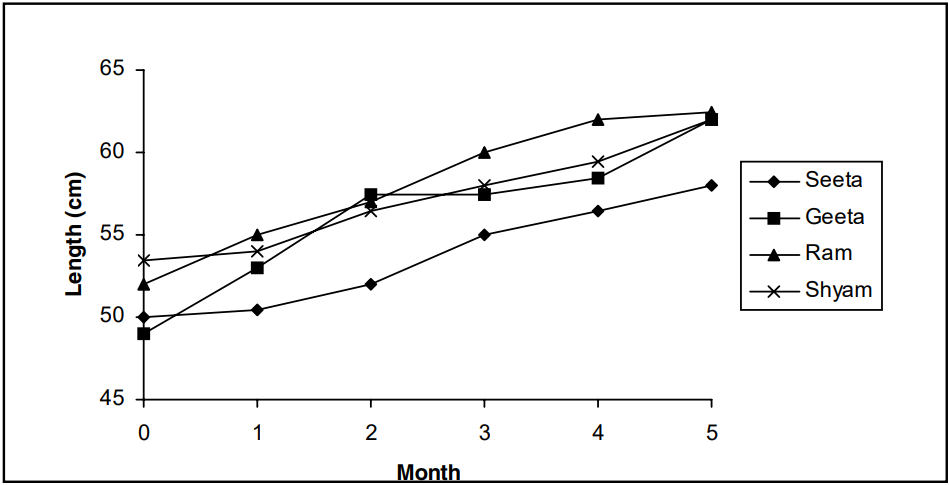
The length of an infant is one of the measures of his/her development in the early stages of his/her life. The figure below shows the growth chart of four infants in the first five months of life. (Refer to the line graph provided showing Length in cm vs Month for Seeta, Geeta, Ram, and Shyam).
DILR set, figure 1

Question 1 · MCQ

After which month did Seeta's rate of growth start to decline?
  1. A.
    Second month
  2. B.
    Third month
    ✓ Correct
  3. C.
    Fourth month
  4. D.
    Never
Solution
Seeta's lengths: month 0: 50.0, 1: 50.5, 2: 52.0, 3: 55.0, 4: 56.5, 5: 58.0 cm.
Monthly growth: 0→1 = 0.5, 1→2 = 1.5, 2→3 = 3.0, 3→4 = 1.5, 4→5 = 1.5 cm.
Growth rate increased till month 3, then declined.
Hence, Seeta's rate of growth started to decline after the third month.

Question 2 · MCQ

Who grew at the fastest rate in the first two months of life?
  1. A.
    Geeta
    ✓ Correct
  2. B.
    Seeta
  3. C.
    Ram
  4. D.
    Shyam
Solution
Growth from month 0 to month 2:
Seeta: 52.0 − 50.0 = 2.0 cm
Geeta: 57.5 − 49.0 = 8.5 cm
Ram: 57.0 − 52.0 = 5.0 cm
Shyam: 56.5 − 53.5 = 3.0 cm
Geeta grew the most (8.5 cm).

Question 3 · MCQ

The rate of growth during the third month was the lowest for
  1. A.
    Geeta
    ✓ Correct
  2. B.
    Seeta
  3. C.
    Ram
  4. D.
    Shyam
Solution
Growth during the third month = Length at Month 3 – Length at Month 2.
InfantMonth 2 (cm)Month 3 (cm)Growth (cm)
Seeta52.055.03.0
Geeta57.557.50.0
Ram57.060.03.0
Shyam56.558.01.5
Geeta’s growth is 0 cm, the lowest.

Question 4 · MCQ

Among the four infants, who grew the least in the first five months of life?
  1. A.
    Geeta
  2. B.
    Seeta
    ✓ Correct
  3. C.
    Ram
  4. D.
    Shyam
Solution
Total growth in first five months = Length at Month 5 – Length at Month 0.
InfantMonth 0 (cm)Month 5 (cm)Growth (cm)
Seeta50.058.08.0
Geeta49.062.013.0
Ram52.062.510.5
Shyam53.562.08.5
Seeta grew the least (8.0 cm).

QA · Quantitative Ability

Question 1 · MCQ

How much does R owe to S in Thai Baht?
  1. A.
    428
  2. B.
    416
  3. C.
    334
  4. D.
    324
    ✓ Correct
Solution
Total cost for 3 bottles = 520 + 2 × (0.7 × 520) = 520 + 2 × 364 = 1248 Bahts.
Equal share per person = 1248/3 = 416 Bahts.
R pays 2 Euros = 2 × 46 = 92 Bahts.
R owes 416 − 92 = 324 Bahts to S.
Answer: 324.

Question 2 · MCQ

How much does M owe to S in US Dollars?
  1. A.
    3
  2. B.
    4
  3. C.
    5
    ✓ Correct
  4. D.
    6
Solution
M pays 4 Euros + 27 Bahts = (4 × 46) + 27 = 184 + 27 = 211 Bahts.
M’s share = 416 Bahts, so M owes 416 − 211 = 205 Bahts.
S paid the remaining amount (1248 − 92 − 211 = 945 Bahts), which is 529 Bahts more than his share. Thus, M’s debt of 205 Bahts is owed to S.
Convert to USD at 41 Bahts/USD: 205/41 = 5 US Dollars.
Answer: 5.

Question 3 · MCQ

What is the number of projects in which Gyani alone is involved?
  1. A.
    Uniquely equal to zero.
  2. B.
    Uniquely equal to 1.
  3. C.
    Uniquely equal to 4.
  4. D.
    Cannot be determined uniquely.
    ✓ Correct
Solution
Let G, M, B denote Gyani, Medha, Buddhi.
n(G∩M∩B) = 6.
n(G∩M) = 14 ⇒ n(exactly G∩M) = 14 − 6 = 8.
n(B∩M) − n(G∩M∩B) = 2 ⇒ n(B∩M) = 8 ⇒ n(exactly B∩M) = 8 − 6 = 2.
n(B∩G) − n(G∩M∩B) = 3 ⇒ n(B∩G) = 9 ⇒ n(exactly B∩G) = 9 − 6 = 3.
So projects with exactly two consultants = 8+3+2 = 13.
More than one consultant: X = exactly two + all three = 13+6 = 19.
Total projects T = 2X − 1 = 37.
Given n(G)+n(B)=n(M). Write n(G)=g0+8+3+6=g0+17, n(B)=b0+11, n(M)=m0+16.
Then g0+b0+28 = m0+16 ⇒ m0 = g0+b0+12.
Also T = g0+b0+m0+19 = 37 ⇒ g0+b0+m0 = 18.
Substituting m0: 2(g0+b0)+12=18 ⇒ g0+b0=3.
Gyani alone (g0) cannot be uniquely determined (g0∈{0,1,2,3}).
Hence, uniquely equal to zero, one, or four are all possible; the correct choice is ‘Cannot be determined uniquely’.

Question 4 · MCQ

The number of non-negative real roots of \(2^x - x - 1 = 0\) equals
  1. A.
    0
  2. B.
    1
  3. C.
    2
    ✓ Correct
  4. D.
    3
Solution
Equation: \(2^x - x - 1 = 0\).
Check \(x=0\): \(2^0-0-1=0\) → root.
\(x=1\): \(2-1-1=0\) → root.
Let \(f(x)=2^x - x - 1\).
\(f'(x)=2^x \ln 2 - 1\).
\(f'(0)=\ln2-1<0\), so \(f\) decreases initially.
\(f'(x)=0\) when \(2^x = 1/\ln2 \approx 1.44\) (\(x\approx0.53\)).
At this minimum, \(f(x)<0\).
For \(x>0.53\), \(f'(x)>0\) and increasing, so \(f\) is strictly increasing.
Since \(f(1)=0\), no root with \(x>1\).
Between 0 and 1, \(f\) goes from 0 to negative then back to 0, no other root.
Thus exactly two non‑negative real roots: \(x=0\) and \(x=1\).
Answer: 2.

Question 5 · MCQ

When the curves \(y = \log_{10}x\) and \(y = x^{-1}\) are drawn in the \(x-y\) plane, how many times do they intersect for values \(x \ge 1\)?
  1. A.
    Never
  2. B.
    Once
    ✓ Correct
  3. C.
    Twice
  4. D.
    More than twice
Solution
At \(x = 1\), \(\log_{10}1 = 0\) and \(1/1 = 1\); the curves are not equal.
For \(x > 1\), define \(f(x) = \log_{10}x - x^{-1}\).
\(f(1) = -1\) and as \(x \to \infty\), \(f(x) \to \infty\).
\(f'(x) = \frac{1}{x\ln 10} + \frac{1}{x^2} > 0\) for all \(x > 0\), so \(f\) is strictly increasing.
Thus \(f(x) = 0\) has exactly one solution for \(x \ge 1\).
The curves intersect once.

The other 55 questions are in the simulator

Sit CAT 2003 Slot 1 with the real exam's timer and interface, then see where your marks went: silly slips, traps, topics that cost you time, and the questions you should have skipped. Start with the free mock test: no payment needed.

Unlock this paper