Official paper · included in Plus & Pro

CAT 2024 Slot 1 Question Paper with Solutions

68 questions in 120 minutes, in three timed sections. Below: how the paper is built, the topics each section tested, and a solved sample from every section. Take the whole paper in the simulator to get your Score Waterfall, Topic ROI Map and Strategic IQ.

Paper structure and topics

VARC

Verbal Ability & Reading Comprehension

24 questions · 22 MCQ · 2 TITA

  • Reading Comprehension · 12
  • Verbal Ability · 12

DILR

Data Interpretation & Logical Reasoning

22 questions · 12 MCQ · 10 TITA

  • Logical Reasoning · 14
  • Data Interpretation · 8

QA

Quantitative Ability

22 questions · 14 MCQ · 8 TITA

  • Arithmetic · 9
  • Algebra · 6
  • Number System · 4
  • Geometry · 3

Sample questions with solutions

13 of the 68 questions: the first passage, the first DILR set and the first QA questions of the paper.

VARC · Verbal Ability & Reading Comprehension

Passage

Landing in Australia, the British colonists weren't much impressed with the small-bodied, slender-snooted marsupials called bandicoots. "Their muzzle, which is much too long, gives them an air exceedingly stupid," one naturalist noted in 1805. They nicknamed one type the "zebra rat" because of its black-striped rump.

Silly-looking or not, though, the zebra rat-the smallest bandicoot, more commonly known today as the western barred bandicoot-exhibited a genius for survival in the harsh outback, where its ancestors had persisted for some 26 million years. Its births were triggered by rainfall in the bone-dry desert. It carried its breath-mint-size babies in a backward-facing pouch so mothers could forage for food and dig shallow, camouflaged shelters.

Still, these adaptations did not prepare the western barred bandicoot for the colonial-era transformation of its ecosystem, particularly the onslaught of imported British animals, from cattle and rabbits that damaged delicate desert vegetation to ravenous house cats that soon developed a taste for bandicoots. Several of the dozen-odd bandicoot species went extinct, and by the 1940s the western barred bandicoot, whose original range stretched across much of the continent, persisted only on two predator-free islands in Shark Bay, off Australia's western coast.

"Our isolated fauna had simply not been exposed to these predators," says Reece Pedler, an ecologist with the Wild Deserts conservation program.

Now Wild Deserts is using descendants of those few thousand island survivors, called Shark Bay bandicoots, in a new effort to seed a mainland bandicoot revival. They've imported 20 bandicoots to a preserve on the edge of the Strzelecki Desert, in the remote interior of New South Wales. This sanctuary is a challenging place, desolate much of the year, with one of the world's most mercurial rainfall patterns-relentless droughts followed by sudden drenching floods.

The imported bandicoots occupy two fenced "exclosures," cleared of invasive rabbits (courtesy of Pedler's sheepdog) and of feral cats (which slunk off once the rabbits disappeared). A third fenced area contains the program's Wild Training Zone, where two other rare marsupials (bilbies, a larger type of bandicoot, and mulgaras, a somewhat fearsome fuzzball known for sucking the brains out of prey) currently share terrain with controlled numbers of cats, learning to evade them. It's unclear whether the Shark Bay bandicoots, which are perhaps even more predator-naive than their now-extinct mainland bandicoot kin, will be able to make that kind of breakthrough.

For now, though, a recent surge of rainfall has led to a bandicoot joey boom, raising the Wild Deserts population to about 100, with other sanctuaries adding to that number. There are also signs of rebirth in the landscape itself. With their constant digging, the bandicoots trap moisture and allow for seed germination so the cattle-damaged desert can restore itself.

They have a new nickname-a flattering one, this time. "We call them ecosystem engineers," Pedler says.

Question 1 · MCQ

Which one of the following statements provides a gist of this passage?
  1. A.
    The onslaught of animals, such as cattle, rabbits and housecats, brought in by the British led to the extinction of the western barred bandicoot.
  2. B.
    Marsupials are going extinct due to the colonial era transformation of the ecosystem which also destroyed natural vegetation.
  3. C.
    A type of bandicoots was nearly wiped out by invasive species but rescuers now pin hopes on a remnant island population.
    ✓ Correct
  4. D.
    The negligent attitude of the British colonists towards these bandicoots evidenced by the names given to them led to their annihilation.
Solution
The passage describes how the western barred bandicoot (a type of bandicoot) was nearly wiped out on the mainland due to invasive species introduced during the colonial era, surviving only on two predator-free islands. It then details the current conservation efforts using descendants from this remnant island population to seed a mainland revival. This makes option (c) the perfect summary.

Question 2 · MCQ

The text uses the word 'exclosures' because Wild Deserts has adopted a measure of
  1. A.
    restoring cattle damaged deserts to green landscapes.
  2. B.
    excluding animals to make the islands predator-free.
  3. C.
    barring the entry of invasive species.
    ✓ Correct
  4. D.
    ridding the main desert of feral cats and large bilbies.
Solution
The text states that the imported bandicoots occupy fenced "exclosures" that have been "cleared of invasive rabbits... and of feral cats." Thus, these fenced areas are designed to exclude or bar the entry of invasive species to protect the bandicoots, making option (c) the correct choice.

Question 3 · MCQ

Which one of the following options does NOT represent the characteristics of the western barred bandicoot?
  1. A.
    Shallow diggers having an elongated muzzle
  2. B.
    Smallest black striped marsupial that uses camouflage and dig
    ✓ Correct
  3. C.
    Long thin nose, black striped back, pouch for joeys
  4. D.
    Look of a rat but with a baby pouch and a slender snout
Solution
Option (b) is incorrect because the passage states that the bandicoot has a "black-striped rump" (backside), not that it is a "black striped marsupial" entirely. Furthermore, the passage mentions that they dig "shallow, camouflaged shelters" rather than using camouflage on their bodies. Thus, option (b) does not accurately represent its characteristics.

Question 4 · MCQ

According to the text, the western barred bandicoots now have a flattering name because they have
  1. A.
    aided in altering an arid environment.
    ✓ Correct
  2. B.
    grown fivefold in terms of population.
  3. C.
    led to a surge and increase of rainfall.
  4. D.
    led a revival in preserving the species.
Solution
The passage states that the bandicoots are called "ecosystem engineers" because "with their constant digging, the bandicoots trap moisture and allow for seed germination so the cattle-damaged desert can restore itself." This directly corresponds to aiding in altering and restoring an arid environment, as stated in option (a).

DILR · Data Interpretation & Logical Reasoning

Set

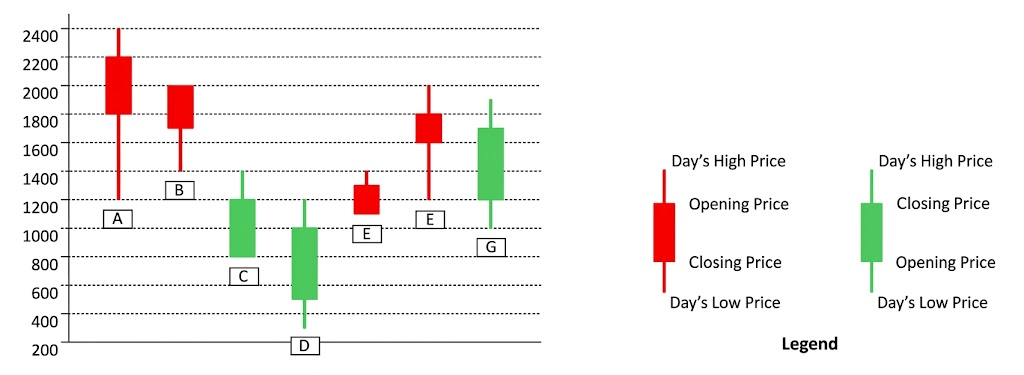
The chart below shows the price data for seven shares - A, B, C, D, E, F, and G as a candlestick plot for a particular day. The vertical axis shows the price of the share in rupees. A share whose closing price (price at the end of the day) is more than its opening price (price at the start of the day) is called a bullish share; otherwise, it is called a bearish share. All bullish and bearish shares are shown in green and red colour respectively.

[See candlestick chart and legend in image]
DILR set, figure 1

Question 1 · MCQ

Daily Share Price Variability (SPV) is defined as (Day's high price - Day's low price) / (Average of the opening and closing prices during the day). Which among the shares A, C, D and F had the highest SPV on that day?
  1. A.
    F
  2. B.
    A
  3. C.
    D
    ✓ Correct
  4. D.
    C
Solution
The SPV is calculated as \(\frac{\text{High} - \text{Low}}{(\text{Open} + \text{Close})/2}\).
By extracting the High, Low, Open, and Close values for shares A, C, D, and F from the candlestick chart, we evaluate the SPV for each.
Comparing the calculated values, share D yields the highest SPV.

[IMAGE: Candlestick chart showing Open, Close, High, and Low prices for shares A-G]

Question 2 · TITA (type in the answer)

Daily Share Price Variability (SPV) is defined as (Day's high price - Day's low price) / (Average of the opening and closing prices during the day). How many shares had an SPV greater than 0.5 on that day?

Answer: 3

Solution
The SPV is calculated as \(\frac{\text{High} - \text{Low}}{(\text{Open} + \text{Close})/2}\).
By extracting the High, Low, Open, and Close values for all seven shares from the chart, we compute their respective SPVs.
Counting the shares where this value strictly exceeds 0.5, we find exactly 3 shares meet the condition.

[IMAGE: Candlestick chart showing Open, Close, High, and Low prices for shares A-G]

Question 3 · MCQ

Daily loss for a share is defined as (Opening price - Closing price) / (Opening price). Which among the shares A, B, F and G had the highest daily loss on that day?
  1. A.
    A
  2. B.
    B
    ✓ Correct
  3. C.
    F
  4. D.
    G
Solution
Daily loss is calculated as \(\frac{\text{Open} - \text{Close}}{\text{Open}}\).
This applies to bearish shares (where Open > Close).
By extracting the Open and Close values for shares A, B, F, and G from the chart, we compute the daily loss for each.
Comparing the results, share B has the highest daily loss.

[IMAGE: Candlestick chart showing Open, Close, High, and Low prices for shares A-G]

Question 4 · MCQ

What would have been the percentage wealth gain for a trader, who bought equal numbers of all bullish shares at opening price and sold them at their day's high?
  1. A.
    72%
    ✓ Correct
  2. B.
    80%
  3. C.
    50%
  4. D.
    100%
Solution
Bullish shares are those with a green body, indicating Close > Open.
From the chart, identify all bullish shares and extract their Opening and High prices.
The total cost price is the sum of the Opening prices of these shares, and the total selling price is the sum of their High prices.
The percentage wealth gain is calculated as \(\frac{\text{Total High} - \text{Total Open}}{\text{Total Open}} \times 100\), which evaluates to 72%.

[IMAGE: Candlestick chart showing Open, Close, High, and Low prices for shares A-G]

QA · Quantitative Ability

Question 1 · MCQ

In the XY-plane, the area, in sq. units, of the region defined by the inequalities \(y\geq x+4\) and \(-4\leq x^2 + y^2 +4(x-y)\leq0\) is
  1. A.
    \(\pi\)
  2. B.
    \(2\pi\)
    ✓ Correct
  3. C.
    \(4\pi\)
  4. D.
    \(3\pi\)
Solution
Rewrite the second inequality by completing the square:
\(-4 \leq x^2 + 4x + y^2 - 4y \leq 0\)
\(4 \leq (x+2)^2 + (y-2)^2 \leq 8\)
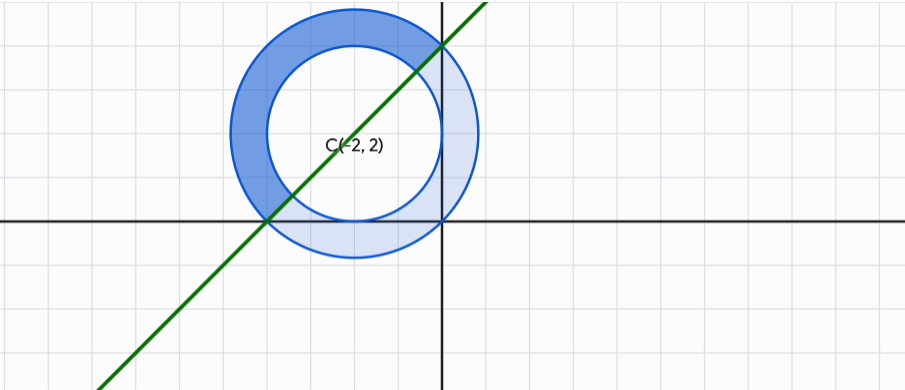
This represents an annulus centered at \((-2, 2)\) with inner radius \(2\) and outer radius \(\sqrt{8}\).
The area of the full annulus is \(\pi((\sqrt{8})^2 - 2^2) = 4\pi\).
The first inequality \(y \geq x+4\) represents a half-plane bounded by the line \(x - y + 4 = 0\).
Substituting the center \((-2, 2)\) into the line equation gives \(-2 - 2 + 4 = 0\), meaning the line passes exactly through the center.
Thus, the line divides the annulus into two equal halves, making the area of the defined region \(\frac{1}{2} \times 4\pi = 2\pi\).
Solution 1, figure 1

Question 2 · MCQ

The sum of all real values of \(k\) for which \((\frac{1}{8})^k \times (\frac{1}{32768})^{\frac{1}{3}} = (\frac{1}{8})^{-k} \times (\frac{1}{32768})^{\frac{1}{k}}\) is
  1. A.
    \(\frac{4}{3}\)
  2. B.
    \(-\frac{4}{3}\)
  3. C.
    \(-\frac{5}{6}\)
    ✓ Correct
  4. D.
    \(\frac{5}{6}\)
Solution
Express both sides of the equation with base 2, using \(8 = 2^3\) and \(32768 = 2^{15}\):
\((2^{-3})^k \times (2^{-15})^{\frac{1}{3}} = (2^{-3})^{-k} \times (2^{-15})^{\frac{1}{k}}\)
\(2^{-3k} \times 2^{-5} = 2^{3k} \times 2^{-\frac{15}{k}}\)
Equating the exponents:
\(-3k - 5 = 3k - \frac{15}{k}\)
\(6k + 5 - \frac{15}{k} = 0\)
Multiply by \(k\) (since \(k \neq 0\)) to form a quadratic equation:
\(6k^2 + 5k - 15 = 0\)
The sum of the real roots for this quadratic is given by \(-\frac{b}{a} = -\frac{5}{6}\).

Question 3 · TITA (type in the answer)

The sum of all four-digit numbers that can be formed with the distinct non-zero digits \(a,b,c,\) and \(d,\) with each digit appearing exactly once in every number, is \(153310+n\), where \(n\) is a single digit natural number. Then, the value of \((a+b+c+d+n)\) is

Answer: 31

Solution
Given:

Sum of all 4-digit numbers formed using four distinct non-zero digits \(a,b,c,d\)

\(= 3!(a+b+c+d)\times1111\)

\(= 6666(a+b+c+d)\)

Given:

\(6666(a+b+c+d)=153310+n\)

For \(153310+n\) to be divisible by \(6666\),

\(6666\times23=153318\)

\(\Rightarrow 153310+n=153318\)

\(\Rightarrow n=8\)

Therefore,

\(a+b+c+d=23\)

Required value:

\((a+b+c+d+n)\)

\(=23+8\)

\(=31\)

Final Answer: 31

Question 4 · TITA (type in the answer)

Renu would take 15 days working 4 hours per day to complete a certain task whereas Seema would take 8 days working 5 hours per day to complete the same task. They decide to work together to complete this task. Seema agrees to work for double the number of hours per day as Renu, while Renu agrees to work for double the number of days as Seema. If Renu works 2 hours per day, then the number of days Seema will work, is

Answer: 6

Solution
Given:

Let the total work be \(120\) units.

Renu's efficiency

\(=\frac{120}{15\times4}\)

\(=2\) units/hour

Seema's efficiency

\(=\frac{120}{8\times5}\)

\(=3\) units/hour

Renu works \(2\) hours per day.

Therefore, Seema works \(2\times2=4\) hours per day.

Let Seema work for \(x\) days.

Then Renu works for \(2x\) days.

Work done by Renu

\(=2\times2\times2x\)

\(=8x\) units

Work done by Seema

\(=3\times4\times x\)

\(=12x\) units

Total work:

\(8x+12x=120\)

\(\Rightarrow 20x=120\)

\(\Rightarrow x=6\)

Therefore, Seema works for \(6\) days.

Final Answer: 6 days

Question 5 · TITA (type in the answer)

For any natural number \(n\), let \(a_n\) be the largest integer not exceeding \(\sqrt{n}\). Then the value of \(a_1+a_2+\ldots+a_{50}\) is

Answer: 217

Solution
Given:
\(a_n=\lfloor\sqrt{n}\rfloor\)
The number of integers \(n\) such that
\(\lfloor\sqrt{n}\rfloor=k\)
is
\((k+1)^2-k^2=2k+1\)
For \(k=1\):
Number of terms \(=3\)
(\(n=1,2,3\))
For \(k=2\):
Number of terms \(=5\)
(\(n=4\) to \(8\))
For \(k=3\):
Number of terms \(=7\)
(\(n=9\) to \(15\))
For \(k=4\):
Number of terms \(=9\)
(\(n=16\) to \(24\))
For \(k=5\):
Number of terms \(=11\)
(\(n=25\) to \(35\))
For \(k=6\):
Number of terms \(=13\)
(\(n=36\) to \(48\))
For \(k=7\):
Number of terms \(=2\)
(\(n=49,50\))
Therefore,
\(\sum_{n=1}^{50}\lfloor\sqrt{n}\rfloor\)
\(=1(3)+2(5)+3(7)+4(9)+5(11)+6(13)+7(2)\)
\(=3+10+21+36+55+78+14\)
\(=217\)
Final Answer: 217

The other 55 questions are in the simulator

Sit CAT 2024 Slot 1 with the real exam's timer and interface, then see where your marks went: silly slips, traps, topics that cost you time, and the questions you should have skipped. Start with the free mock test: no payment needed.

Unlock this paper