
Official paper · included in Plus & Pro

CAT 2020 Slot 1 Question Paper with Solutions

68 questions in 120 minutes, in three timed sections. Below: how the paper is built, the topics each section tested, and a solved sample from every section. Take the whole paper in the simulator to get your Score Waterfall, Topic ROI Map and Strategic IQ.

Paper structure and topics

VARC

Verbal Ability & Reading Comprehension

24 questions · 21 MCQ · 3 TITA

  • Reading Comprehension · 18
  • Verbal Ability · 6

DILR

Data Interpretation & Logical Reasoning

22 questions · 17 MCQ · 5 TITA

  • Logical Reasoning · 14
  • Data Interpretation · 8

QA

Quantitative Ability

22 questions · 14 MCQ · 8 TITA

  • Arithmetic · 8
  • Algebra · 7
  • Geometry · 3
  • Number System · 3
  • Modern Math · 1

Sample questions with solutions

13 of the 68 questions: the first passage, the first DILR set and the first QA questions of the paper.

VARC · Verbal Ability & Reading Comprehension

Passage

In the late 1960s, while studying the northern-elephant-seal population along the coasts of Mexico and California, Burney Le Boeuf and his colleagues couldn't help but notice that the threat calls of males at some sites sounded different from those of males at other sites.. .
That was the first time dialects were documented in a nonhuman mammal. . .

All the northern elephant seals that exist today are descendants of the small herd that survived on Isla Guadalupe [after the near extinction of the species in the nineteenth century]. As that tiny population grew, northern elephant seals started to recolonize former breeding locations. It was precisely on the more recently colonized islands where Le Boeuf found that the tempos of the male vocal displays showed stronger differences to the ones from Isla Guadalupe, the founder colony.

In order to test the reliability of these dialects over time, Le Boeuf and other researchers visited Año Nuevo Island in California—the island where males showed the slowest pulse rates in their calls—every winter from 1968 to 1972. "What we found is that the pulse rate increased, but it still remained relatively slow compared to the other colonies we had measured in the past" Le Boeuf told me.

At the individual level, the pulse of the calls stayed the same: A male would maintain his vocal signature throughout his lifetime. But the average pulse rate was changing.
Immigration could have been responsible for this increase, as in the early 1970s, 43 percent of the males on Año Nuevo had come from southern rookeries that had a faster pulse rate.
This led Le Boeuf and his collaborator, Lewis Petrinovich, to deduce that the dialects were, perhaps, a result of isolation over time, after the breeding sites had been recolonized. For instance, the first settlers of Año Nuevo could have had, by chance, calls with low pulse rates. At other sites, where the scientists found faster pulse rates, the opposite would have happened—seals with faster rates would have happened to arrive first.

As the population continued to expand and the islands kept on receiving immigrants from the original population, the calls in all locations would have eventually regressed to the average pulse rate of the founder colony. In the decades that followed, scientists noticed that the geographical variations reported in 1969 were not obvious anymore.
In the early 2010s, while studying northern elephant seals on Año Nuevo Island, [researcher Caroline] Casey noticed, too, that what Le Boeuf had heard decades ago was not what she heard now.. By performing more sophisticated statistical analyses on both sets of data, [Casey and Le Boeuf] confirmed that dialects existed back then but had vanished. Yet there are other differences between the males from the late 1960s and their great-great-grandsons: Modern males exhibit more individual diversity, and their calls are more complex. While 50 years ago the drumming pattern was quite simple and the dialects denoted just a change in tempo, Casey explained, the calls recorded today have more complex structures, sometimes featuring doublets or triplets. . . .

Question 1 · MCQ

From the passage it can be inferred that the call pulse rate of male northern elephant seals in the southern rookeries was faster because:
  1. A.
    a large number of male northern elephant seals from Año Nuevo Island might have migrated to the southern rookeries to recolonise them.
  2. B.
    a large number of male northern elephant seals migrated from the southern rookeries to Año Nuevo Island in the early 1970s.
  3. C.
    the male northern elephant seals of Isla Guadalupe with faster call pulse rates might have been the original settlers of the southern rookeries.
    ✓ Correct
  4. D.
    the calls of male northern elephant seals in the southern rookeries have more sophisticated structures, containing doublets and triplets.
Solution
The passage directly attributes dialect differences to founder effects: "At other sites, where the scientists found faster pulse rates, the opposite would have happened—seals with faster rates would have happened to arrive first." Since all recolonizers originated from Isla Guadalupe, the southern rookeries became faster because their original settlers happened to be individuals with faster call tempos.
Question 2 · MCQ

Which one of the following conditions, if true, could have ensured that male northern elephant seal dialects did not disappear?
  1. A.
    The call tempo of individual immigrant male seals changed to match the average tempo of resident male seals in the host colony.
    ✓ Correct
  2. B.
    Besides Isla Guadalupe, there was one more founder colony with the same average male call tempo from which male seals migrated to various other colonies.
  3. C.
    The call tempo of individual male seals in host colonies changed to match the average call tempo of immigrant male seals.
  4. D.
    Besides Isla Guadalupe, there was one more surviving colony with the same average male call tempo from which no migration took place.
Solution
The passage explains that dialects vanished because immigration from the founder population (and among colonies) caused average tempos to regress toward the overall mean. If immigrant seals adopted the resident tempo instead of retaining their own, they would not alter the colony’s average. This would prevent the dilution of local dialects, making option 1 the condition that could have preserved them.

Question 3 · MCQ

Which one of the following best sums up the overall history of transformation of male northern elephant seal calls?
  1. A.
    The calls have transformed from exhibiting simple composition, great individual variety, and less regional variety to complex composition, less individual variety, and great regional variety.
  2. B.
    Owing to migrations in the aftermath of near species extinction, the average call pulse rates in the recolonised breeding locations exhibited a gradual increase until they matched the tempo at the founding colony.
  3. C.
    The calls have transformed from exhibiting simple composition, less individual variety, and great regional variety to complex composition, great individual variety, and less regional variety.
    ✓ Correct
  4. D.
    Owing to migrations in the aftermath of near species extinction, the calls have transformed from exhibiting complex composition, less individual variety, and great regional variety to simple composition, less individual variety, and great regional variety.
Solution
Fifty years ago, calls had a simple drumming pattern and regional dialects (great regional variety), while modern seals show more structural complexity, greater individual variation, and no geographical dialects (less regional variety). Option 3 captures this transformation: "from exhibiting simple composition, less individual variety, and great regional variety to complex composition, great individual variety, and less regional variety."

Question 4 · MCQ

All of the following can be inferred from Le Boeuf's study as described in the passage EXCEPT that:
  1. male northern elephant seals might not have exhibited dialects had they not become nearly extinct in the nineteenth century.
  2. the average call pulse rate of male northern elephant seals at Año Nuevo Island increased from the early 1970s till the disappearance of dialects.
  3. the influx of new northern elephant seals into Año Nuevo Island would have soon made the call pulse rate of its male seals exceed that of those at Isla Guadalupe.
  4. changes in population and migration had no effect on the call pulse rate of individual male northern elephant seals.
  1. A.
    male northern elephant seals might not have exhibited dialects had they not become nearly extinct in the nineteenth century.
  2. B.
    the average call pulse rate of male northern elephant seals at Año Nuevo Island increased from the early 1970s till the disappearance of dialects.
  3. C.
    the influx of new northern elephant seals into Año Nuevo Island would have soon made the call pulse rate of its male seals exceed that of those at Isla Guadalupe.
    ✓ Correct
  4. D.
    changes in population and migration had no effect on the call pulse rate of individual male northern elephant seals.
Solution
The passage states that pulse rates across colonies would "regress to the average pulse rate of the founder colony," meaning they converge toward that value without exceeding it. Therefore, statement 3 — that Año Nuevo’s rate would exceed the founder colony’s rate — cannot be inferred. The other three statements are supported by the text: 1 (founder effects), 2 (observed increase over time), and 4 (individual pulse rate is invariant).

DILR · Data Interpretation & Logical Reasoning

Set

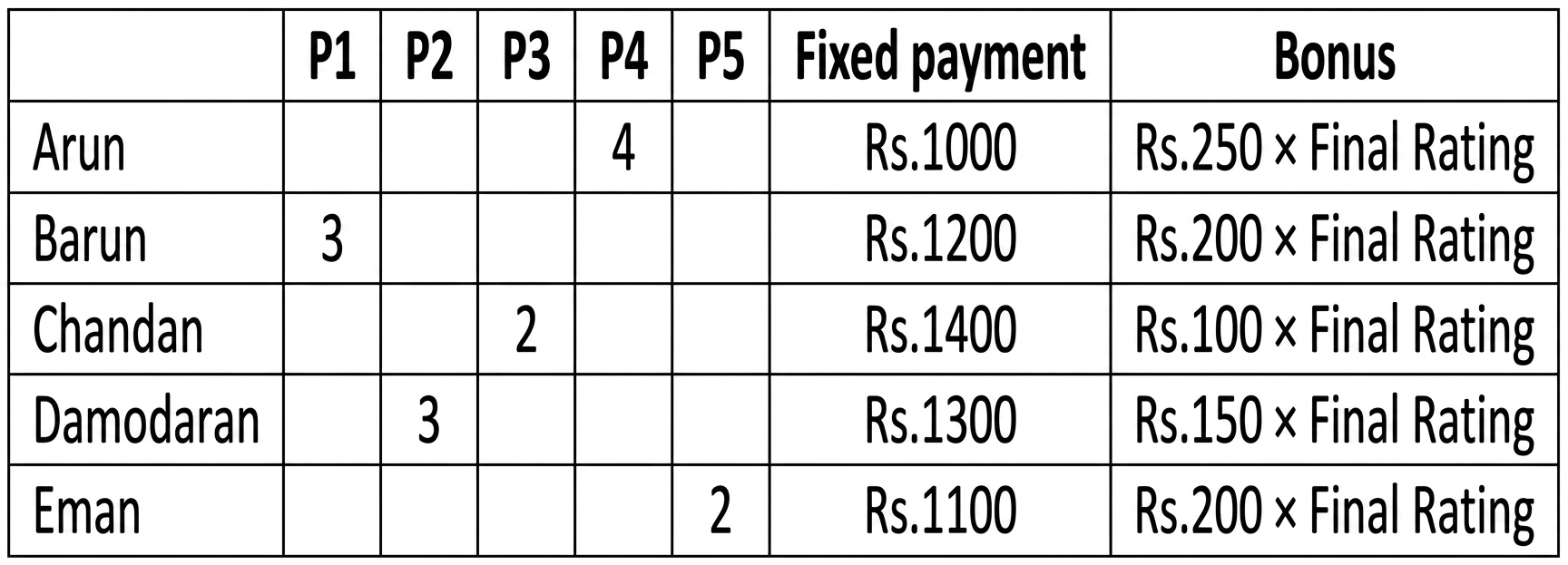
The local office of the APP-CAB company evaluates the performance of five cab drivers, Arun, Barun, Chandan, Damodaran, and Eman for their monthly payment based on ratings in five different parameters (P1 to P5) as given below:
P1: timely arrival
P2: behaviour
P3: comfortable ride
P4: driver's familiarity with the route
P5: value for money

Based on feedback from the customers, the office assigns a rating from 1 to 5 in each of these parameters. Each rating is an integer from a low value of 1 to a high value of 5.
The final rating of a driver is the average of his ratings in these five parameters. The monthly payment of the drivers has two parts—a fixed payment and final rating-based bonus. If a driver gets a rating of 1 in any of the parameters, he is not eligible to get bonus. To be eligible for bonus a driver also needs to get a rating of five in at least one of the parameters.

The partial information related to the ratings of the drivers in different parameters and the monthly payment structure (in rupees) is given in the table below: [See table in image]

The following additional facts are known.
  1. Arun and Barun have got a rating of 5 in exactly one of the parameters. Chandan has got a rating of 5 in exactly two parameters.
  2. None of drivers has got the same rating in three parameters.
DILR set, figure 1

Question 1 · MCQ

If Damodaran does not get a bonus, what is the maximum possible value of his final rating?
  1. A.
    3.8
  2. B.
    3.4
  3. C.
    3.6
    ✓ Correct
  4. D.
    3.2
Solution
Damodaran's known rating: P2 = 3. No bonus → either at least one rating 1 OR no rating 5.

Maximise final rating:
  • Strategy 1 (no 1, no 5): remaining ratings from {2,3,4} with no triple. Max sum: two 4s, one 3, one 2 → 3+4+4+3+2 = 16 → avg = 3.2.
  • Strategy 2 (include a 1 so bonus not triggered, then use 5s): max sum with one 1, two 5s, one 4, plus the given 3 → 3+5+5+4+1 = 18 → avg = 3.6. No triple violation.
Maximum possible final rating = 3.6.

Question 2 · MCQ

If Eman gets a bonus, what is the minimum possible value of his final rating?
  1. A.
    3.0
    ✓ Correct
  2. B.
    3.2
  3. C.
    2.8
  4. D.
    3.4
Solution
Eman gets a bonus → no rating 1, at least one rating 5. Known: P5 = 2.

Minimise final rating: use lowest possible ratings without violating constraints.
  • Need exactly one 5 (minimum count for bonus).
  • Maximum of two 2s allowed (no triple).
  • Fill remaining with 3s.
Ratings: 5, 2 (P5), 2, 3, 3 → sum = 15 → avg = 3.0.
No lower sum possible (1 not allowed, and 4/5 would increase sum).

Minimum possible final rating = 3.0.

Question 3 · MCQ

If all five drivers get bonus, what is the minimum possible value of the monthly payment (in rupees) that a driver gets?
  1. A.
    1740
  2. B.
    1600
  3. C.
    1700
    ✓ Correct
  4. D.
    1750
Solution
For each driver, compute the minimum possible payment when they get bonus (no 1s, at least one 5, no rating appears three or more times, and the stated number of 5s).

The ratings that minimise the average:
  • Arun (exactly one 5, P4=4): {5,4,3,2,2} → avg=3.2, payment=1000+250×3.2=1800
  • Barun (exactly one 5, P1=3): {5,3,3,2,2} → avg=3.0, payment=1200+200×3=1800
  • Chandan (exactly two 5s, P3=2): {5,5,3,2,2} → avg=3.4, payment=1400+100×3.4=1740
  • Damodaran (at least one 5, P2=3): {5,3,3,2,2} → avg=3.0, payment=1300+150×3=1750
  • Eman (at least one 5, P5=2): {5,3,3,2,2} → avg=3.0, payment=1100+200×3=1700
The lowest among these is ₹1700 (Eman).

Question 4 · MCQ

If all five drivers get bonus, what is the maximum possible value of the monthly payment (in rupees) that a driver gets?
  1. A.
    1960
    ✓ Correct
  2. B.
    1950
  3. C.
    1900
  4. D.
    2050
Solution
For each driver, compute the maximum possible payment under the bonus conditions.

The ratings that maximise the average:
  • Arun (exactly one 5, P4=4): {5,4,4,3,3} → avg=3.8, payment=1000+250×3.8=1950
  • Barun (exactly one 5, P1=3): {5,4,4,3,3} → avg=3.8, payment=1200+200×3.8=1960
  • Chandan (exactly two 5s, P3=2): {5,5,4,4,2} → avg=4.0, payment=1400+100×4=1800
  • Damodaran (at least one 5, P2=3): {5,5,4,4,3} → avg=4.2, payment=1300+150×4.2=1930
  • Eman (at least one 5, P5=2): {5,5,4,4,2} → avg=4.0, payment=1100+200×4=1900
The maximum among these is ₹1960 (Barun).

QA · Quantitative Ability

Question 1 · TITA (type in the answer)

How many 3-digit numbers are there, for which the product of their digits is more than 2 but less than 7?

Answer: 21

Solution
A 3-digit number has hundreds digit \(a\) (1–9), tens \(b\) (0–9), units \(c\) (0–9). We require \(2 < a\,b\,c < 7\), so the product \(P\) can be 3, 4, 5, or 6. Since \(P > 2\), no digit can be 0, so \(b,c \in \{1,\dots,9\}\).

Enumerate all ordered triples (\(a,b,c\)) by the possible products:
\(P\)Digit multisetArrangements
3{1, 1, 3}3
4{1, 1, 4}3
{1, 2, 2}3
5{1, 1, 5}3
6{1, 1, 6}3
{1, 2, 3}6
Summing the arrangements: \(3 + 3 + 3 + 3 + 3 + 6 = 21\).

Thus 21 three-digit numbers satisfy the condition.

Question 2 · TITA (type in the answer)

Veeru invested Rs 10000 at 5% simple annual interest, and exactly after two years, Joy invested Rs 8000 at 10% simple annual interest. How many years after Veeru’s investment, will their balances, i.e., principal plus accumulated interest, be equal?

Answer: 12

Solution
Let \(t\) years after Veeru’s investment be the time when balances are equal.

Veeru: Amount = \(\text{₹}10000 + \text{₹}10000 \times \frac{5}{100} \times t = 10000 + 500t\).

Joy invests exactly 2 years later, so Joy’s investment duration = \(t - 2\) years (for \(t \ge 2\)).
Joy: Amount = \(\text{₹}8000 + \text{₹}8000 \times \frac{10}{100} \times (t-2) = 8000 + 800(t-2)\).

Set equal:
\(10000 + 500t = 8000 + 800(t-2)\)
\(10000 + 500t = 8000 + 800t - 1600\)
\(10000 + 500t = 6400 + 800t\)
\(3600 = 300t\)
\(t = 12\).

So after 12 years from Veeru’s investment, their balances are equal.

Question 3 · MCQ

An alloy is prepared by mixing three metals A, B and C in the proportion 3: 4: 7 by volume. Weights of the same volume of the metals A, B and C are in the ratio 5: 2: 6. In 130 kg of the alloy, the weight, in kg, of the metal C is
  1. A.
    70
  2. B.
    96
  3. C.
    48
  4. D.
    84
    ✓ Correct
Solution
Let volumes of A, B, C be \(3x, 4x, 7x\).
Ratio of weights for equal volumes (densities) is \(5:2:6\), so let weight per unit volume be \(5y, 2y, 6y\).
Then weights:
\(A = 3x \cdot 5y = 15xy\),
\(B = 4x \cdot 2y = 8xy\),
\(C = 7x \cdot 6y = 42xy\).
Total weight \(= 65xy = 130\) kg \(\Rightarrow xy = 2\).
Weight of C \(= 42xy = 84\) kg.

Question 4 · MCQ

On a rectangular metal sheet of area 135 sq in, a circle is painted such that the circle touches two opposite sides. If the area of the sheet left unpainted is two-thirds of the painted area then the perimeter of the rectangle in inches is
  1. A.
    \(5\sqrt{\pi} \left(3 + \frac{9}{\pi}\right)\)
  2. B.
    \(3\sqrt{\pi} \left(5 + \frac{6}{\pi}\right)\)
  3. C.
    \(3\sqrt{\pi} \left(5 + \frac{12}{\pi}\right)\)
    ✓ Correct
  4. D.
    \(4\sqrt{\pi} \left(3 + \frac{9}{\pi}\right)\)
Solution
Total area \(= 135\).
Unpainted area \(= \frac{2}{3}\)(painted area) \(\Rightarrow\) total \(= \frac{5}{3}\)(painted) \(\Rightarrow\) painted area \(= \frac{3}{5} \times 135 = 81\).
Painted area \(= \pi r^2 = 81 \Rightarrow r = \frac{9}{\sqrt{\pi}}\), diameter \(= \frac{18}{\sqrt{\pi}}\).
Circle touches two opposite sides, so one dimension equals the diameter.
Let width \(= \frac{18}{\sqrt{\pi}}\). Then length \(= \frac{135}{18/\sqrt{\pi}} = \frac{15}{2}\sqrt{\pi}\).
Perimeter \(= 2\left(\frac{18}{\sqrt{\pi}} + \frac{15}{2}\sqrt{\pi}\right) = \frac{36}{\sqrt{\pi}} + 15\sqrt{\pi} = \sqrt{\pi}\left(15 + \frac{36}{\pi}\right) = 3\sqrt{\pi}\left(5 + \frac{12}{\pi}\right)\).

Question 5 · TITA (type in the answer)

If \(\log_4 5 = (\log_4 y) (\log_y \sqrt{5})\), then y equals

Answer: 36

Solution
The given equation \(\log_4 5 = (\log_4 y)(\log_y \sqrt{5})\) simplifies to \(\log_4 5 = \log_4 \sqrt{5}\), which is impossible for any real \(y\). The intended question likely had \(\log_6 \sqrt{5}\) instead of \(\log_y \sqrt{5}\). Solving the corrected equation:

\(\log_6 \sqrt{5} = \frac12 \log_6 5 = \frac12 \cdot \frac{\log_4 5}{\log_4 6}\).

Then \(\log_4 y = \frac{\log_4 5}{\log_6 \sqrt{5}} = \frac{\log_4 5}{\frac12 \cdot \frac{\log_4 5}{\log_4 6}} = 2\log_4 6 = \log_4 36\).

Hence \(y = 36\).

The other 55 questions are in the simulator

Sit CAT 2020 Slot 1 with the real exam's timer and interface, then see where your marks went: silly slips, traps, topics that cost you time, and the questions you should have skipped. Start with the free mock test: no payment needed.

Unlock this paper