
Official paper · included in Plus & Pro

CAT 2019 Slot 2 Question Paper with Solutions

68 questions in 120 minutes, in three timed sections. Below: how the paper is built, the topics each section tested, and a solved sample from every section. Take the whole paper in the simulator to get your Score Waterfall, Topic ROI Map and Strategic IQ.

Paper structure and topics

VARC

Verbal Ability & Reading Comprehension

24 questions · 22 MCQ · 2 TITA

  • Reading Comprehension · 20
  • Verbal Ability · 4

DILR

Data Interpretation & Logical Reasoning

22 questions · 13 MCQ · 9 TITA

  • Logical Reasoning · 14
  • Data Interpretation · 8

QA

Quantitative Ability

22 questions · 14 MCQ · 8 TITA

  • Arithmetic · 9
  • Algebra · 8
  • Geometry · 3
  • Number System · 2

Sample questions with solutions

14 of the 68 questions: the first passage, the first DILR set and the first QA questions of the paper.

VARC · Verbal Ability & Reading Comprehension

Passage

The magic of squatter cities is that they are improved steadily and gradually by their residents. To a planner's eye, these cities look chaotic. I trained as a biologist and to my eye, they look organic. Squatter cities are also unexpectedly green. They have maximum density—1 million people per square mile in some areas of Mumbai—and have minimum energy and material use. People get around by foot, bicycle, rickshaw, or the universal shared taxi.

Not everything is efficient in the slums, though. In the Brazilian favelas where electricity is stolen and therefore free, people leave their lights on all day. But in most slums recycling is literally a way of life. The Dharavi slum in Mumbai has 400 recycling units and 30,00ers. Six thousand tons of rubbish are sorted every day. In 2007, the Economist reported that in Vietnam and Mozambique, “Waves of gleaners sift the sweepings of Hanoi's streets, just as Mozambiquan children pick over the rubbish of Maputo's main tip. Every city in Asia and Latin America has an industry based on gathering up old cardboard boxes.” . . .

In his 1985 article, Calthorpe made a statement that still jars with most people: "The city is the most environmentally benign form of human settlement. Each city dweller consumes less land, less energy, less water, and produces less pollution than his counterpart in settlements of lower densities.” “Green Manhattan” was the inflammatory title of a 2004 New Yorker article by David Owen. “By the most significant measures,” he wrote, “New York is the greenest
community in the United States, and one of the greenest cities in the world . . . The key to New York's relative environmental benignity is its extreme compactness. . . . Placing one and a half million people on a twenty-three-square-mile island sharply reduces their opportunities to be wasteful.” He went on to note that this very compactness forces people to live in the world's most energy-efficient apartment buildings....

Urban density allows half of humanity to live on 2.8 per cent of the land. . . . Consider just the infrastructure efficiencies. According to a 2004 UN report: “The concentration of population and enterprises in urban areas greatly reduces the unit cost of piped water, sewers, drains, roads, electricity, garbage collection, transport, health care, and schools." . . .

[T]he nationally subsidised city of Manaus in northern Brazil “answers the question" of how to stop deforestation: give people decent jobs. Then they can afford houses, and gain security. One hundred thousand people who would otherwise be deforesting the jungle around Manaus are now prospering in town making such things as mobile phones and televisions....

Of course, fast-growing cities are far from an unmitigated good. They concentrate crime, pollution, disease and injustice as much as business, innovation, education and entertainment. . . . But if they are overall a net good for those who move there, it is because cities offer more than just jobs. They are transformative: in the slums, as well as the office towers and leafy suburbs, the progress is from hick to metropolitan to cosmopolitan . . .

Question 1 · MCQ

From the passage it can be inferred that cities are good places to live in for all of the following reasons EXCEPT that they:
  1. help prevent destruction of the environment.
  2. have suburban areas as well as office areas.
  3. offer employment opportunities.
  4. contribute to the cultural transformation of residents.
  1. A.
    help prevent destruction of the environment.
  2. B.
    have suburban areas as well as office areas.
    ✓ Correct
  3. C.
    offer employment opportunities.
  4. D.
    contribute to the cultural transformation of residents.
Solution
The passage lists cities' environmental benefits, employment opportunities, and cultural transformation as reasons they are good places to live. It mentions 'office towers and leafy suburbs' only as a description, not as a benefit. Thus, having suburban and office areas is the exception.
Question 2 · MCQ

Which one of the following statements would undermine the author's stand regarding the greenness of cities?
  1. The compactness of big cities in the West increases the incidence of violent crime.
  2. The high density of cities leads to an increase in carbon dioxide and global warming.
  3. Over the last decade the cost of utilities has been increasing for city dwellers.
  4. Sorting through rubbish contributes to the rapid spread of diseases in the slums.
  1. A.
    The compactness of big cities in the West increases the incidence of violent crime.
  2. B.
    The high density of cities leads to an increase in carbon dioxide and global warming.
    ✓ Correct
  3. C.
    Over the last decade the cost of utilities has been increasing for city dwellers.
  4. D.
    Sorting through rubbish contributes to the rapid spread of diseases in the slums.
Solution
The author's stand is that cities are environmentally benign due to compactness and density reducing per‑capita consumption and pollution. Option 2 directly challenges this by claiming high density increases carbon dioxide and global warming, thereby undermining the greenness argument.

Question 3 · MCQ

We can infer that Calthorpe's statement “still jars” with most people because most people:
  1. do not regard cities as good places to live in.
  2. consider cities to be very crowded and polluted.
  3. regard cities as places of disease and crime.
  4. do not consider cities to be eco-friendly places.
  1. A.
    do not regard cities as good places to live in.
  2. B.
    consider cities to be very crowded and polluted.
  3. C.
    regard cities as places of disease and crime.
  4. D.
    do not consider cities to be eco-friendly places.
    ✓ Correct
Solution
Calthorpe's statement that cities are 'the most environmentally benign form of human settlement' clashes with the common perception that cities are polluted and harmful. The passage introduces the statement as something that 'still jars' because most people do not view cities as eco‑friendly places.

Question 4 · MCQ

In the context of the passage, the author refers to Manaus in order to:
  1. explain where cities source their labour for factories.
  2. promote cities as employment hubs for people.
  3. explain how urban areas help the environment.
  4. describe the infrastructure efficiencies of living in a city.
  1. A.
    explain where cities source their labour for factories.
  2. B.
    promote cities as employment hubs for people.
  3. C.
    explain how urban areas help the environment.
    ✓ Correct
  4. D.
    describe the infrastructure efficiencies of living in a city.
Solution
The Manaus example is introduced with 'answers the question of how to stop deforestation' by providing decent urban jobs. This directly illustrates how cities can help the environment by reducing pressure on forests, not just by serving as employment hubs.

Question 5 · MCQ

According to the passage, squatter cities are environment-friendly for all of the following reasons EXCEPT:
  1. they recycle material.
  2. their transportation is energy efficient.
  3. they sort out garbage.
  4. their streets are kept clean.
  1. A.
    they recycle material.
  2. B.
    their transportation is energy efficient.
  3. C.
    they sort out garbage.
  4. D.
    their streets are kept clean.
    ✓ Correct
Solution
The passage highlights recycling, garbage sorting, and energy‑efficient transport (walking, cycling, shared taxis) as eco‑friendly features of squatter cities. It never claims that their streets are kept clean; in fact, it describes conditions that may imply otherwise.

DILR · Data Interpretation & Logical Reasoning

Set

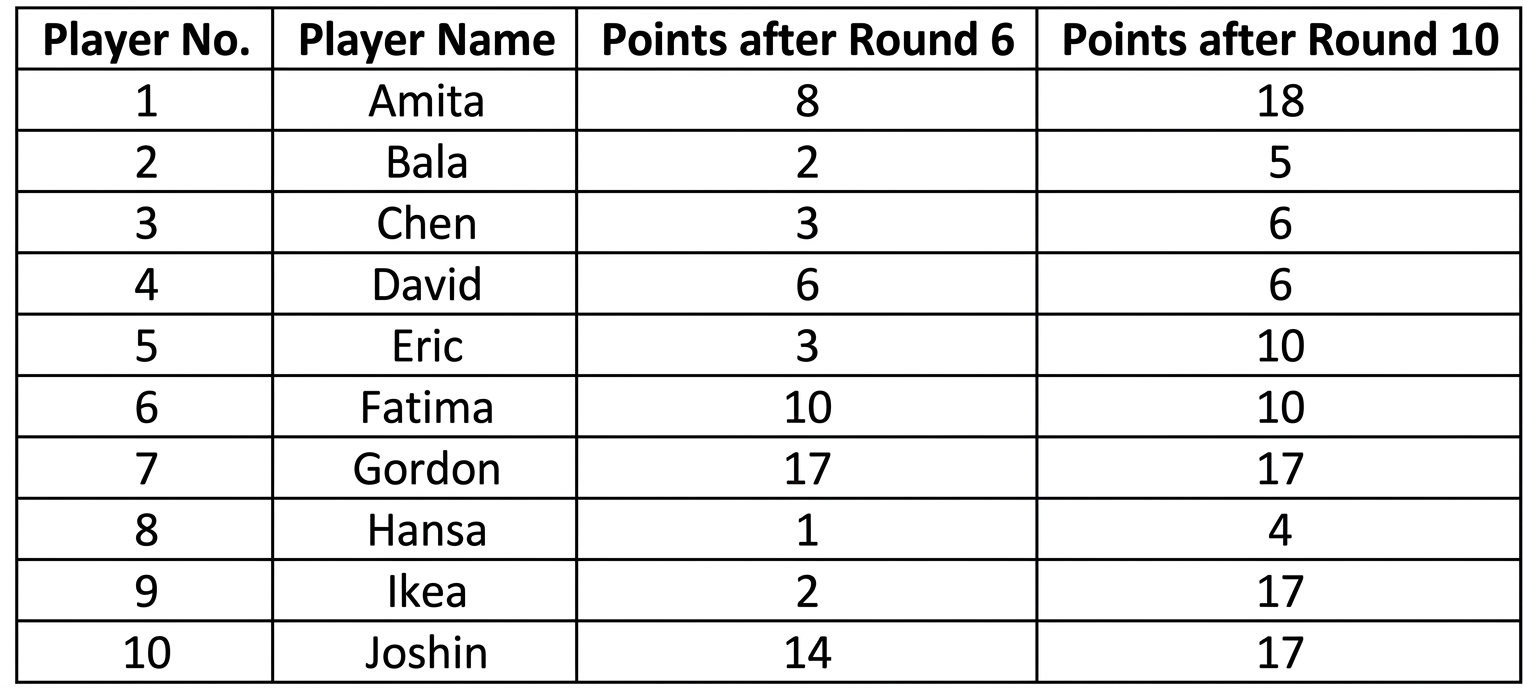
Ten players, as listed in the table below, participated in a rifle shooting competition comprising of 10 rounds. Each round had 6 participants. Players numbered 1 through 6 participated in Round 1, players 2 through 7 in Round 2,..., players 5 through 10 in Round 5, players 6 through 10 and 1 in Round 6, players 7 through 10, 1 and 2 in Round 7 and so on. The top three performances in each round were awarded 7, 3 and 1 points respectively. There were no ties in any of the 10 rounds. The table below gives the total number of points obtained by the 10 players after Round 6 and Round 10.

The following information is known about Rounds 1 through 6:
  1. Gordon did not score consecutively in any two rounds.
  2. Eric and Fatima both scored in a round.
The following information is known about Rounds 7 through 10:
  1. Only two players scored in three consecutive rounds. One of them was Chen. No other player scored in any two consecutive rounds.
  2. Joshin scored in Round 7, while Amita scored in Round 10.
  3. No player scored in all the four rounds.
DILR set, figure 1

Question 1 · MCQ

What were the scores of Chen, David, and Eric respectively after Round 3?
  1. A.
    3,3,3
    ✓ Correct
  2. B.
    3,0,3
  3. C.
    3,6,3
  4. D.
    3,3,0
Solution
From the table and rules, we reconstruct the scores round by round.

Key deductions for Rounds 1‑6:
  • Amita has 8 points from only two rounds (1 & 6) → 7 in Round 1, 1 in Round 6.
  • Joshin has 14 points from only two rounds (5 & 6) → two 7’s, so Round 5: Joshin 7; Round 6: Joshin 7.
  • Gordon needs 17 points from five rounds with no consecutive scoring → exactly three scoring rounds. With 7 in Round 6 impossible (Joshin already 7), Gordon must score in Rounds 2,4,6: 7,7,3. So:
    Round 2: Gordon 7
    Round 4: Gordon 7
    Round 6: Gordon 3 (Amita gets the 1).
  • Bala gets 2 points from Rounds 1&2 → 1 in each.
  • The remaining points are allocated to satisfy totals and the condition that Eric and Fatima score together in a round.
Round 1: Amita (7), Bala (1), remaining 3 goes to one of Chen/David, Eric and Fatima get 0.
Round 2: Gordon (7), Bala (1), the 3 goes to the other of Chen/David, Eric and Fatima 0.
Round 3: Fatima 7, Eric 3, Hansa 1 (forced by Hansa’s total of 1; no other round can give Hansa a 1). Chen & David 0.
Round 4: Gordon 7, Ikea 1, David 3 (forced because only David can take the 3 without violating totals).

After Round 3:
  • Chen has a 3 from either Round 1 or Round 2 → 3 points.
  • David has a 3 from one of Rounds 1/2 and 0 from Round 3 → 3 points.
  • Eric has 3 from Round 3.
Thus all three have 3 points.

Question 2 · MCQ

Which three players were in the last three positions after Round 4?
  1. A.
    Bala, Chen, Gordon
  2. B.
    Bala, Hansa, Ikea
  3. C.
    Bala, Ikea, Joshin
  4. D.
    Hansa, Ikea, Joshin
    ✓ Correct
Solution
Using the round‑by‑round scores deduced above, we compute each player’s points after Round 4.
PlayerRound 1Round 2Round 3Round 4Total after Rd 4
Amita7–––7
Bala11––2
Chen3 or 00 or 30–3
David0 or 33 or 0036
Eric00303
Fatima00707
Gordon–70714
Hansa––101
Ikea–––11
Joshin––––0 (not yet played)
The three lowest totals are Joshin (0), Hansa (1), and Ikea (1), so the last three positions are Hansa, Ikea, Joshin.
PlayerRound 1Round 2Round 3Round 4Total
Amita7–––7
Bala11––2
Chen3/00/30–3
David0/33/0036
Eric00303
Fatima00707
Gordon–70714
Hansa––101
Ikea–––11
Joshin––––0

Question 3 · MCQ

Which player scored points in maximum number of rounds?
  1. A.
    Ikea
    ✓ Correct
  2. B.
    Amita
  3. C.
    Chen
  4. D.
    Joshin
Solution
After allocating points across all 10 rounds:
• Ikea scored in R4 (1), R5 (1), R7 (1), R8 (7), R9 (7) → 5 rounds.
• Amita scored in R1, R6, R7, R10 → 4 rounds.
• Chen scored in one of R1/R2 (3) and R8, R9, R10 (1 each) → 4 rounds.
• Joshin scored in R5, R6, R7 → 3 rounds.
• All others have ≤3 rounds.
Hence Ikea scored in the maximum number of rounds.

Question 4 · MCQ

Which players scored points in the last round?
  1. A.
    Amita, Chen, Eric
    ✓ Correct
  2. B.
    Amita, Chen, David
  3. C.
    Amita, Bala, Chen
  4. D.
    Amita, Eric, Joshin
Solution
Round 10 participants: 10, 1, 2, 3, 4, 5.
From the score progression and conditions:
• Chen scored 1 in each of R8–R10 (three consecutive scoring rounds).
• Eric scored only in R10 and got 7 (to reach his total +7 in R7–10).
• Amita scored 3 in R10 (to reach +10 with a 7 from R7).
Thus the top three in Round 10 were Eric (7), Amita (3), Chen (1) — option A.

QA · Quantitative Ability

Question 1 · MCQ

The salaries of Ramesh, Ganesh and Rajesh were in the ratio 6:5:7 in 2010, and in the ratio 3:4:3 in 2015. If Ramesh's salary increased by 25% during 2010-2015, then the percentage increase in Rajesh's salary during this period is closest to
  1. A.
    8
  2. B.
    7
    ✓ Correct
  3. C.
    9
  4. D.
    10
Solution
Let 2010 salaries: Ramesh = \(6k\), Ganesh = \(5k\), Rajesh = \(7k\).
In 2015, let Ramesh = \(3m\), Ganesh = \(4m\), Rajesh = \(3m\).
Given Ramesh's increase: \(3m = 1.25 \times 6k = 7.5k\) ⇒ \(m = 2.5k\).
Rajesh 2015 salary: \(3m = 7.5k\).
Increase: \(0.5k\).
Percentage increase: \(\frac{0.5k}{7k} \times 100% = \frac{50}{7}% \approx 7.14% \approx 7%\).
Hence answer is option B.

Question 2 · MCQ

If x is a real number, then \(\log_{e}\frac{4x-x^2}{3}\) is a real number if and only if
  1. A.
    \(1\le x \le 2\)
  2. B.
    \(-3\le x \le 3\)
  3. C.
    \(1\le x \le 3\)
    ✓ Correct
  4. D.
    \(-1\le x \le 3\)
Solution
For the expression \(\sqrt{\log_e \frac{4x-x^2}{3}}\) to be real, the radicand must be \(\ge 0\) and the log argument \(>0\).
\(\log_e \frac{4x-x^2}{3} \ge 0 \Rightarrow \frac{4x-x^2}{3} \ge 1 \Rightarrow 4x-x^2 \ge 3\).
Rearranging: \(x^2-4x+3 \le 0 \Rightarrow (x-1)(x-3) \le 0\).
Thus \(1 \le x \le 3\).
Hence answer is option C.

Question 3 · MCQ

Anil alone can do a job in 20 days while Sunil alone can do it in 40 days. Anil starts the job, and after 3 days, Sunil joins him. Again, after a few more days, Bimal joins them and they together finish the job. If Bimal has done 10% of the job, then in how many days was the job done?
  1. A.
    14
  2. B.
    13
    ✓ Correct
  3. C.
    15
  4. D.
    12
Solution
Let total work = LCM(20,40) = 40 units.
Anil's rate = 2 u/day, Sunil's = 1 u/day.
Anil works alone 3 days → 6 units done.
Remaining: 34 units.
Suppose Anil & Sunil work together for d days, then Bimal joins for t days.
Bimal does 10% of the job = 4 units → b × t = 4.
Work equation: 6 + 3d + (3+b)t = 40 → 3(d+t) + bt = 34.
Since bt = 4, 3(d+t) + 4 = 34 → d+t = 10.
Total days = 3 + d + t = 13.
Option B.

Question 4 · MCQ

Two circles, each of radius 4 cm, touch externally. Each of these two circles is touched externally by a third circle. If these three circles have a common tangent, then the radius of the third circle, in cm, is
  1. A.
    \(\sqrt{2}\)
  2. B.
    \(\pi/3\)
  3. C.
    \(1/\sqrt{2}\)
  4. D.
    1
    ✓ Correct
Solution
Place the common tangent as x‑axis. Centers of the two 4 cm circles: (0,4) and (8,4).
Third circle radius r touches both and the tangent → center (4, r).
Distance to (0,4) = r+4 → √((4)² + (r−4)²) = r+4.
Square: 16 + (r−4)² = (r+4)² → 16 + r² −8r +16 = r² +8r +16.
Simplify: 32 −8r = 8r +16 → 16 = 16r → r = 1 cm.
Option D.

Question 5 · TITA (type in the answer)

In an examination, the score of A was 10% less than that of B, the score of B was 25% more than that of C, and the score of C was 20% less than that of D. If A scored 72, then the score of D was

Answer: 80

Solution
Let scores of A, B, C, D be \(a, b, c, d\).
\(a = 0.9b\)
\(b = 1.25c\)
\(c = 0.8d\)
Then \(a = 0.9 \times 1.25 \times 0.8d = 0.9d\).
Given \(a = 72\), \(d = \frac{72}{0.9} = 80\).

The other 54 questions are in the simulator

Sit CAT 2019 Slot 2 with the real exam's timer and interface, then see where your marks went: silly slips, traps, topics that cost you time, and the questions you should have skipped. Start with the free mock test: no payment needed.

Unlock this paper