Official paper · included in Plus & Pro

CAT 2018 Slot 1 Question Paper with Solutions

68 questions in 120 minutes, in three timed sections. Below: how the paper is built, the topics each section tested, and a solved sample from every section. Take the whole paper in the simulator to get your Score Waterfall, Topic ROI Map and Strategic IQ.

Paper structure and topics

VARC

Verbal Ability & Reading Comprehension

24 questions · 22 MCQ · 2 TITA

  • Reading Comprehension · 17
  • Verbal Ability · 7

DILR

Data Interpretation & Logical Reasoning

22 questions · 13 MCQ · 9 TITA

  • Logical Reasoning · 14
  • Data Interpretation · 8

QA

Quantitative Ability

22 questions · 14 MCQ · 8 TITA

  • Algebra · 7
  • Arithmetic · 7
  • Geometry · 3
  • Modern Math · 3
  • Number System · 2

Sample questions with solutions

14 of the 68 questions: the first passage, the first DILR set and the first QA questions of the paper.

VARC · Verbal Ability & Reading Comprehension

Passage

"Everybody pretty much agrees that the relationship between elephants and people has dramatically changed," [says psychologist Gay] Bradshaw. . . . “Where for centuries humans and elephants lived in relatively peaceful coexistence, there is now hostility and violence. Now, I use the term 'violence' because of the intentionality associated with it, both in the aggression of humans and, at times, the recently observed behavior of elephants.” . . .

Typically, elephant researchers have cited, as a cause of aggression, the high levels of testosterone in newly matured male elephants or the competition for land and resources between elephants and humans. But. . . Bradshaw and several colleagues argue. . . that today's elephant populations are suffering from a form of chronic stress, a kind of species-wide trauma. Decades of poaching and culling and habitat loss, they claim, have so disrupted the intricate web of familial and societal relations by which young elephants have traditionally been raised in the wild, and by which established elephant herds are governed, that what we are now witnessing is nothing less than a precipitous collapse of elephant culture. . . .

Elephants, when left to their own devices, are profoundly social creatures. . . . Young elephants are raised within an extended, multitiered network of doting female caregivers that includes the birth mother, grandmothers, aunts and friends. These relations are maintained over a life span as long as 70 years. Studies of established herds have shown that young elephants stay within 15 feet of their mothers for nearly all of their first eight years of life, after which young females are socialized into the matriarchal network, while young males go off for a time into an all-male social group before coming back into the fold as mature adults. . . .

This fabric of elephant society, Bradshaw and her colleagues [demonstrate], ha[s] effectively been frayed by years of habitat loss and poaching, along with systematic culling by government agencies to control elephant numbers and translocations of herds to different habitats. . . . As a result of such social upheaval, calves are now being born to and raised by ever younger and inexperienced mothers. Young orphaned elephants, meanwhile, that have witnessed the death of a parent at the hands of poachers are coming of age in the absence of the support system that defines traditional elephant life. “The loss of elephant elders,” [says] Bradshaw . . . "and the traumatic experience of witnessing the massacres of their family, impairs normal brain and behavior development in young elephants.”

What Bradshaw and her colleagues describe would seem to be an extreme form of anthropocentric conjecture if the evidence that they've compiled from various elephant researchers. weren't so compelling. The elephants of decimated herds, especially orphans who've watched the death of their parents and elders from poaching and culling, exhibit behavior typically associated with post-traumatic stress disorder and other trauma-related disorders in humans: abnormal startle response, unpredictable asocial behavior, inattentive mothering and hyperaggression. . . .

[According to Bradshaw], “Elephants are suffering and behaving in the same ways that we recognize in ourselves as a result of violence. . . . Except perhaps for a few specific features, brain organization and early development of elephants and humans are extremely similar.”

Question 1 · MCQ

The passage makes all of the following claims EXCEPT:
  1. A.
    elephant mothers are evolving newer ways of rearing their calves to adapt to emerging threats.
    ✓ Correct
  2. B.
    the elephant response to deeply disturbing experiences is similar to that of humans.
  3. C.
    human actions such as poaching and culling have created stressful conditions for elephant communities.
  4. D.
    elephants establish extended and enduring familial relationships as do humans.
Solution
The passage does not claim that elephant mothers are evolving new rearing methods. It states that calves are born to inexperienced mothers and orphans lack support, but this is presented as a breakdown, not an adaptation. Options 2, 3, and 4 are explicitly supported: similarity of trauma responses (para 5, 6), human actions causing stress (throughout), and extended family bonds (para 3).

Question 2 · MCQ

Which of the following statements best expresses the overall argument of this passage?
  1. A.
    Recent elephant behaviour could be understood as a form of species-wide trauma-related response.
    ✓ Correct
  2. B.
    Elephants, like the humans they are in conflict with, are profoundly social creatures.
  3. C.
    The relationship between elephants and humans has changed from one of coexistence to one of hostility.
  4. D.
    The brain organisation and early development of elephants and humans are extremely similar.
Solution
The overall argument is that elephant aggression stems from species-wide trauma (PTSD-like responses), not just hormones or resource competition. Option 1 captures this. Option 2 is a supporting detail. Option 3 is the initial observation, not the argument. Option 4 is evidence for the similarity in trauma response, not the main claim.

Question 3 · MCQ

Which of the following measures is Bradshaw most likely to support to address the problem of elephant aggression?
  1. A.
    Funding of more studies to better understand the impact of testosterone on male elephant aggression.
  2. B.
    The development of treatment programmes for elephants drawing on insights gained from treating post-traumatic stress disorder in humans.
    ✓ Correct
  3. C.
    Studying the impact of isolating elephant calves on their early brain development, behaviour and aggression.
  4. D.
    Increased funding for research into the similarity of humans and other animals drawing on insights gained from human-elephant similarities.
Solution
Bradshaw emphasizes that elephant behaviour mirrors human PTSD and that brain organization is similar. Thus, she would likely support treatment programs based on human PTSD therapies. Option 1 contradicts her argument by focusing on testosterone. Options 3 and 4 are not directly advocated in the passage.

Question 4 · MCQ

In paragraph 4, the phrase, “The fabric of elephant society . . . has(s) effectively been frayed by . . ." is:
  1. A.
    an accurate description of the condition of elephant herds today.
  2. B.
    a metaphor for the effect of human activity on elephant communities.
    ✓ Correct
  3. C.
    an exaggeration aimed at bolstering Bradshaw's claims.
  4. D.
    an ode to the fragility of elephant society today.
Solution
The phrase uses 'fabric' and 'frayed' metaphorically to describe how human activities have disrupted elephant social structures. It is not a literal description (1), exaggeration (3), or an ode (4). The passage presents it as a factual metaphor for the impact.

Question 5 · MCQ

In the first paragraph, Bradshaw uses the term “violence” to describe the recent change in the human-elephant relationship because, according to him:
  1. A.
    there is a purposefulness in human and elephant aggression towards each other.
    ✓ Correct
  2. B.
    elephant herds and their habitat have been systematically destroyed by humans.
  3. C.
    human-elephant interactions have changed their character over time.
  4. D.
    both humans and elephants have killed members of each other's species.
Solution
Bradshaw explicitly says: 'I use the term ‘violence’ because of the intentionality associated with it, both in the aggression of humans and, at times, the recently observed behavior of elephants.' This directly matches option 1's 'purposefulness.' The other options do not reflect this stated reason.

DILR · Data Interpretation & Logical Reasoning

Set

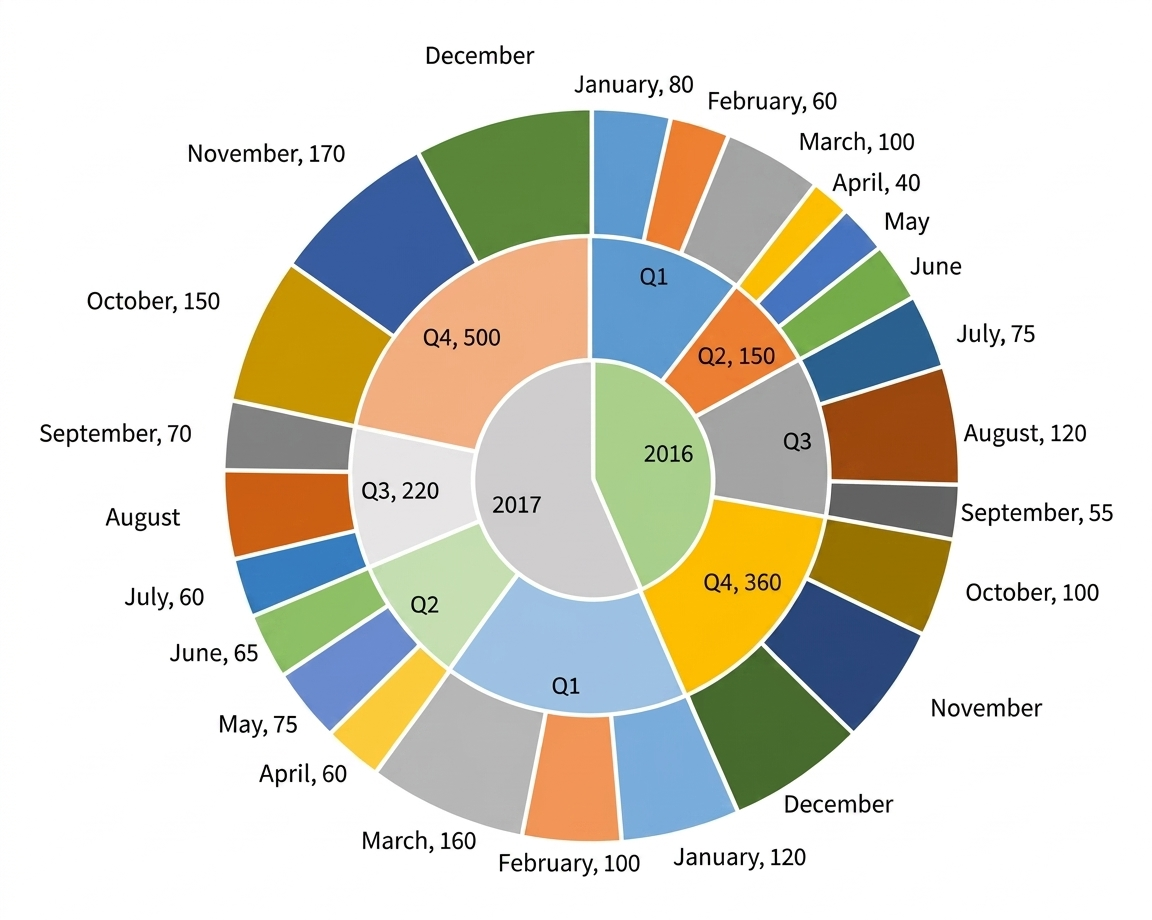
The multi-layered pie-chart below shows the sales of LED television sets for a big retail electronics outlet during 2016 and 2017. The outer layer shows the monthly sales during this period, with each label showing the month followed by sales figure of that month. For some months, the sales figures are not given in the chart. The middle-layer shows quarter-wise aggregate sales figures (in some cases, aggregate quarter-wise sales numbers are not given next to the quarter). The innermost layer shows annual sales. It is known that the sales figures during the three months of the second quarter (April, May, June) of 2016 form an arithmetic progression, as do the three monthly sales figures in the fourth quarter (October, November, December) of that year.

[Pie chart diagram showing sales data for 2016 and 2017]
DILR set, figure 1

Question 1 · TITA (type in the answer)

What is the percentage increase in sales in December 2017 as compared to the sales in December 2016?

Answer: 28.57

Solution
Fill missing monthly sales using given totals and arithmetic progressions.

2016 Q2: Total = 150, April = 40. May, June in AP with April → 40, 50, 60.
2016 Q4: Total = 360, Oct = 100. Oct, Nov, Dec in AP → 100, 120, 140.
2017 Q3: Total = 220, Jul = 60, Sep = 70 → Aug = 220 − 60 − 70 = 90.
2017 Q4: Total = 500, Oct = 150, Nov = 170 → Dec = 500 − 150 − 170 = 180.

December 2016 = 140, December 2017 = 180.

Percentage increase = \(\frac{180 - 140}{140} \times 100 = \frac{40}{140} \times 100 = \frac{200}{7} \approx 28.57%\).

Answer: 28.57

Question 2 · MCQ

In which quarter of 2017 was the percentage increase in sales from the same quarter of 2016 the highest?
  1. A.
    Q1
    ✓ Correct
  2. B.
    Q3
  3. C.
    Q4
  4. D.
    Q2
Solution
Compute quarterly totals for 2016 and 2017.
Quarter2016 Total2017 Total% Increase
Q1240380\(\frac{140}{240}\times100 = 58.33%\)
Q2150200\(\frac{50}{150}\times100 = 33.33%\)
Q3250220\(\frac{-30}{250}\times100 = -12%\)
Q4360500\(\frac{140}{360}\times100 \approx 38.89%\)
Highest percentage increase is in Q1 (≈58.33%).

The correct option is Q1, which corresponds to option 1.

Answer: 1
Quarter2016 Total2017 Total% Increase
Q1240380(140/240)×100 = 58.33%
Q2150200(50/150)×100 = 33.33%
Q3250220(−30/250)×100 = −12%
Q4360500(140/360)×100 ≈ 38.89%

Question 3 · MCQ

During which quarter was the percentage decrease in sales from the previous quarter's sales the highest?
  1. A.
    Q2 of 2017
    ✓ Correct
  2. B.
    Q1 of 2017
  3. C.
    Q4 of 2017
  4. D.
    Q2 of 2016
Solution
Complete missing month values using given totals and arithmetic progressions.
2016 Q2 (AP: 40, May, June, sum 150) → May = 50, June = 60.
2016 Q4 (AP: 100, Nov, Dec, sum 360) → Nov = 120, Dec = 140.
Quarterly sales:
2016: Q1 = 240, Q2 = 150, Q3 = 250, Q4 = 360
2017: Q1 = 380, Q2 = 200, Q3 = 220, Q4 = 500
Quarter-on-quarter decreases:
Q2 2016: \( \frac{240-150}{240} \times 100 \approx 37.5% \) decrease
Q2 2017: \( \frac{380-200}{380} \times 100 \approx 47.37% \) decrease
Other quarters show increases.
Highest percentage decrease is in Q2 2017.

Question 4 · MCQ

During which month was the percentage increase in sales from the previous month's sales the highest?
  1. A.
    March of 2017
  2. B.
    October of 2017
    ✓ Correct
  3. C.
    October of 2016
  4. D.
    March of 2016
Solution
Complete all monthly sales (same as above).
Month-on-month % increase (only positive changes):
Mar 2016: \( \frac{100-60}{60} \times 100 \approx 66.7% \)
Aug 2016: \( \frac{120-75}{75} \times 100 = 60% \)
Oct 2016: \( \frac{100-55}{55} \times 100 \approx 81.8% \)
Mar 2017: \( \frac{160-100}{100} \times 100 = 60% \)
Oct 2017: \( \frac{150-70}{70} \times 100 \approx 114.3% \)

Highest is October 2017 at ~114.3%.

QA · Quantitative Ability

Question 1 · TITA (type in the answer)

While multiplying three real numbers, Ashok took one of the numbers as 73 instead of 37. As a result, the product went up by 720. Then the minimum possible value of the sum of squares of the other two numbers is

Answer: 40

Solution
Let the other two numbers be \(a\) and \(b\). Ashok took one number as 73 instead of 37, so the product increased by \(ab(73-37)=36ab = 720\). Thus \(ab = 20\).
We need the minimum of \(a^2+b^2\). By AM–GM or the inequality \(a^2+b^2 \ge 2ab\), we get \(a^2+b^2 \ge 40\), with equality when \(a=b=\sqrt{20}\) (or both \(-\sqrt{20}\)). Minimum possible sum of squares is 40.

Question 2 · TITA (type in the answer)

The number of integers x such that \(0.25 < 2^x < 200\), and \(2^x +2\) is perfectly divisible by either 3 or 4, is

Answer: 5

Solution
From \(0.25 < 2^x < 200\):
\(2^x > 2^{-2} \Rightarrow x > -2\), so integer \(x \ge -1\).
\(2^x < 200\) and \(2^7=128,\;2^8=256\), so \(x \le 7\).
Thus possible integer \(x\): \(-1,0,1,\dots,7\).
For \(x=-1\), \(2^x+2 = 2.5\) not an integer, so cannot be divisible by 3 or 4.
For \(x\ge 0\): check \(2^x+2\):
\(x=0: 3\) (divisible by 3)
\(x=1: 4\) (divisible by 4)
\(x=2: 6\) (divisible by 3)
\(x=3: 10\) (neither)
\(x=4: 18\) (divisible by 3)
\(x=5: 34\) (neither)
\(x=6: 66\) (divisible by 3)
\(x=7: 130\) (neither)
Successful \(x\): \(0,1,2,4,6\) – total 5 integers.

Question 3 · MCQ

If among 200 students, 105 like pizza and 134 like burger, then the number of students who like only burger can possibly be
  1. A.
    93
    ✓ Correct
  2. B.
    26
  3. C.
    23
  4. D.
    96
Solution
Let \(x\) be the number who like both pizza and burger.

Only burger = \(134 - x\). Since total students = 200 and all counts must be non-negative, \(x \ge 39\) and \(x \le 105\).
Hence only burger lies between \(134 - 105 = 29\) and \(134 - 39 = 95\) (both inclusive).
Among the options, only 93 falls in this range.

Answer: 93.

Question 4 · TITA (type in the answer)

Each of 74 students in a class studies at least one of the three subjects H, E and P. Ten students study all three subjects, while twenty study H and E, but not P. Every student who studies P also studies H or E or both. If the number of students studying H equals that studying E, then the number of students studying H is

Answer: 52

Solution
Let \(a\) = only H, \(b\) = only H and E (not P) = 20, \(c\) = only H and P, \(d\) = all three = 10, \(e\) = only E, \(f\) = only E and P.
Since \(P \subseteq H \cup E\), there is no ‘only P’ region.
Total students: \(a+20+c+10+e+f = 74 \Rightarrow a+c+e+f = 44\).
Given \(n(H) = n(E)\): \(a+20+c+10 = e+20+10+f \Rightarrow a+c = e+f\).
Thus \(2(a+c) = 44 \Rightarrow a+c = 22\).
\(n(H) = a+c+30 = 22+30 = 52\).

Question 5 · TITA (type in the answer)

How many numbers with two or more digits can be formed with the digits 1,2,3,4,5,6,7,8,9, so that in every such number, each digit is used at most once and the digits appear in the ascending order?

Answer: 502

Solution
Any subset of digits from {1,2,…,9} of size \(k \ge 2\) gives exactly one valid number when arranged in ascending order.
Total subsets = \(2^9 = 512\).
Subtract subsets of size 0 and 1: \(\binom{9}{0} + \binom{9}{1} = 1+9 = 10\).
Required count = \(512 - 10 = 502\).

The other 54 questions are in the simulator

Sit CAT 2018 Slot 1 with the real exam's timer and interface, then see where your marks went: silly slips, traps, topics that cost you time, and the questions you should have skipped. Start with the free mock test: no payment needed.

Unlock this paper