
Official paper · included in Pro

CAT 2007 Question Paper with Solutions

68 questions in 120 minutes, in three timed sections. Below: how the paper is built, the topics each section tested, and a solved sample from every section. Take the whole paper in the simulator to get your Score Waterfall, Topic ROI Map and Strategic IQ.

Paper structure and topics

VARC

Verbal Ability & Reading Comprehension

24 questions · 24 MCQ · 0 TITA

  • Reading Comprehension · 12
  • Verbal Ability · 12

DILR

Data Interpretation & Logical Reasoning

22 questions · 22 MCQ · 0 TITA

  • Data Interpretation · 21
  • Logical Reasoning · 1

QA

Quantitative Ability

22 questions · 22 MCQ · 0 TITA

  • Arithmetic · 7
  • Algebra · 5
  • Data Sufficiency · 4
  • Modern Math · 3
  • Number System · 2
  • Geometry · 1

Sample questions with solutions

12 of the 68 questions: the first passage, the first DILR set and the first QA questions of the paper.

VARC · Verbal Ability & Reading Comprehension

Passage

Human Biology does nothing to structure human society: age may enfeeble us all, but cultures vary considerably in the prestige and power they accord to the elderly. Giving birth is a necessary condition for being a mother, but it is not sufficient. We expect mothers to behave in maternal ways and to display appropriately maternal sentiments. We prescribe a clutch of norms or rules that govern the role of a mother. That the social role is independent of the biological base can be demonstrated by going back three sentences. (giving birth is certainly not sufficient to be a mother but, as adoption and fostering show, it is not even necessary!

The fine detail of what is expected of a mother or a father or a dutiful son differs from culture to culture, but everywhere behaviour is coordinated by the reciprocal nature of roles. Husbands and wives, parents and children, employers and employees, waiters and customers, teachers and pupils, warlords and followers: each makes sense only in its relation to the other. The term ‘role’ is an appropriate one. because the metaphor of an actor in a play neatly expresses the rule-governed nature or scripted nature of much of social life and the sense that society is a joint production. Social life occurs only because people play their parts (and that is as true for war and conflicts as for peace and love) and those parts make sense only in the context of the overall show. The drama metaphor also reminds us of the artistic licence available to the players. We can play a part straight or, as the following from J.P. Sartre conveys, we can ham it up.

Let us consider this waiter in the café. His movement is quick and forward, a little too precise, a little too rapid. He comes towards the patrons with a step a little too quick. He bends forward a little too eagerly: his voice, his eyes express an interest a little too solicitous for the order of the customer. Finally there he returns, trying to imitate in his walk the inflexible stiffness of some kind of automation while carrying his tray with the recklessness of a tightropewalker…..All his behaviour seems to us a game….But what is he playing? We need not watch long before we can explain it: he is playing at being a waiter in a café.

The American sociologist Frying Goffman built an influential body of social analysis on elaborations of the metaphor of social life as drama. Perhaps his most telling point was that it is only through acting out a part that we express character. It is not enough to be evil or virtuous: we have to be seen to be evil or virtuous.

There is distinction between the roles we play and some underlying self. Here we might note that some roles are more absorbing than others. We would not be surprised by the waitress who plays the part in such a way as to signal to us that she is much more than her occupation. We would be surprised and offended by the father who played his part ‘tongue in cheek’. Some roles are broader and more far-reaching than others. Describing someone as a clergyman or faith healer would say far more about that person than describing someone as a bus driver.

Question 1 · MCQ

What is the thematic highlight of the passage?
  1. A.
    In the absence of strong biological linkages, reciprocal roles provide the mechanism for coordinating human behaviour.
    ✓ Correct
  2. B.
    In the absence of reciprocal roles, biological linkages provide the mechanism for coordinating human behaviour.
  3. C.
    Human behaviour is independent of biological linkages and reciprocal roles.
  4. D.
    Human behaviour depends on biological linkages and reciprocal roles.
  5. E.
    Reciprocal roles determine normative human behaviour in society.
Solution
The passage opens by asserting that “Human Biology does nothing to structure human society” and then explains that social behaviour is coordinated by the reciprocal nature of roles. The central theme is that in the absence of strong biological determinants, reciprocal roles (like husband‑wife, parent‑child) provide the mechanism for coordinating human behaviour. Option 1 captures this contrast and emphasis precisely.
Question 2 · MCQ

Which of the following would have been true if biological linkages structured human society?
  1. A.
    The role of mother would have been defined through her reciprocal relationship with her children.
  2. B.
    We would not have been offended by the father playing his role ‘tongue in cheek’.
    ✓ Correct
  3. C.
    Women would have adopted and fostered children rather than giving birth to them.
  4. D.
    Even if warlords were physically weaker than their followers, they would still dominate them.
  5. E.
    Waiters would have stronger motivation to serve their customers.
Solution
The passage argues that social roles are governed by norms independent of biology. If biological linkages structured society, roles would be biologically determined and not scripted performances. The author notes that we are “surprised and offended by the father who played his part ‘tongue in cheek’” because the father role is socially absorbing. If biology alone structured society, such a performance would not offend, because the role would just be a biological fact with no social expectations. Option 2 directly follows from this reasoning.

Question 3 · MCQ

It has been claimed in the passage that “some roles are more absorbing than others”. According to the passage, which of the following seem(s) appropriate reason(s) for such a claim?

A. Some roles carry great expectations from the society preventing manifestation of the true self.
B. Society ascribes so much importance to some roles that the conception of self may get aligned with the roles being performed.
C. Some roles require development of skill and expertise leaving little time for manifestation of self.
  1. A.
    A only
  2. B.
    B only
    ✓ Correct
  3. C.
    C only
  4. D.
    A & B
  5. E.
    B & C
Solution
The passage notes that “some roles are more absorbing than others” and illustrates this by saying describing a clergyman “would say far more about that person than describing someone as a bus driver.” This shows that society attaches greater importance to certain roles, leading the self to become aligned with the role. Reason B (society ascribes so much importance that the conception of self aligns with the role) matches this idea. Reason A is not mentioned— the passage does not say expectations prevent manifestation of self. Reason C is unsupported; no mention of skill or time.

DILR · Data Interpretation & Logical Reasoning

Set

Answer the following questions based on the information given below:

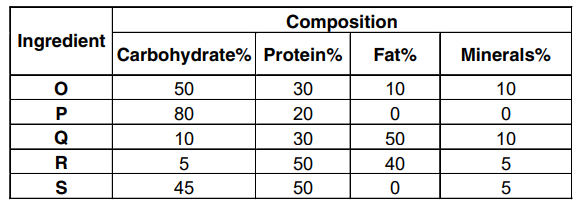
A health-drink company’s R&D department is trying to make various diet formulations, which can be used for certain specific purposes. It is considering a choice of 5 alternative ingredients (O, P, Q, R, and S), which can be used in different proportions in the formulations. The table below gives the composition of these ingredients. The cost per unit of each of these ingredients is O: 150, P: 50. Q: 200, R: 500, S: 100.
DILR set, figure 1

Question 1 · MCQ

For a recuperating patient, the doctor recommended a diet containing 10% minerals and at least 30% protein. In how many different ways can we prepare this diet by mixing at least two ingredients?
  1. A.
    One
    ✓ Correct
  2. B.
    Two
  3. C.
    Three
  4. D.
    Four
  5. E.
    None
Solution
To get exactly 10% minerals, the mixture must consist solely of ingredients with 10% minerals, because any ingredient with <10% minerals will lower the overall mineral content below 10%.

Ingredients with 10% minerals: O and Q.

Mixing O and Q in any proportion yields exactly 10% minerals and exactly 30% protein (since both have 30% protein). The protein requirement (≥30%) is satisfied exactly.

No other pair or combination of at least two ingredients can achieve 10% minerals. For example, mixing O or Q with any other ingredient reduces mineral% below 10%. Three or more ingredients cannot reach 10% because no ingredient has >10% minerals.

Thus, only one way exists: mixing O and Q.
IngredientMinerals%
O10
P0
Q10
R5
S5

Question 2 · MCQ

Which among the following is the formulation having the lowest cost per unit for a diet having 10% fat and at least 30% protein? (The diet has to be formed by mixing two ingredients).
  1. A.
    P and Q
  2. B.
    P and S
  3. C.
    P and R
  4. D.
    Q and S
    ✓ Correct
  5. E.
    R and S
Solution
We need exactly 10% fat and ≥30% protein from two‑ingredient mixtures. Test each option:
PairProportion to get 10% fatProtein%Cost per unit
P-Q20% Q, 80% P22%—
P-Simpossible (both 0% fat)——
P-R25% R, 75% P27.5%—
Q-S20% Q, 80% S46%120
R-S25% R, 75% S50%200
Only Q‑S and R‑S satisfy protein ≥30%. Their costs are 120 and 200 respectively.

Q‑S gives the lowest cost, so it is the answer.

Question 3 · MCQ

In what proportion P, Q and S should be mixed to make a diet having at least 60% carbohydrate at the lowest cost per unit?
  1. A.
    2:1:3
  2. B.
    4:1:2
  3. C.
    2:1:4
  4. D.
    3:1:2
  5. E.
    4:1:1
    ✓ Correct
Solution
We need to check each proposed ratio of P, Q, S for carbohydrate % and cost. The mixture's carbohydrate % = (80P + 10Q + 45S) / (P+Q+S) × 100. Cost per unit = (50P + 200Q + 100S) / (P+Q+S). Compute:
OptionRatio (P:Q:S)Total PartsCarbohydrate %Cost per UnitMeets ≥60%?
12:1:36(160+10+135)/6 = 50.83—No
24:1:27(320+10+90)/7 = 60.00600/7 ≈ 85.71Yes
32:1:47(160+10+180)/7 = 50.00—No
43:1:26(240+10+90)/6 = 56.67—No
54:1:16(320+10+45)/6 = 62.50500/6 ≈ 83.33Yes
Only Options 2 and 5 give at least 60% carbohydrate. Comparing costs, Option 5 (≈83.33) is cheaper than Option 2 (≈85.71). Hence the lowest-cost mixture is 4:1:1.
OptionRatio (P:Q:S)Total PartsCarbohydrate %Cost per UnitMeets ≥60%?
12:1:3650.83—No
24:1:2760.0085.71Yes
32:1:4750.00—No
43:1:2656.67—No
54:1:1662.5083.33Yes

Question 4 · MCQ

The company is planning to launch a balanced diet required for growth needs of adolescent children. This diet must contain at least 30% each of carbohydrate and protein, no more than 25% fat and at least 5% minerals. Which one of the following combinations of equally mixed ingredients is feasible?
  1. A.
    O and P
  2. B.
    R and S
  3. C.
    P and S
  4. D.
    Q and R
  5. E.
    O and S
    ✓ Correct
Solution
Each combination must be mixed equally (1:1). Compute the resulting percentages of carbohydrate, protein, fat, and minerals, and check against the limits: Carb ≥30%, Protein ≥30%, Fat ≤25%, Minerals ≥5%.
OptionPairCarb%Protein%Fat%Minerals%Result
1O & P(50+80)/2 = 65(30+20)/2 = 25(10+0)/2 = 5(10+0)/2 = 5Protein 25% < 30% (Fail)
2R & S(5+45)/2 = 25(50+50)/2 = 50(40+0)/2 = 20(5+5)/2 = 5Carb 25% < 30% (Fail)
3P & S(80+45)/2 = 62.5(20+50)/2 = 35(0+0)/2 = 0(0+5)/2 = 2.5Minerals 2.5% < 5% (Fail)
4Q & R(10+5)/2 = 7.5(30+50)/2 = 40(50+40)/2 = 45(10+5)/2 = 7.5Carb 7.5% < 30% (Fail)
5O & S(50+45)/2 = 47.5(30+50)/2 = 40(10+0)/2 = 5(10+5)/2 = 7.5All conditions met
Only O and S satisfy every requirement. Thus option 5 is correct.
OptionPairCarb%Protein%Fat%Minerals%Result
1O & P652555Protein < 30% (Fail)
2R & S2550205Carb < 30% (Fail)
3P & S62.53502.5Minerals < 5% (Fail)
4Q & R7.540457.5Carb < 30% (Fail)
5O & S47.54057.5All ok

QA · Quantitative Ability

Question 1 · MCQ

Ten years ago, the ages of the members of a joint family of eight people added up to 231 years. Three years later, one member died at the age of 60 years and a child was born during the same year. After another three years, one more member died, again at 60, and a child was born during the same year. The current average age of this eight-member joint family is nearest to
  1. A.
    23 years
  2. B.
    22 years
  3. C.
    21 years
  4. D.
    25 years
  5. E.
    24 years
    ✓ Correct
Solution
Ten years ago, total age of 8 members \(= 231\).
Three years later (7 years ago): all 8 age by 3 years \(\Rightarrow\) sum becomes \(231 + 8 \times 3 = 255\). One member dies at age 60 \((\Rightarrow -60)\) and a new-born is added \((\Rightarrow +0)\). New sum \(= 255 - 60 = 195\).
After another three years (4 years ago): the 8 members age by 3 years \(\Rightarrow\) sum becomes \(195 + 8 \times 3 = 219\). Again one dies at 60 \((\Rightarrow -60)\) and a baby is born \((\Rightarrow +0)\). New sum \(= 219 - 60 = 159\).
From 4 years ago to now: the 8 members age by 4 years \(\Rightarrow\) sum becomes \(159 + 8 \times 4 = 191\).
Current average age \(= \frac{191}{8} = 23.875\), which is nearest to 24 years.

Question 2 · MCQ

A function \(f(x)\) satisfies \(f(1) = 3600\) and \(f(1) + f(2) + \dots + f(n) = n^2 f(n)\), for all positive integers \(n > 1\). What is the value of \(f(9)\)?
  1. A.
    80
    ✓ Correct
  2. B.
    240
  3. C.
    200
  4. D.
    100
  5. E.
    120
Solution
Let \(S(n) = \sum_{k=1}^n f(k) = n^2 f(n)\) for \(n>1\).
For \(n-1>1\), \(S(n-1) = (n-1)^2 f(n-1)\).
Then \(f(n) = S(n) - S(n-1) = n^2 f(n) - (n-1)^2 f(n-1)\).
Rearranging: \((n^2-1)f(n) = (n-1)^2 f(n-1)\) \(\Rightarrow (n+1)f(n) = (n-1)f(n-1)\).
So \(f(n) = \frac{n-1}{n+1} f(n-1)\).
Iterating: \(f(n) = f(1) \prod_{k=2}^n \frac{k-1}{k+1} = f(1) \cdot \frac{2}{n(n+1)}\).
Given \(f(1)=3600\), \(f(n) = \frac{7200}{n(n+1)}\).
For \(n=9\), \(f(9) = \frac{7200}{9 \times 10} = 80\).

Question 3 · MCQ

Suppose you have a currency, named Miso, in three denominations: 1 Miso, 10 Misos and 50 Misos. In how many ways can you pay a bill of 107 Misos?
  1. A.
    17
  2. B.
    16
  3. C.
    18
    ✓ Correct
  4. D.
    15
  5. E.
    19
Solution
Let the number of 50 Miso coins be \(a\), 10 Miso be \(b\), and 1 Miso be \(c\). We need \(50a + 10b + c = 107\), with \(a,b,c \ge 0\) integers.

\(a\) can be 0, 1, or 2.
  • If \(a=0\): \(10b+c=107\) → \(b\) can be 0 to 10 → 11 ways.
  • If \(a=1\): \(10b+c=57\) → \(b\) can be 0 to 5 → 6 ways.
  • If \(a=2\): \(10b+c=7\) → \(b=0\) only → 1 way.
Total = \(11+6+1 = 18\).

Question 4 · MCQ

A confused bank teller transposed the rupees and paise when he cashed a cheque for Shailaja, giving her rupees instead of paise and paise instead of rupees. After buying a toffee for 50 paise, Shailaja noticed that she was left with exactly three times as much as the amount on the cheque. Which of the following is a valid statement about the cheque amount?
  1. A.
    Over Rupees 13 but less than Rupees 14
  2. B.
    Over Rupees 7 but less than Rupees 8
  3. C.
    Over Rupees 22 but less than Rupees 23
  4. D.
    Over Rupees 18 but less than Rupees 19
    ✓ Correct
  5. E.
    Over Rupees 4 but less than Rupees 5
Solution
Let the cheque amount be \(\text{₹}X\) and \(Y\) paise, i.e., \(100X + Y\) paise.

Transposed amount received: \(100Y + X\) paise.

After buying a toffee for 50 paise: \(100Y + X - 50\) paise left.

This equals three times the cheque amount:
\(100Y + X - 50 = 3(100X + Y)\)

Simplify: \(97Y - 299X = 50\)

\(X = \frac{97Y - 50}{299}\)

Since \(X\) must be an integer with \(0 \le Y < 100\), solve \(97Y \equiv 50 \ (\text{mod}\ 299)\). The inverse of 97 mod 299 is 37, so \(Y \equiv 37 \times 50 \equiv 56 \ (\text{mod}\ 299)\). Thus \(Y = 56\).

Then \(X = \frac{97 \times 56 - 50}{299} = \frac{5432 - 50}{299} = \frac{5382}{299} = 18\).

Cheque amount = ₹18.56, which lies between ₹18 and ₹19.

Question 5 · MCQ

How many pairs of positive integers \(m, n\) satisfy \(\frac{1}{m} + \frac{4}{n} = \frac{1}{12}\), where, \(n\) is an odd integer less than 60?
  1. A.
    6
  2. B.
    4
  3. C.
    7
  4. D.
    5
  5. E.
    3
    ✓ Correct
Solution
From \(\frac{1}{m} + \frac{4}{n} = \frac{1}{12}\) we get \(m = \frac{12n}{n-48}\).
For \(m > 0\) integer, \(n > 48\). \(n\) odd and \(< 60\) gives candidates: 49, 51, 53, 55, 57, 59.
Check each:
\(n=49 \Rightarrow m=588\) (valid)
\(n=51 \Rightarrow m=204\) (valid)
\(n=53 \Rightarrow m=127.2\) (invalid)
\(n=55 \Rightarrow m \approx 94.28\) (invalid)
\(n=57 \Rightarrow m=76\) (valid)
\(n=59 \Rightarrow m \approx 64.36\) (invalid)
3 pairs satisfy; option 5.

The other 56 questions are in the simulator

Sit CAT 2007 with the real exam's timer and interface, then see where your marks went: silly slips, traps, topics that cost you time, and the questions you should have skipped. Start with the free mock test: no payment needed.

Unlock this paper