
Official paper · included in Pro

CAT 2005 Question Paper with Solutions

68 questions in 120 minutes, in three timed sections. Below: how the paper is built, the topics each section tested, and a solved sample from every section. Take the whole paper in the simulator to get your Score Waterfall, Topic ROI Map and Strategic IQ.

Paper structure and topics

VARC

Verbal Ability & Reading Comprehension

24 questions · 24 MCQ · 0 TITA

  • Reading Comprehension · 12
  • Verbal Ability · 12

DILR

Data Interpretation & Logical Reasoning

22 questions · 22 MCQ · 0 TITA

  • Data Interpretation · 11
  • Logical Reasoning · 11

QA

Quantitative Ability

22 questions · 22 MCQ · 0 TITA

  • Arithmetic · 10
  • Algebra · 9
  • Geometry · 3

Sample questions with solutions

13 of the 68 questions: the first passage, the first DILR set and the first QA questions of the paper.

VARC · Verbal Ability & Reading Comprehension

Passage

A game of strategy, as currently conceived in game theory, is a situation in which two or more “players” make choices among available alternatives (moves). The totality of choices determines the outcomes of the game, and it is assumed that the rank order of preferences for the outcomes is different for different players. Thus the “interests” of the players are generally in conflict. Whether these interests are diametrically opposed or only partially opposed depends on the type of game.

Psychologically, most interesting situations arise when the interests of the players are partly coincident and partly opposed, because then one can postulate not only a conflict among the players but also inner conflicts within the players. Each is torn between a tendency to cooperate, so as to promote the common interests, and a tendency to compete, so as to enhance his own individual interests.

Internal conflicts are always psychologically interesting. What we vaguely call “interesting” psychology is in very great measure the psychology of inner conflict. Inner conflict is also held to be an important component of serious literature as distinguished from less serious genres. The classical tragedy, as well as the serious novel reveals the inner conflict of central figures. The superficial adventure story on the other hand, depicts only external conflict; that is, the threats to the person with whom the reader (or viewer) identifies stem in these stories exclusively from external obstacles and from the adversaries who create them. On the most primitive level this sort of external conflict is psychologically empty. In the fisticuffs between the protagonists of good and evil, no psychological problems are involved or, at any rate, none are depicted in juvenile representations of conflict.

The detective story, the “adult” analogue of a juvenile adventure tale, has at times been described as a glorification of intellectualized conflict. However, a great deal of the interest in the plots of these stories is sustained by withholding the unraveling of a solution to a problem. The effort of solving the problem is in itself not a conflict if the adversary (the unknown criminal) remains passive, like Nature, whose secrets the scientist supposedly unravels by deduction. If the adversary actively puts obstacles in the detective’s path toward the solution, there is genuine conflict. But the conflict is psychologically interesting only to the extent that it contains irrational components such as a tactical error on the criminal’s part or the detective’s insight into some psychological quirk of the criminal or something of this sort. Conflict conducted in a perfectly rational manner is psychologically no more interesting than a standard Western. For example, Tic-tac-toe, played perfectly by both players, is completely devoid of psychological interest. Chess may be psychologically interesting but only to the extent that it is played not quite rationally. Played completely rationally, chess would not be different from Tic-tac-toe.

In short, a pure conflict of interest (what is called a zero-sum game) although it offers a wealth of interesting conceptual problems, is not interesting psychologically, except to the extent that its conduct departs from rational norms.

Question 1 · MCQ

According to the passage, internal conflicts are psychologically more interesting than external conflicts because
  1. A.
    internal conflicts, rather than external conflicts, form an important component of serious literature as distinguished from less serious genres.
  2. B.
    only juveniles or very few “adults” actually experience external conflict, while internal conflict is more widely prevalent in society.
  3. C.
    in situations of internal conflict, individuals experience a dilemma in resolving their own preferences for different outcomes.
    ✓ Correct
  4. D.
    there are no threats to the reader (or viewer) in case of external conflicts.
Solution
The passage states that internal conflicts are psychologically interesting because the individual is torn between tendencies to cooperate and compete, i.e., experiences a dilemma in resolving preferences ("inner conflicts within the players. Each is torn..."). Option 3 directly captures this dilemma. Option 1 uses serious literature as an example, not the core reason. Options 2 and 4 are not supported by the passage.
Question 2 · MCQ

Which, according to the author, would qualify as interesting psychology?
  1. A.
    A statistician’s dilemma over choosing the best method to solve an optimization problem.
  2. B.
    A chess player’s predicament over adopting a defensive strategy against an aggressive opponent.
    ✓ Correct
  3. C.
    A mountaineer’s choice of the best path to Mt. Everest from the base camp.
  4. D.
    A finance manager’s quandary over the best way of raising money from the market.
Solution
The author says conflict is psychologically interesting only when it contains irrational components or is not played completely rationally. Chess is explicitly mentioned as potentially interesting if played not quite rationally. A chess player's predicament over adopting a defensive strategy against an aggressive opponent introduces psychological, non‑purely‑rational elements, fitting this criterion. The other options describe rational decision‑making without such irrational components.

Question 3 · MCQ

According to the passage, which of the following options about the application of game theory to a conflict-of-interest situation is true?
  1. A.
    Assuming that the rank order of preferences for options is different for different players.
  2. B.
    Accepting that the interests of different players are often in conflict.
  3. C.
    Not assuming that the interests are in complete disagreement.
  4. D.
    All of the above.
    ✓ Correct
Solution
The passage explicitly states: (i) "it is assumed that the rank order of preferences for the outcomes is different for different players" – option 1; (ii) "Thus the 'interests' of the players are generally in conflict" – option 2; and (iii) "Whether these interests are diametrically opposed or only partially opposed depends on the type of game" – meaning they are not assumed to be in complete disagreement – option 3. Hence all three are true.

Question 4 · MCQ

The problem solving process of a scientist is different from that of a detective because
  1. A.
    scientists study inanimate objects, while detectives deal with living criminals or law offenders.
  2. B.
    scientists study known objects, while detectives have to deal with unknown criminals or law offenders.
  3. C.
    scientists study phenomena that are not actively altered, while detectives deal with phenomena that have been deliberately influenced to mislead.
    ✓ Correct
  4. D.
    scientists study psychologically interesting phenomena, while detectives deal with “adult” analogues of juvenile adventure tales.
Solution
The passage compares the detective's criminal adversary to a passive Nature faced by a scientist: if the adversary remains passive there is no conflict, but if they actively put obstacles, there is genuine conflict. Thus the scientist works with phenomena not actively altered, while the detective may deal with phenomena deliberately influenced to mislead. Option 3 reflects this distinction. The other options are not supported by the passage.

DILR · Data Interpretation & Logical Reasoning

Set

Answer the questions on the basis of the information given below:
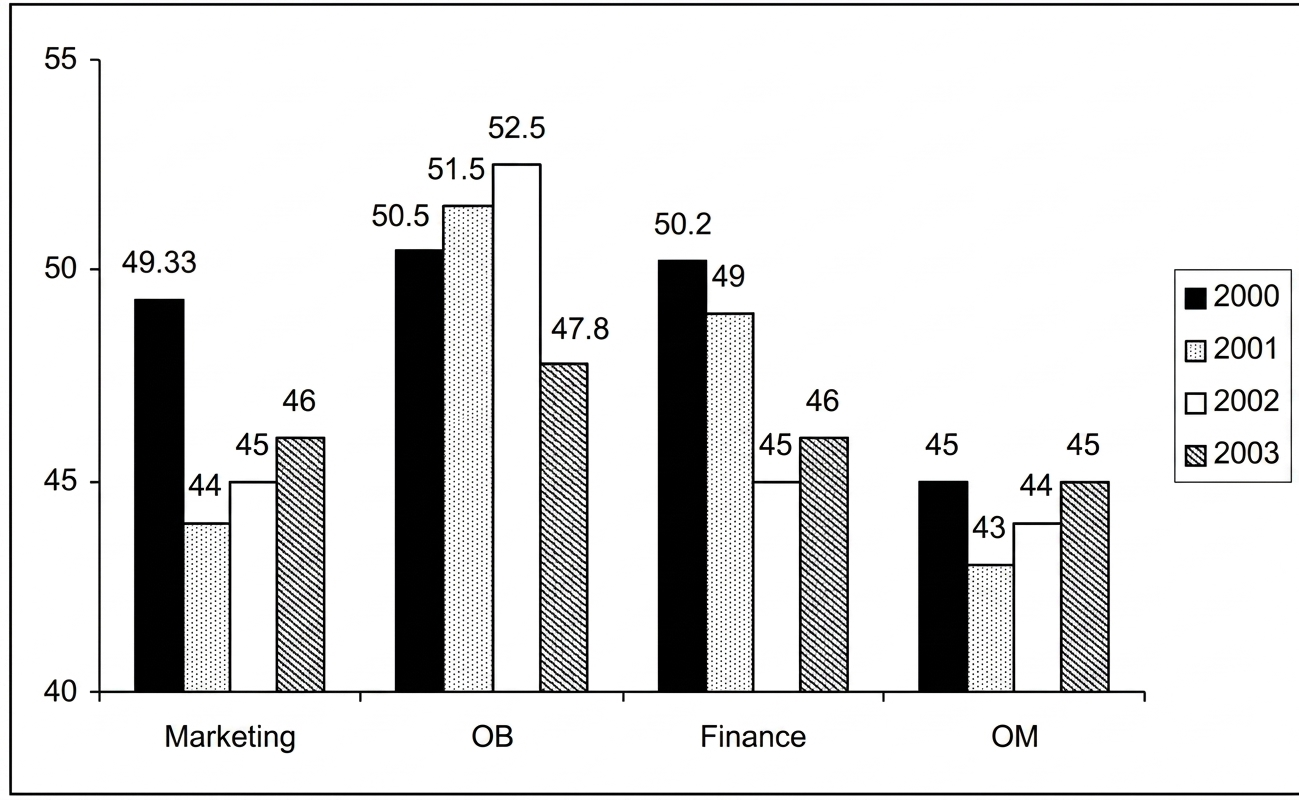
A management institute was established on January 1, 2000 with 3, 4, 5, and 6 faculty members in the Marketing, Organisational Behaviour (OB), Finance, and Operations Management (OM) areas respectively, to start with. No faculty member retired or joined the institute in the first three months of the year 2000. In the next four years, the institute recruited one faculty member in each of the four areas. All these new faculty members, who joined the institute subsequently over the years, were 25 years old at the time of their joining the institute. All of them joined the institute on April 1. During these four years, one of the faculty members retired at the age of 60. The following diagram gives the area-wise average age (in terms of number of completed years) of faculty members as on April 1 of 2000, 2001, 2002, and 2003.

[See chart in image]
DILR set, figure 1

Question 1 · MCQ

From which area did the faculty member retire?
  1. A.
    Finance
    ✓ Correct
  2. B.
    Marketing
  3. C.
    OB
  4. D.
    OM
Solution
From the initial faculty counts and average ages on 1 Apr 2000, compute the initial age-sum for each area.
AreaN(2000)Avg(2000)Sum(2000)
Marketing349.33148
OB450.50202
Finance550.20251
OM645.00270
Trace year-wise changes:
  • Marketing: in 2001, a new 25-year-old joins → sum becomes 148 + 3×1 + 25 = 176, N=4, avg=44 (matches). No other change.
  • OB: averages 50.5→51.5→52.5 (pure aging). In 2003, a new 25-year-old joins → sum 202+4×3 +25 = 239, N=5, avg=47.8 (matches).
  • Finance: in 2001, avg=49. If one faculty (age 59 in 2000) retired after 1 Apr 2000, remaining 4 sum = 251 – 59 + 4 = 196, avg=49 (matches). In 2002, a new 25-year-old joins → sum 196+4+25=225, N=5, avg=45 (matches).
  • OM: in 2001, a new 25-year-old joins → sum 270+6+25=301, N=7, avg=43 (matches).
Only Finance shows a retirement (option 1).

Question 2 · MCQ

Professors Naresh and Devesh, two faculty members in the Marketing area, who have been with the Institute since its inception, share a birthday, which falls on 20th November. One was born in 1947 and the other one in 1950. On April 1 2005, what was the age of the third faculty member, who has been in the same area since inception?
  1. A.
    47
  2. B.
    50
  3. C.
    51
  4. D.
    52
    ✓ Correct
Solution
The original Marketing trio sum to 148 years on 1 Apr 2000 (avg 49.33).

Naresh (born 1947) and Devesh (born 1950) both celebrate their birthday on 20 Nov, which is after 1 Apr. Hence, their completed ages on 1 Apr 2000 are:
  • Born 1947 → 2000 – 1947 – 1 = 52
  • Born 1950 → 2000 – 1950 – 1 = 49
52 + 49 = 101. Let the third member’s age be \(x\):
\(101 + x = 148 \Rightarrow x = 47\).

Since the member’s age on 1 Apr 2000 is 47 completed years, his/her birthday falls on or before 1 Apr. Over the next five years, on each 1 Apr the age increments by exactly 1. On 1 Apr 2005, the age is \(47 + 5 = 52\) (option 4).

Question 3 · MCQ

In which year did the new faculty member join the Finance area?
  1. A.
    2000
  2. B.
    2001
  3. C.
    2002
    ✓ Correct
  4. D.
    2003
Solution
Initial counts and average ages: Marketing 3 (49.33), OB 4 (50.5), Finance 5 (50.2), OM 6 (45).
Finance: 2000 total = 5×50.2 = 251.
2001 avg=49 → a retirement occurred (person aged 59 on 1 Apr 2000 retired at 60). Count becomes 4, total = 251 + 5 (aging) − 59 − 1? Wait: simpler: total in 2001 without the retired = (251 − 59) + 4 = 196, avg=49.
2002 avg=45 → a new 25‑year‑old joined on 1 Apr 2002. Count=5, total = 196 + 4 (aging of the 4) + 25 = 225, avg=45.
2003 avg=46 confirms.
Hence new Finance faculty joined in 2002.

Question 4 · MCQ

What was the age of the new faculty member, who joined the OM area, as on April 1, 2003?
  1. A.
    25
  2. B.
    26
  3. C.
    27
    ✓ Correct
  4. D.
    28
Solution
OM: 2000 total = 6×45 = 270.
2001 avg=43 → a new 25‑year‑old joined on 1 Apr 2001. Count=7, total = 270 + 6 (aging of the 6) + 25 = 301, avg=43.
2002 avg=44, 2003 avg=45 confirm no further changes.
So OM new faculty joined on 1 Apr 2001 at age 25.
On 1 Apr 2003, age = 25 + 2 = 27.

QA · Quantitative Ability

Question 1 · MCQ

If \(x = (16^3 + 17^3 + 18^3 + 19^3)\), then \(x\) divided by 70 leaves a remainder of
  1. A.
    0
    ✓ Correct
  2. B.
    1
  3. C.
    69
  4. D.
    35
Solution
Sum the cubes:
\(16^3=4096,\; 17^3=4913,\; 18^3=5832,\; 19^3=6859\)
Total \(x = 4096+4913+5832+6859 = 21700\)
\(21700 \div 70 = 310\) exactly, remainder \(0\).

Question 2 · MCQ

A chemical plant has four tanks (A, B, C and D), each containing 1000 litres of a chemical. The chemical is being pumped from one tank to another as follows.
From A to B @ 20 litres/minute
From C to A @ 90 litres/minute
From A to D @ 10 litres/minute
From C to D @ 50 litres/minute
From B to C @ 100 litres/minute
From D to B @ 110 litres/minute

Which tank gets emptied first, and how long does it take (in minutes) to get empty after pumping starts?
  1. A.
    A, 16.66
  2. B.
    C, 20
  3. C.
    D, 20
    ✓ Correct
  4. D.
    D, 25
Solution
Compute net flow rates for each tank:
TankInflow (L/min)Outflow (L/min)Net (L/min)
A90 (C→A)20 (A→B) + 10 (A→D)+60
B20 (A→B) + 110 (D→B)100 (B→C)+30
C100 (B→C)90 (C→A) + 50 (C→D)-40
D10 (A→D) + 50 (C→D)110 (D→B)-50
Only C and D have net outflow. D empties at 50 L/min, so time = \(1000/50 = 20\) min. C takes \(1000/40 = 25\) min. Hence tank D empties first, in 20 minutes.

Question 3 · MCQ

Two identical circles intersect so that their centers, and the points at which they intersect, form a square of side 1 cm. The area in sq. cm of the portion that is common to the two circles is
  1. A.
    \(\frac{\pi}{4}\)
  2. B.
    \(\frac{\pi}{2} - 1\)
    ✓ Correct
  3. C.
    \(\frac{\pi}{5}\)
  4. D.
    \(\sqrt{2} - 1\)
Solution
Let radius = \(r\). Centers and intersection points form a square of side 1 cm, so \(r = 1\).
Distance between centers = \(\sqrt{2}\) (diagonal of square).
Angle subtended by common chord at center: \(\theta = 2 \arccos(d/(2r)) = 2 \arccos(\sqrt{2}/2) = \pi/2\).
Common area = \(r^2(\theta - \sin\theta) = 1\cdot(\pi/2 - 1) = \pi/2 - 1\).
Hence option (2).

Question 4 · MCQ

A jogging park has two identical circular tracks touching each other, and a rectangular track enclosing the two circles. The edges of the rectangles are tangential to the circles. Two friends, A and B, start jogging simultaneously from the point where one of the circular tracks touches the smaller side of the rectangular track. A jogs along the rectangular track, while B jogs along the two circular tracks in a figure of eight. Approximately, how much faster than A does B have to run, so that they take the same time to return to their starting point?
  1. A.
    3.88%
  2. B.
    4.22%
  3. C.
    4.44%
  4. D.
    4.72%
    ✓ Correct
Solution
Let radius of each circle = \(r\).
Rectangle dimensions: length = \(4r\), breadth = \(2r\).
Rectangle perimeter = \(2(4r+2r) = 12r\).
Figure-of-eight path on two circles = \(2 \times\) circumference = \(4\pi r\).
Speed ratio \(v_B/v_A\) = distance ratio = \(4\pi r/12r = \pi/3\).
Percentage faster = \((\pi/3 - 1) \times 100% \approx 4.72%\).
Hence option (4).

Question 5 · MCQ

In a chess competition involving some boys and girls of a school, every student had to play exactly one game with every other student. It was found that in 45 games both the players were girls, and in 190 games both were boys. The number of games in which one player was a boy and the other was a girl is
  1. A.
    200
    ✓ Correct
  2. B.
    216
  3. C.
    235
  4. D.
    256
Solution
Let number of girls = \(g\), boys = \(b\).
\(\binom{g}{2} = 45 \Rightarrow g(g-1) = 90 \Rightarrow g = 10\)
\(\binom{b}{2} = 190 \Rightarrow b(b-1) = 380 \Rightarrow b = 20\)
Mixed games = \(g \times b = 10 \times 20 = 200\)

The other 55 questions are in the simulator

Sit CAT 2005 with the real exam's timer and interface, then see where your marks went: silly slips, traps, topics that cost you time, and the questions you should have skipped. Start with the free mock test: no payment needed.

Unlock this paper