
Official paper · included in Pro

CAT 2004 Question Paper with Solutions

68 questions in 120 minutes, in three timed sections. Below: how the paper is built, the topics each section tested, and a solved sample from every section. Take the whole paper in the simulator to get your Score Waterfall, Topic ROI Map and Strategic IQ.

Paper structure and topics

VARC

Verbal Ability & Reading Comprehension

24 questions · 24 MCQ · 0 TITA

  • Reading Comprehension · 17
  • Verbal Ability · 7

DILR

Data Interpretation & Logical Reasoning

22 questions · 22 MCQ · 0 TITA

  • Data Interpretation · 16
  • Logical Reasoning · 6

QA

Quantitative Ability

22 questions · 22 MCQ · 0 TITA

  • Arithmetic · 8
  • Algebra · 6
  • Geometry · 3
  • Number System · 3
  • Modern Math · 2

Sample questions with solutions

14 of the 68 questions: the first passage, the first DILR set and the first QA questions of the paper.

VARC · Verbal Ability & Reading Comprehension

Passage

The painter is now free to paint anything he chooses. They are scarcely any forbidden subjects, and today everybody is prepared to admit that a painting of some fruit can be as important as a painting of a hero dying. The Impressionists did as much as anybody to win this previously unheard-of freedom for the artist. Yet, by the next generation, painters began to abandon the subject altogether, and began to paint abstract pictures. Today the majority of pictures painted are abstract.

Is there a connection between these two developments? Has art gone abstract because the artist is embarrassed by his freedom? Is it that, because he is free to paint anything, he doesn't know what to paint? Apologists for abstract art often talk of it as the art of maximum freedom. But could this be the freedom of the desert island? It would take to long to answer these questions properly. I believe there is a connection. Many things have encouraged the development of abstract art. Among them has been the artists' wish to avoid the difficulties of finding subjects when all subjects are equally possible.

I raise the matter now because I want to draw attention to the fact that the painter's choice of a subject is a far more complicated question than it would at first seem. A subject does not start with what is put in front of the easel or with something which the painter happens to remember. A subject starts with the painter deciding he would like to paint such-and-such because for some reason or other he finds it meaningful. A subject begins when the artist selects something for special mention. (What makes it special or meaningful may seem to the artist to be purely visual – its colours or its form.) When the subject has been selected, the function of the painting itself is to communicate and justify the significance of that selection.

It is often said today that subject matter is unimportant. But this is only a reaction against the excessively literary and moralistic interpretation of subject matter in the nineteenth century. In truth the subject is literary the beginning and end of a painting. The painting begins with a selection (I will paint this and not everything else in the world); it is finished when that selection is justified (now you can see all that I saw and felt in this and how it is more than merely itself).

Thus, for a painting to succeed it is essential that the painter and his public agree about what is significant. The subject may have a personal meaning for the painter or individual spectator; but there must also be the possibility of their agreement on its general meaning. It is at this point that the culture of the society and period in question precedes the artist and his art. Renaissance art would have meant nothing to the Aztecs -and vice versa. If, to some extent, a few intellectuals can appreciate them both today it is because their culture is an historical one; its inspiration is history and therefore it can include within itself, in principle if not in every particular, all known developments to date.

When a culture is secure and certain of its values, it presents it presents its artists with subjects. The general agreement about what is significant is so well established that the significance of a particular subject accrues and becomes traditional. This is true, for instance, of reeds and water in China, of the nude body in Renaissance, of the animal in Africa. Furthermore, in such cultures the artist is unlikely to be a free agent: he will be employed for the sake of particulars subjects, and the problem, as we have just described it, will not occur to him.

When a culture is in a state of disintegration or transition the freedom of the artist increases – but the question of subject matter becomes problematic for him: he, himself, has to choose for society. This was at the basis of all the increasing, crises in European art during the nineteenth century. It is too often forgotten how many of the art scandals of that time were provoked by the choice of subject (Gericault, Courbet, Daumier, Degas, Lautrec, Van Gogh, etc.).

By the end of the nineteenth century there were, roughly speaking, two ways in which the painter could meet this challenge of deciding what to paint and so choosing for society. Either he identified himself with the people and so allowed their lives to dictate his subjects to him; or he had to find his subjects within himself as painter. By people I mean everybody except the bourgeoisie. Many painters did of course work of the bourgeoisie according to their copy-book of approved subjects, but all of them, filling the Salon and the Royal Academy year after year, are now forgotten, buried under the hypocrisy of those they served so sincerely.

Question 1 · MCQ

When a culture is insecure, the painter chooses his subject on the basis of:
  1. A.
    The prevalent style in the society of his time.
  2. B.
    Its meaningfulness to the painter.
    ✓ Correct
  3. C.
    What is put in front of the easel.
  4. D.
    Past experience and memory of the painter
Solution
When culture disintegrates, the artist must choose for society (para 7). The choice originates from what the painter finds meaningful (para 3). Thus, meaningfulness to the painter is the basis.
Question 2 · MCQ

In the sentence, “I believe there is a connection” (second paragraph), what two developments is the author referring to?
  1. A.
    Painters using a dying hero and using a fruit as a subject of painting.
  2. B.
    Growing success of painters and an increase in abstract forms.
  3. C.
    Artists gaining freedom to choose subjects and abandoning subjects altogether.
    ✓ Correct
  4. D.
    Rise of Impressionists and an increase in abstract forms.
Solution
The first development is artists gaining the freedom to paint any subject (won by the Impressionists). The second is painters abandoning subjects altogether and turning to abstract art. The sentence refers to the connection between these two shifts described in the opening paragraphs.

Question 3 · MCQ

Which of the following is NOT necessarily among the attributes needed for a painter to succeed:
  1. A.
    The painter and his public agree on what is significant.
  2. B.
    The painting is able to communicate and justify the significance of its subject selection.
  3. C.
    The subject has a personal meaning for the painter.
    ✓ Correct
  4. D.
    The painting of subjects is inspired by historical developments.
Solution
The passage states that a subject “may have a personal meaning for the painter” but the essential requirement is agreement on its general meaning (para 4). Therefore, personal meaning is not a necessary attribute for success.

Question 4 · MCQ

In the context of the passage, which of the following statements would NOT be true?
  1. A.
    Painters decided subjects based on what they remembered from their own lives.
    ✓ Correct
  2. B.
    Painters of reeds and water in China faced no serious problem of choosing a subject.
  3. C.
    The choice of subject was a source of scandals in nineteenth century European art.
  4. D.
    Agreement on the general meaning of a painting is influenced by culture and historical context.
Solution
The passage directly contradicts this: “A subject does not start with what is put in front of the easel or with something which the painter happens to remember” (para 3). Hence, painters did not base subject choices simply on memories.

Question 5 · MCQ

Which of the following views is taken by the author?
  1. A.
    The more insecure a culture, the greater the freedom of the artist.
    ✓ Correct
  2. B.
    The more secure a culture, the greater the freedom of the artist.
  3. C.
    The more secure a culture, more difficult the choice of subject.
  4. D.
    The more insecure a culture, the less significant the choice of the subject.
Solution
The author states, “When a culture is in a state of disintegration or transition the freedom of the artist increases” (para 7). This directly supports the view that greater cultural insecurity leads to greater artistic freedom.

DILR · Data Interpretation & Logical Reasoning

Set

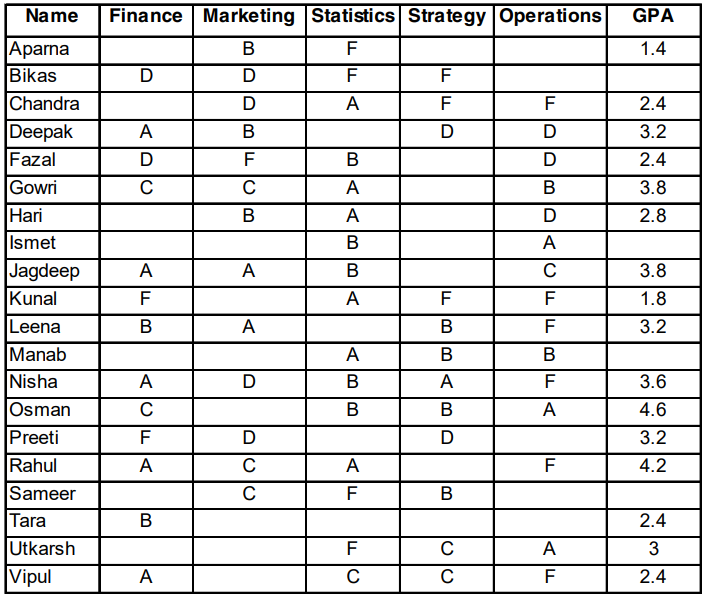
The Dean's office recently scanned student results into the central computer system. When their character reading software cannot read something, it leaves the space blank. The scanner output reads as follows:
[See table in image]
DILR set, figure 1

Question 1 · MCQ

What grade did Preeti obtain in Statistics?
  1. A.
    A
    ✓ Correct
  2. B.
    B
  3. C.
    C
  4. D.
    D
Solution
Using the given conditions, we deduce the complete table:
NameFinanceMarketingStatisticsOperations
PreetiBDAC
MohitD-CF
TaraBADB
HariC-BD
JagdeepACAA
ManabF-BB
IsmetAFBC
Finance: Exactly two males get A → Jagdeep, Ismet are A. Exactly two females get B → Preeti, Tara are B.
Operations: Jagdeep same in Finance & Operations → Ops A. Males Ops all distinct: Hari D, Manab B → Mohit, Ismet take C, F. No same Stat & Ops: Mohit Stat C → Mohit Ops F, Ismet Ops C.
Statistics: Exactly three males B. Ismet B → Hari, Manab also B. At least one female A. No same Marketing & Statistics: Tara Mkt A → Tara cannot be A. So Preeti must be the female A. Hence Preeti’s Statistics grade is A.

Question 2 · MCQ

In operations, Tara could have received the same grade as
  1. A.
    Ismet
  2. B.
    Hari
  3. C.
    Jagdeep
  4. D.
    Manab
    ✓ Correct
Solution
Continuing from previous deductions and the filled table:
  • Statistics: Preeti A, Mohit C, Jagdeep A, Hari B, Manab B, Ismet B. No F in Statistics → Tara must take D. So Tara Stat = D.
  • Operations: Preeti cannot have A (Stat A), D (Mkt D), F (no female F) or B (Fin B, Fin‑Ops no same) → Preeti Ops = C.
  • Female Ops are distinct, so Tara ≠ C. Also Tara cannot be A (Mkt A), cannot be F, and because her Statistics is D, Stat‑Ops no same prevents her from taking D. Hence Tara Ops = B.
Among the given options, only Manab (B) matches Tara’s Operations grade. So Tara could have received the same grade as Manab.

Question 3 · MCQ

In Strategy, Gowri's grade point was higher than that obtained by
  1. A.
    Fazal
  2. B.
    Hari
    ✓ Correct
  3. C.
    Nisha
  4. D.
    Rahul
Solution
Decode grade points: each grade corresponds to a numeric point. Using the given GPAs, the only mapping that satisfies all rows is A = 6, B = 4, C = 3, D = 2, F = 0.

• Gowri: Finance C (3), Marketing C (3), Statistics A (6), Operations B (4) → subtotal 16 → missing Strategy = 19 − 16 = 3 → Strategy point = 3.

• Compare with the grade points of the four students in Strategy:
– Fazal: known D,F,B,D → subtotal 8 → Strategy = 4.
– Hari: known B,A,D → subtotal 12 → Finance + Strategy = 2 → possible (D,F) or (F,D) → max Strategy = 2.
– Nisha: A,D,B,A,F → all known → Strategy = A = 6.
– Rahul: A,C,A,F → subtotal 15 → Strategy = 6.

Gowri’s point (3) is higher only than Hari’s (max 2).
Answer: option 2 (Hari).

Question 4 · MCQ

What grade did Utkarsh obtain in Finance?
  1. A.
    B
  2. B.
    C
  3. C.
    D
    ✓ Correct
  4. D.
    F
Solution
Using the same grade‑point mapping (A = 6, B = 4, C = 3, D = 2, F = 0):

Utkarsh’s GPA = 3.0 → total points = 15.
Known: Statistics F (0), Strategy C (3), Operations A (6) → subtotal = 9.
Missing Finance and Marketing must sum to 6.

The pair (Finance, Marketing) from {6,4,3,2,0} that sums to 6 can be:
(6,0), (4,2), (3,3), (2,4), (0,6).

Cross‑referencing with the rest of the table (and the answers to the other questions) the only consistent assignment is Finance = D (2) and Marketing = B (4).

Thus Utkarsh obtained grade D in Finance.
Answer: option 3 (D).

QA · Quantitative Ability

Question 1 · MCQ

A milkman mixes 20 litres of water with 80 litres of milk. After selling one-fourth of this mixture, he adds water to replenish the quantity that he had sold. What is the current proportion of water to milk?
  1. A.
    2 : 3
    ✓ Correct
  2. B.
    1 : 2
  3. C.
    1 : 3
  4. D.
    3 : 4
Solution
Initial mixture: 20 L water, 80 L milk → total = 100 L.
Sold one‑fourth = 25 L of mixture (water : milk = 1 : 4).
Water removed = \( \frac{1}{5} \times 25 = 5 \) L, milk removed = 20 L.
Remaining: water = \( 20 - 5 = 15 \) L, milk = \( 80 - 20 = 60 \) L.
Added 25 L water → water = 40 L, milk = 60 L.
Proportion = \( 40 : 60 = 2 : 3 \).

Question 2 · MCQ

In NutsAndBolts factory, one machine produces only nuts at the rate of 100 nuts per minute and needs to be cleaned for 5 minutes after production of every 1000 nuts. Another machine produces only bolts at the rate of 75 bolts per minute and needs to cleaned for10 minutes after production of every 1500 bolts. If both the machines start production at the same time, what is the minimum duration required for producing 9000 pairs of nuts and bolts?
  1. A.
    130 minutes
  2. B.
    135 minutes
  3. C.
    170 minutes
    ✓ Correct
  4. D.
    180 minutes
Solution
Nuts machine: 100 nuts/min → 1000 nuts in 10 min + 5 min cleaning.
For 9000 nuts: 9 batches, 8 cleaning breaks.
Time = \( 9 \times 10 + 8 \times 5 = 90 + 40 = 130 \) min.

Bolts machine: 75 bolts/min → 1500 bolts in 20 min + 10 min cleaning.
For 9000 bolts: 6 batches, 5 cleaning breaks.
Time = \( 6 \times 20 + 5 \times 10 = 120 + 50 = 170 \) min.

Both machines run simultaneously → minimum duration = \( \max(130, 170) = 170 \) min.

Question 3 · MCQ

If \( \frac{a}{b+c} = \frac{b}{c+a} = \frac{c}{a+b} = r \) then \( r \) cannot take any value except.
  1. A.
    \( \frac{1}{2} \)
  2. B.
    -1
  3. C.
    \( \frac{1}{2} \) or -1
    ✓ Correct
  4. D.
    \( -\frac{1}{2} \) or -1
Solution
Given \(\frac{a}{b+c} = \frac{b}{c+a} = \frac{c}{a+b} = r\).
If \(a+b+c \neq 0\), then by property of equal ratios,
\(r = \frac{a+b+c}{(b+c)+(c+a)+(a+b)} = \frac{a+b+c}{2(a+b+c)} = \frac{1}{2}\).
If \(a+b+c = 0\), then \(b+c = -a\), so \(r = \frac{a}{b+c} = \frac{a}{-a} = -1\).
Thus \(r\) can only be \(\frac{1}{2}\) or \(-1\).

Question 4 · MCQ

Karan and Arjun run a 100-meter race, where Karan beats Arjun 10 metres. To do a favour to Arjun, Karan starts 10 metres behind the starting line in a second 100 metre race. They both run at their earlier speeds. Which of the following is true in connection with the second race?
(1) Karan and Arjun reach the finishing line simultaneously.
(2) Arjun beats Karan by 1 metre
(3) Arjun beats Karan by 11 metres.
(4) Karan beats Arjun by 1 metre.
  1. A.
    Karan and Arjun reach the finishing line simultaneously.
  2. B.
    Arjun beats Karan by 1 metre
  3. C.
    Arjun beats Karan by 11 metres.
  4. D.
    Karan beats Arjun by 1 metre.
    ✓ Correct
Solution
In first race, when Karan covers 100 m, Arjun covers 90 m.
So speed ratio \( \frac{v_k}{v_a} = \frac{100}{90} = \frac{10}{9}\).
In second race, Karan runs 110 m, Arjun runs 100 m.
Time for Karan: \(t_k = \frac{110}{v_k}\).
Time for Arjun: \(t_a = \frac{100}{v_a} = \frac{100}{0.9 v_k} = \frac{1000}{9 v_k}\).
Since \(\frac{110}{v_k} = \frac{990}{9 v_k} < \frac{1000}{9 v_k}\), Karan finishes first.
Distance Arjun covers in time \(t_k\): \(v_a \cdot t_k = 0.9 v_k \cdot \frac{110}{v_k} = 99\) m.
So Arjun is \(100 - 99 = 1\) m behind when Karan finishes.
Hence Karan beats Arjun by 1 metre.

Question 5 · MCQ

Two boats, traveling at 5 and 10 kms per hour, head directly towards each other. They begin at a distance of 20 kms from each other. How far apart are they (in kms) one minute before they collide.
  1. A.
    \( \frac{1}{12} \)
  2. B.
    \( \frac{1}{6} \)
  3. C.
    \( \frac{1}{4} \)
    ✓ Correct
  4. D.
    \( \frac{1}{3} \)
Solution
Relative speed = 5 + 10 = 15 km/h.
1 minute = 1/60 h.
Distance covered together in 1 minute = \(15 \times \frac{1}{60} = \frac{1}{4}\) km.
Hence one minute before collision they are \(\frac{1}{4}\) km apart.

The other 54 questions are in the simulator

Sit CAT 2004 with the real exam's timer and interface, then see where your marks went: silly slips, traps, topics that cost you time, and the questions you should have skipped. Start with the free mock test: no payment needed.

Unlock this paper