Official paper · included in Pro

CAT 2002 Question Paper with Solutions

68 questions in 120 minutes, in three timed sections. Below: how the paper is built, the topics each section tested, and a solved sample from every section. Take the whole paper in the simulator to get your Score Waterfall, Topic ROI Map and Strategic IQ.

Paper structure and topics

VARC

Verbal Ability & Reading Comprehension

24 questions · 24 MCQ · 0 TITA

  • Reading Comprehension · 21
  • Verbal Ability · 3

DILR

Data Interpretation & Logical Reasoning

22 questions · 22 MCQ · 0 TITA

  • Logical Reasoning · 13
  • Data Interpretation · 9

QA

Quantitative Ability

22 questions · 22 MCQ · 0 TITA

  • Arithmetic · 11
  • Algebra · 6
  • Geometry · 3
  • Number System · 2

Sample questions with solutions

14 of the 68 questions: the first passage, the first DILR set and the first QA questions of the paper.

VARC · Verbal Ability & Reading Comprehension

Passage

The production of histories of India has become very frequent in recent years and may well call for some explanation. Why so many and why this one in particular? The reason is a two-fold one: changes in the Indian scene requiring a re-interpretation of the facts and changes in attitudes of historians about the essential elements of Indian history. These two considerations are in addition to the normal fact of fresh information, whether in the form of archeological discoveries throwing fresh light on an obscure period or culture, or the revelations caused by the opening of archives or the release of private papers. The changes in the Indian scene are too obvious to need emphasis. Only two generations ago British rule seemed to most Indian as well as British observers likely to extend into an indefinite future; now there is a teenage generation which knows nothing of it. Changes in the attitudes of historians have occurred everywhere, changes in attitudes to the content of the subject as well as to particular countries, but in India there have been some special features. Prior to the British, Indian historiographers were mostly Muslims, who relied, as in the case of Sayyid Ghulam Hussain, on their own recollection of events and on information from friends and men of affairs. Only a few like Abu’l Fazl had access to official papers. These were personal narratives of events, varying in value with the nature of the writer. The early British writers were officials. In the 18th century they were concerned with some aspect of Company policy, or like Robert Orme in his Military Transactions gave a straight narrative in what was essentially a continuation of the Muslim tradition. In the early 19th century the writers were still, with two notable exceptions, officials, but they were now engaged in chronicling, in varying moods of zest, pride, and awe, the rise of the British power in India to supremacy. The two exceptions were James Mill, with his critical attitude to the Company and John Marchman, the Baptist missionary. But they, like the officials, were anglo-centric in their attitude, so that the history of modern India in their hands came to be the history of the rise of the British in India.

The official school dominated the writing of Indian history until we get the first professional historian’s approach. Ramsay Muir and P. E. Roberts in England and H. H. Dodwell in India. Then Indian historians trained in the English school joined in, of whom the most distinguished was Sir Jadunath Sarkar and the other notable writers: Surendranath Sen, Dr Radhakumud Mukherji, and Professor Nilakanta Sastri. They, it may be said, restored India to Indian history, but their bias was mainly political. Finally have come the nationalists who range from those who can find nothing good or true in the British to sophisticated historical philosophers like K. M. Panikker.

Along the types of historians with their varying bias have gone changes in the attitude to the content of Indian history. Here Indian historians have been influenced both by their local situation and by changes of thought elsewhere. It is this field that this work can claim some attention since it seeks to break new ground, or perhaps to deepen a freshly turned furrow in the field of Indian history. The early official historians were content with the glamour and drama of political history from Plassey to the Mutiny, from Dupleix to the Sikhs. But when the raj was settled down, glamour departed from politics, and they turned to the less glorious but more solid ground of administration. Not how India was conquered but how it was governed was the theme of this school of historians. It found its archpriest in H. H. Dodwell, its priestess in Dame Lilian Penson, and its chief shrine in the Volume VI of the Cambridge History of India. Meanwhile, in Britain other currents were moving, which led historical study into the economic and social fields. R. C. Dutt entered the first of these currents with his Economic History of India to be followed more recently by the whole group of Indian economic historians. W. E. Moreland extended these studies to the Mughal Period. Social history is now being increasingly studied and there is also of course a school of nationalist historians who see modern Indian history in terms of the rise and the fulfillment of the national movement.

All these approaches have value, but all share in the quality of being compartmental. It is not enough to remove political history from its pedestal of being the only kind of history worth having if it is merely to put other types of history in its place. Too exclusive an attention to economic, social, or administrative history can be as sterile and misleading as too much concentration on politics. A whole subject needs a whole treatment for understanding. A historian must dissect his subject into its elements and then fuse them together again into an integrated whole. The true history of a country must contain all the features just cited but must present them as parts of a single consistent theme.

Question 1 · MCQ

Which of the following may be the closest in meaning to the statement ‘restored India to Indian history’?
  1. A.
    Indian historians began writing Indian history.
  2. B.
    Trained historians began writing Indian history.
  3. C.
    Writing India-centric Indian history began.
    ✓ Correct
  4. D.
    Indian history began to be written in India.
Solution
The phrase refers to Indian historians trained in the English school who brought an India-centric focus to Indian history, replacing the earlier anglo-centric narratives. Option 3 captures this shift towards writing history centered on India itself.

Question 2 · MCQ

Which of the following is the closest implication of the statement ‘to break new ground, or perhaps to deepen a freshly turned furrow’?
  1. A.
    Dig afresh or dig deeper.
  2. B.
    Start a new stream of thought or help establish a recently emerged perspective.
    ✓ Correct
  3. C.
    Begin or conduct further work on existing archeological sites to unearth new evidence.
  4. D.
    Begin writing a history free of any biases.
Solution
The author uses this metaphor to describe his work: either initiating a completely new approach ('break new ground') or strengthening a recently introduced but not yet established one ('deepen a freshly turned furrow'). Option 2 matches this intended meaning.

Question 3 · MCQ

Historians moved from writing political history to writing administrative history because
  1. A.
    attitudes of the historians changed.
  2. B.
    the raj was settled down.
  3. C.
    politics did not retain its past glamour.
    ✓ Correct
  4. D.
    administrative history was based on solid ground.
Solution
The passage states: 'when the raj was settled down, glamour departed from politics, and they turned to the less glorious but more solid ground of administration.' The direct reason is that politics lost its glamour, making option 3 the closest implication.

Question 4 · MCQ

According to the author, which of the following is not among the attitudes of Indian historians of Indian origin?
  1. A.
    Writing history as personal narratives.
  2. B.
    Writing history with political bias.
  3. C.
    Writing non-political history due to lack of glamour.
  4. D.
    Writing history by dissecting elements and integrating them again.
    ✓ Correct
Solution
The author mentions personal narratives as the approach of early Indian historiographers, political bias in the works of later Indian historians, and economic/social history by Indian economic historians. The shift to administrative history due to loss of glamour is attributed to the official (British) historians, not specifically to Indian historians. The integrated approach of dissecting and fusing is the author's own proposed method, not a described attitude of past Indian historians. Thus, option 4 is not among the attitudes of Indian historians of Indian origin discussed.

Question 5 · MCQ

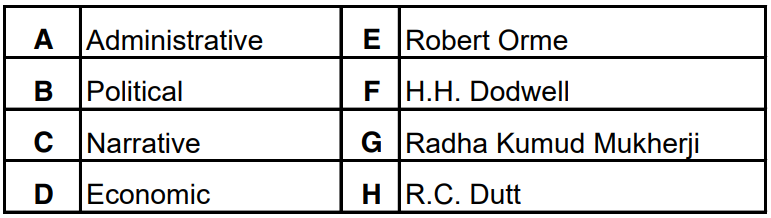
In the table given below, match the historians to the approaches taken by them.
Dictionary definition:
A. Administrative
B. Political
C. Narrative
D. Economic
Usage:
E. Robert Orme
F. H.H. Dodwell
G. Radha Kumud Mukherji
H. R.C. Dutt
Question 5, figure 1
  1. A.
    A-F, B-G, C-E, D-H
    ✓ Correct
  2. B.
    A-G, B-F, C-E, D-H
  3. C.
    A-E, B-F, C-G, D-H
  4. D.
    A-F, B-H, C-E, D-G
Solution
Based on the passage:
  • Robert Orme wrote a straight narrative (C-E).
  • H.H. Dodwell championed administrative history (A-F).
  • Radha Kumud Mukherji belonged to the group with political bias (B-G).
  • R.C. Dutt wrote Economic History of India (D-H).
Thus, the correct matching is A-F, B-G, C-E, D-H, which corresponds to option 1.
HistorianApproach
Robert OrmeNarrative (C)
H.H. DodwellAdministrative (A)
Radha Kumud MukherjiPolitical (B)
R.C. DuttEconomic (D)

DILR · Data Interpretation & Logical Reasoning

Set

Answer the questions based on the information given below.
A country has the following types of traffic signals.
3 red lights = stop
2 red lights = turn left
1 red light = turn right
3 green lights = go at 100 km/hr speed
2 green lights = go at 40 km/hr speed
1 green light = go at 20 km/hr speed
A motorist starts at a point on a road and follows all traffic signals. His car is heading towards the north.
He encounters the following signals (the time mentioned in each case below is applicable after crossing the previous signal).
Starting point - 1 green light
After half an hour, 1st signal - 2 red and 2 green lights
After 15 min, 2nd signal - 1 red light
After half an hour, 3rd signal - 1 red and 3 green lights
After 24 min, 4th signal - 2 red and 2 green lights
After 15 min, 5th signal - 3 red lights

Question 1 · MCQ

The total distance travelled by the motorist from the starting point till the last signal is
  1. A.
    90 km
    ✓ Correct
  2. B.
    100 km
  3. C.
    120 km
  4. D.
    None of these
Solution
Interpretation: The number of green lights sets the speed for the upcoming segment; if a signal has no green, speed remains unchanged.
  • Start: 1 green → 20 km/h. For 0.5 h: \(20 \times 0.5 = 10\) km.
  • 1st signal: 2 green → 40 km/h. For 0.25 h: \(40 \times 0.25 = 10\) km.
  • 2nd signal: no green → speed remains 40 km/h. For 0.5 h: \(40 \times 0.5 = 20\) km.
  • 3rd signal: 3 green → 100 km/h. For 0.4 h (24 min): \(100 \times 0.4 = 40\) km.
  • 4th signal: 2 green → 40 km/h. For 0.25 h: \(40 \times 0.25 = 10\) km.
  • 5th signal: stop.
Total = \(10+10+20+40+10 = 90\) km.
Hence, option (1).

Question 2 · MCQ

What is the position (radial distance) of the motorist when he reaches the last signal?
  1. A.
    45 km directly north of the starting point
  2. B.
    30 km directly to the east of the starting point
  3. C.
    50 km away to the north-east of the starting point
    ✓ Correct
  4. D.
    45 km away to the north-west of the starting point
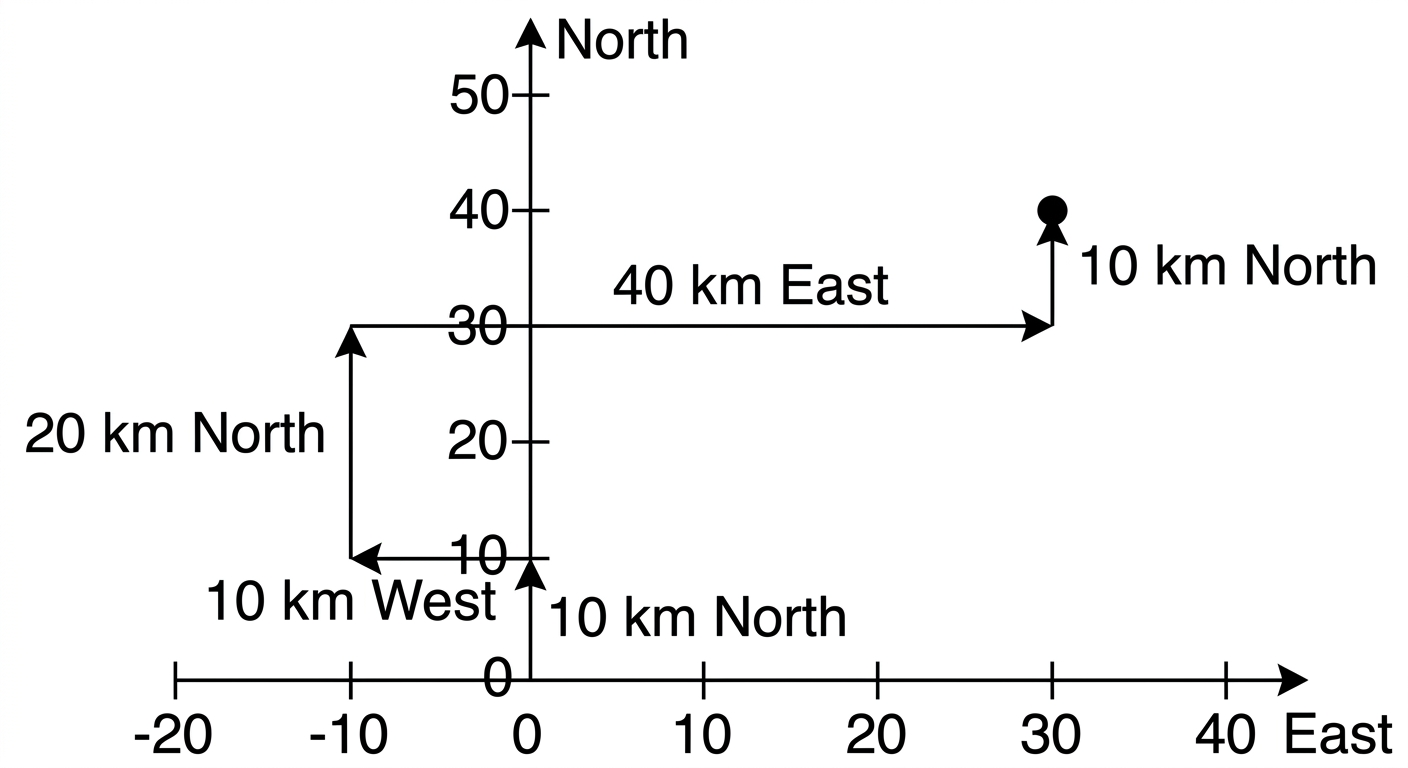
Solution
Track directions and distances:
Start heading North.
  • 1st segment: North 10 km → position (0, 10).
  • 1st signal: 2 red → turn left to West. Travel West 10 km → (–10, 10).
  • 2nd signal: 1 red → turn right from West to North. Speed unchanged (40 km/h). Travel North 20 km → (–10, 30).
  • 3rd signal: 1 red and 3 green → turn right from North to East. Speed 100 km/h. Travel East 40 km → (30, 30).
  • 4th signal: 2 red → turn left from East to North. Speed 40 km/h. Travel North 10 km → (30, 40).
  • 5th signal: stop.
[IMAGE: Route map of the motorist]
Final coordinates (30 km East, 40 km North).
Radial distance = \(\sqrt{30^2+40^2}=50\) km, direction North-East.
Matches option (3).
Solution 2, figure 1

Question 3 · MCQ

After the starting point if the 1st signal were 1 red and 2 green lights, what would be the final position of the motorist?
  1. A.
    30 km to the west and 20 km to the south
    ✓ Correct
  2. B.
    30 km to the west and 40 km to the north
  3. C.
    50 km to the east and 40 km to the north
  4. D.
    Directly 30 km to the east
Solution
All segments recalculated with the modified 1st signal (1 red + 2 green).
StepTurnDirectionSpeed (km/h)Time (h)Distance (km)Position (x,y)
Start–North200.510(0, 10)
1strightEast400.2510(10, 10)
2ndrightSouth40*0.520(10, –10)
3rdrightWest1000.440(–30, –10)
4thleftSouth400.2510(–30, –20)
5thstop––––(–30, –20)
*Speed unchanged (no green at 2nd signal).

Final coordinates: (–30, –20) → 30 km west, 20 km south. Option 1.

Question 4 · MCQ

If at the starting point, the car was heading towards south, what would be the final position of the motorist?
  1. A.
    30 km to the east and 40 km to the south
  2. B.
    50 km to the east and 40 km to the south
  3. C.
    30 km to the west and 40 km to the south
    ✓ Correct
  4. D.
    50 km to the west and 20 km to the north
Solution
Start facing south; all signals as originally given.
StepTurnDirectionSpeed (km/h)Time (h)Distance (km)Position (x,y)
Start–South200.510(0, –10)
1stleftEast400.2510(10, –10)
2ndrightSouth40*0.520(10, –30)
3rdrightWest1000.440(–30, –30)
4thleftSouth400.2510(–30, –40)
5thstop––––(–30, –40)
*Speed unchanged (no green at 2nd signal).

Final coordinates: (–30, –40) → 30 km west, 40 km south. Option 3.

QA · Quantitative Ability

Question 1 · MCQ

If there are 10 positive real numbers \(n_1 < n_2 < n_3 < \dots < n_{10}\), how many triplets of these numbers \((n_1, n_2, n_3), (n_2, n_3, n_4), \dots\) can be generated such that in each triplet the first number is always less than the second number, and the second number is always less than the third number?
  1. A.
    45
  2. B.
    90
  3. C.
    120
    ✓ Correct
  4. D.
    180
Solution
The 10 numbers are in increasing order. Any triplet chosen from them automatically satisfies the required inequality.

Number of triplets = number of ways to choose 3 numbers from 10 = \( \binom{10}{3} = 120 \).

Question 2 · MCQ

In \(\Delta ABC\), the internal bisector of \(\angle A\) meets BC at D. If AB = 4, AC = 3 and \(\angle A = 60^\circ\), then the length of AD is
  1. A.
    \(2\sqrt{3}\)
  2. B.
    \(\frac{12\sqrt{3}}{7}\)
    ✓ Correct
  3. C.
    \(\frac{15\sqrt{3}}{8}\)
  4. D.
    \(\frac{6\sqrt{3}}{7}\)
Solution
Use the angle bisector length formula:

\( AD = \frac{2bc \cos(A/2)}{b+c} \)

with \( b = AC = 3 \), \( c = AB = 4 \), \( A = 60^\circ \).

\( AD = \frac{2 \cdot 3 \cdot 4 \cdot \cos 30^\circ}{3+4} = \frac{24 \cdot \frac{\sqrt{3}}{2}}{7} = \frac{12\sqrt{3}}{7} \).

Question 3 · MCQ

The length of the common chord of two circles of radii 15 cm and 20 cm, whose centres are 25 cm apart, is
  1. A.
    24 cm
    ✓ Correct
  2. B.
    25 cm
  3. C.
    15 cm
  4. D.
    20 cm
Solution
Let the circles have centres \(A\) (radius 15) and \(B\) (radius 20) with \(AB=25\).
Let the common chord \(CD\) intersect \(AB\) at \(O\).
Set \(AO = x\), then \(BO = 25-x\).
In the right triangles: \(OC = \sqrt{15^2 - x^2} = \sqrt{20^2 - (25-x)^2}\).
Solving: \(225 - x^2 = 400 - (625 - 50x + x^2)\) → \(x = 9\).
Then \(OC = \sqrt{225 - 81} = 12\).
Chord length \(= 2 \times 12 = 24\) cm.

Question 4 · MCQ

If \(f(x) = \log \left\{ \frac{(1+x)}{(1-x)} \right\}\), then \(f(x) + f(y)\) is
  1. A.
    \(f(x + y)\)
  2. B.
    \(f\left\{ \frac{(x + y)}{(1 + xy)} \right\}\)
    ✓ Correct
  3. C.
    \((x + y) f\left\{ \frac{1}{(1 + xy)} \right\}\)
  4. D.
    \(\frac{f(x) + f(y)}{(1 + xy)}\)
Solution
\(f(x) + f(y) = \log\frac{1+x}{1-x} + \log\frac{1+y}{1-y} = \log\frac{(1+x)(1+y)}{(1-x)(1-y)}\).
Let \(z = \frac{x+y}{1+xy}\). Then
\(\frac{1+z}{1-z} = \frac{1+\frac{x+y}{1+xy}}{1-\frac{x+y}{1+xy}} = \frac{1+xy+x+y}{1+xy-x-y} = \frac{(1+x)(1+y)}{(1-x)(1-y)}\).
Hence \(f(x)+f(y) = \log\frac{1+z}{1-z} = f(z) = f\!\left(\frac{x+y}{1+xy}\right)\).

Question 5 · MCQ

Four horses are tethered at four corners of a square plot of side 14 m so that the adjacent horses can just reach one another. There is a small circular pond of area 20 \(m^2\) at the centre. Find the ungrazed area.
  1. A.
    22 \(m^2\)
  2. B.
    42 \(m^2\)
    ✓ Correct
  3. C.
    84 \(m^2\)
  4. D.
    168 \(m^2\)
Solution
Side of square = 14 m. Each horse grazes a quarter circle of radius 7 m.
Total grazed area = 4 × \(\frac{1}{4}\) × π × 7² = π × 49 = 154 m² (using π = 22/7).
Ungrazed area = area of square – grazed area = 14² – 154 = 196 – 154 = 42 m².
The pond at the centre is not reached by the horses, so it remains ungrazed and is already accounted for.

The other 54 questions are in the simulator

Sit CAT 2002 with the real exam's timer and interface, then see where your marks went: silly slips, traps, topics that cost you time, and the questions you should have skipped. Start with the free mock test: no payment needed.

Unlock this paper