Official paper · included in Pro

CAT 2000 Question Paper with Solutions

68 questions in 120 minutes, in three timed sections. Below: how the paper is built, the topics each section tested, and a solved sample from every section. Take the whole paper in the simulator to get your Score Waterfall, Topic ROI Map and Strategic IQ.

Paper structure and topics

VARC

Verbal Ability & Reading Comprehension

24 questions · 24 MCQ · 0 TITA

  • Reading Comprehension · 24

DILR

Data Interpretation & Logical Reasoning

22 questions · 22 MCQ · 0 TITA

  • Logical Reasoning · 13
  • Data Interpretation · 9

QA

Quantitative Ability

22 questions · 22 MCQ · 0 TITA

  • Arithmetic · 8
  • Algebra · 6
  • Geometry · 3
  • Modern Math · 3
  • Number System · 2

Sample questions with solutions

14 of the 68 questions: the first passage, the first DILR set and the first QA questions of the paper.

VARC · Verbal Ability & Reading Comprehension

Passage

Read the passage below and answer the questions that follow.

The current debate on intellectual property rights (IPRs) raises a number of important issues concerning the strategy and policies for building a more dynamic national agricultural research system, the relative roles of the public and private sectors, and the role of agribusiness multinational corporations (MNCs). This debate has been stimulated by the international agreement on Trade Related Intellectual Property Rights (TRIPs), negotiated as part of the Uruguay Round. TRIPs, for the first time, seeks to bring innovations in agricultural technology under a new worldwide IPR regime. The agribusiness MNCs (along with pharmaceutical companies) played a leading role in lobbying for such a regime during the Uruguay Round negotiations. The argument was that incentives are necessary to stimulate innovation, and that this requires a system of patents which gives innovators the exclusive right to use, sell, or license their innovations for a specified period while protecting them against unauthorized copying or use. With strong support from their national governments, these corporations were influential in shaping the TRIPs agreement that eventually emerged from the Uruguay Round.

The current debate on TRIPs in India, as elsewhere, reflects broader concerns about the privatization of research and the growing role of MNCs in biotechnology and agriculture. Agribusiness corporations, along with those who have great faith in the power of science to solve problems of hunger, malnutrition, and poverty, argue that new technology holds enormous potential and that patents are essential to encourage private-sector investment in research. Others, while less optimistic, believe that fears of MNC domination are exaggerated because farmers will adopt new products only if they clearly outperform existing alternatives.

Opponents of introducing an IPR regime in agriculture argue that it could make farmers increasingly dependent on monopolistic multinational corporations. Another concern is that extensive use of hybrids and genetically engineered varieties may increase agriculture's vulnerability to pests and diseases. The long-term effects of reduced biodiversity resulting from widespread use of specially bred varieties are also viewed as a serious risk. Since corporations are driven by profit, they may understate or ignore adverse consequences, particularly those that become evident only after many years. Aggressive marketing campaigns may also persuade farmers to adopt new varieties without understanding their potential risks. If such varieties fail, farmers may suffer severe losses, yet existing laws provide no mechanism for compensation.

Excessive focus on seeds and seed material has diverted attention from other equally important aspects of agricultural research. Improved varieties alone cannot ensure sustained increases in crop yields. Early high-yielding varieties (HYVs) of rice and wheat, for example, were found to be vulnerable to pests and suffered from grain-quality problems. These shortcomings were largely corrected through research carried out by public institutions. Although private companies could theoretically have undertaken such research, their willingness to do so depends on commercial considerations such as market losses and their ability to finance long-term corrective research. Public research institutions, being less constrained by profit motives, are often better suited for such work.

Research on common-pool resource management, ecological sustainability, and environmental health is both essential and technologically demanding. Although such research directly affects the effectiveness of seeds, chemicals, and equipment sold by private firms, these firms have limited commercial incentives to invest in it because knowledge related to resource management is not easily marketable. Furthermore, its successful application depends on solving institutional and social challenges involving land, water, and forests. Such long-term research is therefore more appropriately undertaken by public or quasi-public institutions.

The public sector must therefore continue to play a major role in the national agricultural research system. It is misleading to frame the issue simply as one of public versus private research. Instead, the focus should be on ensuring effective collaboration between the two sectors while maintaining an efficient public research system. Private firms do not develop innovations solely through their own efforts. Much of their work builds upon knowledge accumulated through earlier research conducted in universities, research organizations, and other public institutions. In addition, valuable knowledge exists outside formal scientific institutions in the traditions and practices of local communities.

Modern biotechnology is founded upon discoveries regarding the structure and functioning of DNA, yet these discoveries remain public goods that are freely available. At the same time, products developed using this knowledge may be patented for private profit. Similarly, private corporations frequently make use of germ plasm from plant species such as neem and turmeric, as well as publicly funded gene banks and publicly developed crop varieties, without paying for these resources. This raises several important questions. Should private companies be allowed unrestricted access to publicly funded scientific discoveries and traditional knowledge? Should they compensate the institutions and communities that developed and preserved these resources? If compensation is required, how should it be determined, and who should receive it? Should communities and public institutions themselves be allowed to patent their innovations? These issues deserve far greater attention and require careful study to develop fair, practical, and effective policies.

Finally, it is incorrect to equate the public sector solely with the government. The public sphere includes universities, cooperatives, public trusts, research organizations, and non-governmental organizations (NGOs). Providing these institutions with greater autonomy and resources is therefore an important step toward strengthening and restructuring the national public research system.

Question 1 · MCQ

Which one of the following statements describes an important issue, or important issues, not being raised in the context of the current debate on IPRs?
  1. A.
    The role of MNCs in the sphere of biotechnology and agriculture.
  2. B.
    The strategy and policies for establishing an IPR regime for Indian agriculture.
    ✓ Correct
  3. C.
    The relative roles of public and private sectors.
  4. D.
    Wider concerns about ‘privatization’ of research.
Solution
The passage raises a series of unanswered questions about access, compensation, and patenting of agricultural innovations and laments that these issues 'deserve more attention than they now get'. This corresponds directly to the absence of a clear IPR strategy, making option (2) correct.

Question 2 · MCQ

The fundamental breakthrough in deciphering the structure and functioning of DNA has become a public good. This means that
  1. A.
    breakthroughs in fundamental research on DNA are accessible by all without any monetary
    considerations.
    ✓ Correct
  2. B.
    the fundamental research on DNA has the characteristic of having beneficial effects for the public
    at large.
  3. C.
    due to the large scale of fundamental research on DNA, it falls in the domain of public sector
    research institutions.
  4. D.
    the public and other companies must have free access to such fundamental breakthroughs in
    research.
Solution
The passage contrasts free use of basic scientific discoveries with paid access, implying that a 'public good' is freely accessible. Therefore, the breakthrough becoming a public good means it is available to all without monetary considerations, as in option (1).

Question 3 · MCQ

In debating the respective roles of the public and private sectors in the national research system, it is important to recognise
  1. A.
    that private companies do not produce new varieties and inputs entirely on their own research.
  2. B.
    that almost all technology improvements are based on knowledge and experience accumulated
    from the past.
  3. C.
    the complementary role of public and private-sector research.
    ✓ Correct
  4. D.
    that knowledge repositories are primarily the scientific community and its academic publications.
Solution
The author argues that private firms build on public research and that the public sector includes diverse institutions; this interdependence makes it important to acknowledge their complementary roles, as in option (3).

Question 4 · MCQ

Which one of the following may provide incentives to address the problem of potential adverse consequences of biotechnology?
  1. A.
    Include IPR issues in the TRIPs agreement.
  2. B.
    Nationalize MNCs engaged in private research in biotechnology.
  3. C.
    Encourage domestic firms to patent their innovations.
  4. D.
    Make provisions in the law for user compensation against failure of newly-developed varieties.
    ✓ Correct
Solution
The passage discusses the need for compensation to address adverse consequences of biotechnology. The final paragraph raises issues about user compensation for failure of newly‑developed varieties. Option 4 directly addresses this by proposing legal provisions for user compensation, creating an incentive to mitigate adverse outcomes. Other options focus on IP protection for innovation, not on handling negative consequences.

Question 5 · MCQ

Which of the following statements is not a likely consequence of emerging technologies in agriculture?
  1. A.
    Development of newer and newer varieties will lead to increase in biodiversity.
    ✓ Correct
  2. B.
    MNCs may underplay the negative consequences of the newer technology on environment.
  3. C.
    Newer varieties of seeds may increase vulnerability of crops to pests and diseases.
  4. D.
    Reforms in patent laws and user compensation against crop failures would be needed to address
    new technology problems.
Solution
The passage states that emerging technologies in agriculture "could lead to a further reduction in biodiversity." Therefore, an increase in biodiversity is not a likely consequence. Options 2, 3, and 4 are all consistent with concerns raised in the passage (underplaying negatives, increased vulnerability to pests, and need for patent/compensation reforms).

Question 6 · MCQ

The TRIPs agreement emerged from the Uruguay Round to
  1. A.
    address the problem of adverse consequences of genetically engineered new varieties of grain.
  2. B.
    fulfil the WTO requirement to have an agreement on trade related property rights.
  3. C.
    provide incentives to innovators by way of protecting their intellectual property.
    ✓ Correct
  4. D.
    give credibility to the innovations made by MNCs in the field of pharmaceuticals and agriculture.
Solution
The passage explicitly states: "The rationale is that such protection provides incentives for innovation by allowing inventors to recover their costs and make profits." It refers to TRIPs as providing intellectual property protection, aligning with option 3. Option 1 is too specific, option 2 reverses causality, and option 4 is not mentioned.

DILR · Data Interpretation & Logical Reasoning

Set

Each question is followed by two statements, I and II. Answer each question using the following instructions.
Mark the answer as
a. if the question can be answered by one of the statements alone, but cannot be answered by using the other statement alone.
b. if the question can be answered by using either statement alone.
c. if the question can be answered by using both the statements together, but cannot be answered by using either statement alone.
d. if the question cannot be answered even by using both statements together.

Question 1 · MCQ

Consider three real numbers, X, Y and Z. Is Z the smallest of these numbers?
I. X is greater than at least one of Y and Z.
II. Y is greater than at least one of X and Z.
  1. A.
    a
  2. B.
    b
  3. C.
    c
    ✓ Correct
  4. D.
    d
Solution
Statement I: X > at least one of Y and Z. This gives no definitive order among all three.
Statement II: Y > at least one of X and Z. Similarly insufficient.
Using both: Suppose Z is not the smallest. Then either X ≤ Z or Y ≤ Z.
If X ≤ Z, from II, Y > X; from I, X > min(Y,Z). Since X ≤ Z, min(Y,Z) must be Y (if Y<Z) or Z (if Z≤Y). If min=Y, X>Y contradicts Y>X. If min=Z, X>Z contradicts X≤Z.
Similarly, Y ≤ Z leads to contradiction. Hence Z must be the smallest.
Both statements together are sufficient, but neither alone is. Thus answer is c (option 3).

Question 2 · MCQ

Let X be a real number. Is the modulus of X necessarily less than 3?
I. \(X(X + 3) < 0\)
II. \(X(X - 3) > 0\)
  1. A.
    a
    ✓ Correct
  2. B.
    b
  3. C.
    c
  4. D.
    d
Solution
We need to check if \(|X| < 3\), i.e. \(-3 < X < 3\).
Statement I: \(X(X+3) < 0\) ⇒ \(-3 < X < 0\). Clearly \(|X| < 3\). Sufficient.
Statement II: \(X(X-3) > 0\) ⇒ \(X < 0\) or \(X > 3\). Examples: \(X=4\) gives \(|X|=4 > 3\), \(X=-1\) gives \(|X|=1 < 3\). Insufficient.
Only statement I alone is sufficient. Answer is a (option 1).

Question 3 · MCQ

How many people are watching TV programme P?
I. Number of people watching TV programme Q is 1,000 and number of people watching both the programmes P and Q, is 100.
II. Number of people watching either P or Q or both is 1,500.
  1. A.
    a
  2. B.
    b
  3. C.
    c
    ✓ Correct
  4. D.
    d
Solution
Let a = only P, b = only Q, c = both. Need P total = a + c.
Statement I: b + c = 1000, c = 100 ⇒ b = 900. No info on a.
Statement II: a + b + c = 1500. No breakdown of b and c.
Combining: a = 1500 − (b + c) = 1500 − 1000 = 500. Then P total = 500 + 100 = 600.
Both together sufficient, neither alone sufficient. Answer is c (option 3).

QA · Quantitative Ability

Question 1 · MCQ

Let D be a recurring decimal of the form \(D = 0. a_1 a_2 a_1 a_2 a_1 a_2 ...\), where digits \(a_1\) and \(a_2\) lie between 0 and 9. Further, at most one of them is zero. Which of the following numbers necessarily produces an integer, when multiplied by D?
  1. A.
    18
  2. B.
    108
  3. C.
    198
    ✓ Correct
  4. D.
    288
Solution
\(D = 0.\overline{a_1 a_2} = \frac{10a_1 + a_2}{99}\). For integer \(D \times X\), take worst case: \(a_1=0, a_2=1\) gives \(D=\frac{1}{99}\). Then \(X\) must be a multiple of 99. Only 198 is a multiple of 99.

Question 2 · MCQ

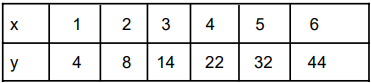
In the following table, for suitably chosen constants a, b and c, which one of the following best describes the relation between y and x?
Question 2, figure 1
  1. A.
    \(y = a + bx\)
  2. B.
    \(y = a + bx + cx^2\)
    ✓ Correct
  3. C.
    \(y = e^{a + bx}\)
  4. D.
    None of these
Solution
Successive differences:
xyΔ1Δ2
14
284
31462
42282
532102
644122
Second differences constant → quadratic. Fit \(y = a + bx + cx^2\). From Δ2=2 we get \(c=1\), then \(a=2, \ b=1\). Thus \(y = 2 + x + x^2\). Option (2) is correct.

Question 3 · MCQ

If \(a_1 = 1\) and \(a_{n+1} = 2a_n + 5, n = 1, 2 ...\), then \(a_{100}\) is equal to
  1. A.
    \((5 \times 2^{99} - 6)\)
  2. B.
    \((5 \times 2^{99} + 6)\)
  3. C.
    \((6 \times 2^{99} + 5)\)
  4. D.
    \((6 \times 2^{99} - 5)\)
    ✓ Correct
Solution
Rewrite recurrence as:
\(a_{n+1} + 5 = 2(a_n + 5)\)
Let \(b_n = a_n + 5\). Then \(b_1 = 6\), and
\(b_n = 6 \cdot 2^{n-1}\)
So \(a_n = 6 \cdot 2^{n-1} - 5\)
For \(n = 100\):
\(a_{100} = 6 \cdot 2^{99} - 5\)

Question 4 · MCQ

What is the value of the following expression? \(\left(\frac{1}{(2^2 - 1)}\right) + \left(\frac{1}{(4^2 - 1)}\right) + \left(\frac{1}{(6^2 - 1)}\right) + \dots + \left(\frac{1}{(20^2 - 1)}\right)\)
  1. A.
    \(\frac{9}{19}\)
  2. B.
    \(\frac{10}{19}\)
  3. C.
    \(\frac{10}{21}\)
    ✓ Correct
  4. D.
    \(\frac{11}{21}\)
Solution
General term for even \(n\):
\(\frac{1}{n^2-1} = \frac{1}{(n-1)(n+1)} = \frac{1}{2} \left( \frac{1}{n-1} - \frac{1}{n+1} \right)\)
Sum from \(n=2\) to \(20\) (step 2):
\(\frac{1}{2} \left[ \left(\frac{1}{1} - \frac{1}{3}\right) + \left(\frac{1}{3} - \frac{1}{5}\right) + \dots + \left(\frac{1}{19} - \frac{1}{21}\right) \right]\)
Telescopes to:
\(\frac{1}{2} \left( 1 - \frac{1}{21} \right) = \frac{1}{2} \cdot \frac{20}{21} = \frac{10}{21}\)

Question 5 · MCQ

A truck travelling at 70 km/hr uses 30% more diesel to travel a certain distance than it does when it travels at a speed of 50 km/hr. If the truck can travel 19.5 km/L of diesel at 50 km/hr, how far can the truck travel on 10 L of diesel at a speed of 70 km/hr?
  1. A.
    130 km
  2. B.
    140 km
  3. C.
    150 km
    ✓ Correct
  4. D.
    175 km
Solution
Mileage at \(50\) km/hr \(= 19.5\) km/L.
At \(70\) km/hr, diesel consumption increases by \(30%\), so mileage decreases by the factor \(1/1.3\).
Mileage at \(70\) km/hr \(= \frac{19.5}{1.3} = 15\) km/L.
Distance on \(10\) L \(= 15 \times 10 = 150\) km.
Hence, option 3.

The other 54 questions are in the simulator

Sit CAT 2000 with the real exam's timer and interface, then see where your marks went: silly slips, traps, topics that cost you time, and the questions you should have skipped. Start with the free mock test: no payment needed.

Unlock this paper