Official paper · included in Pro

CAT 1996 Question Paper with Solutions

68 questions in 120 minutes, in three timed sections. Below: how the paper is built, the topics each section tested, and a solved sample from every section. Take the whole paper in the simulator to get your Score Waterfall, Topic ROI Map and Strategic IQ.

Paper structure and topics

VARC

Verbal Ability & Reading Comprehension

24 questions · 24 MCQ · 0 TITA

  • Reading Comprehension · 16
  • Verbal Ability · 8

DILR

Data Interpretation & Logical Reasoning

22 questions · 22 MCQ · 0 TITA

  • Data Interpretation · 20
  • Logical Reasoning · 2

QA

Quantitative Ability

22 questions · 22 MCQ · 0 TITA

  • Arithmetic · 9
  • Algebra · 7
  • Geometry · 3
  • Number System · 2
  • Modern Math · 1

Sample questions with solutions

14 of the 68 questions: the first passage, the first DILR set and the first QA questions of the paper.

VARC · Verbal Ability & Reading Comprehension

Passage

I want to stress this personal helplessness we are all stricken with in the face of a system that has passed beyond our knowledge and control. To bring it nearer home, I propose that we switch off from the big things like empires and their wars to more familiar little things. Take pins for example! I do not know why it is that I so seldom use a pin when my wife cannot get on without boxes of them at hand; but it is so; and I will therefore take pins as being for some reason specially important to women.

There was a time when pinmakers would buy the material; shape it; make the head and the point; ornament it; and take it to the market, and sell it and the making required skill in several operations. They not only knew how the thing was done from beginning to end, but could do it all by themselves. But they could not afford to sell you a paper of pins for the farthing. Pins cost so much that a woman's dress allowance was calling pin money.

By the end of the 18th century Adam Smith boasted that it took 18 men to make a pin, each man doing a little bit of the job and passing the pin on to the next, and none of them being able to make a whole pin or to buy the materials or to sell it when it was made. The most you could say for them was that at least they had some idea of how it was made, though they could not make it. Now as this meant that they were clearly less capable and knowledgeable men than the old pin-makers, you may ask why Adam Smith boasted of it as a triumph of civilisation when its effect had so clearly a degrading effect. The reason was that by setting each man to do just one little bit of the work and nothing but that, over and over again, he became very quick at it. The men, it is said, could turn out nearly 5000 pins a day each; and thus pins became plentiful and cheap. The country was supposed to be richer because it had more pins, though it had turned capable men into mere machines doing their work without intelligence and being fed by the spare food of the capitalist just as an engine is fed with coals and oil. That was why the poet Goldsmith, who was a farsighted economist as well as a poet, complained that 'wealth accumulates, and men decay'.

Nowadays Adam Smith's 18 men are as extinct as the diplodocus. The 18 flesh-and-blood men have been replaced by machines of steel which spout out pins by the hundred million. Even sticking them into pink papers is done by machinery. The result is that with the exception of a few people who design the machines, nobody knows how to make a pin or how a pin is made: that is to say, the modern worker in pin manufacture need not be one-tenth so intelligent, skilful and accomplished as the old pinmaker; and the only compensation we have for this deterioration is that pins are so cheap that a single pin has no expressible value at all. Even with a big profit stuck on to the cost-price you can buy dozens for a farthing; and pins are so recklessly thrown away and wasted that verses have to be written to persuade children (without success) that it is a sin to steal, if even it’s a pin.

Many serious thinkers, like John Ruskin and William Morris, have been greatly troubled by this, just as Goldsmith was, and have asked whether we really believe that it is an advance in wealth to lose our skill and degrade our workers for the sake of being able to waste pins by the ton. We shall see later on, when we come to consider the Distribution of Leisure, that the cure for this is not to go back to the old free for higher work than pin-making or the like. But in the meantime the fact remains that the workers are now not able to make anything themselves even in little bits. They are ignorant and helpless, and cannot lift their finger to begin their day's work until it has all been arranged for them by their employer's who themselves do not understand the machines they buy, and simply pay other people to set them going by carrying out the machine maker's directions.

The same is true for clothes. Earlier the whole work of making clothes, from the shearing of the sheep to the turning out of the finished and washed garment ready to put on, had to be done in the country by the men and women of the household, especially the women; so that to this day an unmarried woman is called a spinster. Nowadays nothing is left of all this but the sheep shearing; and even that, like the milking of cows, is being done by machinery, as the sewing is. Give a woman a sheep today and ask her to produce a woollen dress for you; and not only will she be quite unable to do it, but you are likely to find that she is not even aware of any connection between sheep and clothes. When she gets her clothes, which she does by buying them at the shop, she knows that there is a difference between wool and cotton and silk, between flannel and merino, perhaps even between stockinet and other wefts; but as to how they are made, or what they are made of, or how they came to be in the shop ready for her to buy, she knows hardly anything. And the shop assistant from whom she buys is no wiser. The people engaged in the making of them know even less; for many of them are too poor to have much choice of materials when they buy their own clothes.

Thus the capitalist system has produced an almost universal ignorance of how things are made and done, whilst at the same time it has caused them to be made and done on a gigantic scale. We have to buy books and encyclopaedias to find out what it is we are doing all day; and as the books are written by people who are not doing it, and who get their information from other books, what they tell us is twenty to fifty years out of date knowledge and almost impractical today. And of course most of us are too tired of our work when we come home to want to read about it; what we need is cinema to take our minds off it and feel our imagination.

It is a funny place, this word of capitalism, with its astonishing spread of education and enlightenment. There stand the thousands of property owners and the millions of wage workers, none of them able to make anything, none of them knowing what to do until somebody tells them, none of them having the least notion of how it is made that they find people paying them money, and things in the shops to buy with it. And when they travel they are surprised to find that savages and Esquimaux and villagers who have to make everything for themselves are more intelligent and resourceful! The wonder would be if they were anything else. We should die of idiocy through disuse of our mental faculties if we did not fill our heads with romantic nonsense out of illustrated newspapers and novels and plays and films. Such stuff keeps us alive, but it falsifies everything for us so absurdly that it leaves us more or less dangerous lunatics in the real world.

Excuse my going on like this; but as I am a writer of books and plays myself, I know the folly and peril of it better than you do. And when I see that this moment of our utmost ignorance and helplessness, delusion and folly, has been stumbled on by the blind forces of capitalism as the moment for giving votes to everybody, so that the few wise women are hopelessly overruled by the thousands whose political minds, as far as they can be said to have any political minds at all, have been formed in the cinema, I realise that I had better stop writing plays for a while to discuss political and social realities in this book with those who are intelligent enough to listen to me.

Question 1 · MCQ

A suitable title to the passage would be
  1. A.
    You Can't Hear a Pin-drop Nowadays.
  2. B.
    Capitalism and Labour Disintegration: Pinning the Blame.
    ✓ Correct
  3. C.
    The Saga of the Non Safety Pins.
  4. D.
    Reaching the Pinnacle of Capitalistic Success.
Solution
The passage’s central complaint is that capitalism’s division of labour has destroyed the old skilled pin-maker, degraded workers into ignorant machine-minders, and spread helplessness even as goods become cheap. The title 'Capitalism and Labour Disintegration: Pinning the Blame' captures this argument and its recurring pin example, while the other options are too narrow, irrelevant, or positive.

Question 2 · MCQ

Why do you think that the author gives the example of Adam Smith?
  1. A.
    Because he thinks that Adam Smith was a boaster without any facts to back his utterance.
  2. B.
    Because he wants to give us an example of something undesirable that Adam Smith was proud of.
    ✓ Correct
  3. C.
    Because he is proud to be a believer in a tenet of production that even a great man like Adam Smith boasted about.
  4. D.
    Because he feels that Adam Smith was right when he said that it took 18 men to make a pin.
Solution
The author cites Adam Smith’s boast about 18 men making a pin, but then says this had 'so clearly a degrading effect' on capable men. The example is used to show that Adam Smith proudly praised something the author regards as undesirable.

Question 3 · MCQ

Which of the following is true as far as pins are concerned?
  1. A.
    The cost of pins is more nowadays to produce.
  2. B.
    Earlier, workmen made pins with a lot of love and care.
  3. C.
    Pinball machines are the standard pin producing gadgets nowadays.
  4. D.
    It took much longer to make a pin earlier.
    ✓ Correct
Solution
Older pin-makers performed all the operations themselves, requiring skill in several processes, and could not sell a paper of pins for a farthing. Today machines produce pins by the hundred million. Hence pin-making was much slower earlier.

Question 4 · MCQ

The reason that children have to be taught that stealing a pin is wrong is that
  1. A.
    they have an amazing proclivity to steal them right from childhood.
  2. B.
    pins are so common and cheap that taking one would not even be considered stealing by them.
    ✓ Correct
  3. C.
    stealing a pin would lead to stealing bigger and bigger things in the future.
  4. D.
    stealing an insignificant thing like a pin smacks of kleptomania.
Solution
The passage says pins are so recklessly thrown away and wasted that verses are needed to persuade children that it is a sin to steal 'if even it’s a pin.' Because pins are so common and cheap, children do not naturally regard taking one as stealing.

DILR · Data Interpretation & Logical Reasoning

Set

Answer the questions based on the following information. The data given in the table shows the investment details in country ‘Fortune Land’ of companies A, B, C, D, E and F. Figures in the table are in US dollars in billions.
CompanyYear 1Year 3
A2.511.5
B4.618.7
C5.821.2
D3.117.7
E10.629.8
F7.860.1
Total34.41149.0

Question 1 · MCQ

What is the percentage increase in investment of B, C, D and E from year 1 to year 3?
  1. A.
    121%
  2. B.
    321%
  3. C.
    221%
    ✓ Correct
  4. D.
    300%
Solution
Combining B, C, D and E:
CompanyYear 1Year 3
B11.938.9
C8.529.7
D5.413.6
E2.99.9
Total28.792.1
Increase = \(\frac{92.1 - 28.7}{28.7} \times 100 = \frac{63.4}{28.7} \times 100 \approx 220.9%\), rounded to \(221%\). Hence option 3.

Question 2 · MCQ

What is the ratio of investments of E to F for the years 1 to 3?
  1. A.
    31 : 19
  2. B.
    19 : 31
    ✓ Correct
  3. C.
    20 : 29
  4. D.
    41 : 53
Solution
Total investments of E and F over years 1 to 3:
CompanyYear 1Year 2Year 3Total
E2.96.29.919.0
F8.916.85.331.0
Required ratio \(= 19.0 : 31.0 = 19 : 31\). Hence option 2.

Question 3 · MCQ

What is D’s contribution as a percentage of total investments in year 2?
  1. A.
    8.2%
  2. B.
    4.5%
  3. C.
    7.4%
    ✓ Correct
  4. D.
    9.2%
Solution
Year 2 investments:
CompanyABCDEFTotal
Year 240.418.011.27.46.216.8100.0
D’s contribution \(= \frac{7.4}{100.0} \times 100 = 7.4%\). Hence option 3.

Question 4 · MCQ

For which company is investment not increased from year 1 to year 3?
  1. A.
    C
  2. B.
    D
  3. C.
    F
  4. D.
    None of these
    ✓ Correct
Solution
From the table:
  • C: Year 1 = 10.2, Year 3 = 15.1 → increased
  • D: Year 1 = 5.4, Year 3 = 7.8 → increased
  • F: Year 1 = 6.1, Year 3 = 8.5 → increased
All three companies show an increase from Year 1 to Year 3, so none of them has investment not increased.

Correct option: 4 (None of these).

Question 5 · MCQ

What is the percentage difference in investments of companies A, B, C and companies D, E, F in year 2?
  1. A.
    75%
  2. B.
    81%
    ✓ Correct
  3. C.
    67.5%
  4. D.
    42.3%
Solution
For Year 2:
GroupCompaniesInvestment (US $ bn)
IA + B + C11.8 + 10.4 + 12.6 = 34.8
IID + E + F6.3 + 5.7 + 7.2 = 19.2
Difference = 34.8 − 19.2 = 15.6.

Percentage difference = \(\frac{15.6}{19.2} \times 100 = 81.25% \approx 81%\).

Correct option: 2.

QA · Quantitative Ability

Question 1 · MCQ

If a number 774958A96B is to be divisible by 8 and 9, the respective values of A and B will be
  1. A.
    7 and 8
  2. B.
    8 and 0
    ✓ Correct
  3. C.
    5 and 8
  4. D.
    None of these
Solution
Divisibility by 8: last three digits \(96B\) must be divisible by 8, so \(B=0\) or \(B=8\).
Divisibility by 9: digit sum \(55+A+B\) must be divisible by 9.
If \(B=0\), then \(55+A\) divisible by 9 gives \(A=8\).
If \(B=8\), then \(63+A\) divisible by 9 gives \(A=0\) or \(A=9\).
Among the given options, only \(A=8,B=0\) appears.
Hence option 2.

Question 2 · MCQ

Which of the following values of x do not satisfy the inequality \( (x^2 - 3x + 2 > 0) \) at all?
  1. A.
    1 \(\leq\) x \(\leq 2\)
    ✓ Correct
  2. B.
    -1 \(\geq\) x \(\geq -2\)
  3. C.
    0 \(\leq\) x \(\leq 2\)
  4. D.
    0 \(\geq\) x \(\geq -2\)
Solution
\(x^2-3x+2=(x-1)(x-2)>0\).
This holds for \(x<1\) or \(x>2\), so it is not satisfied exactly for \(1\le x\le 2\).
Therefore the interval that fails the inequality is option 1.

Question 3 · MCQ

A cube of side 12 cm is painted red on all the faces and then cut into smaller cubes, each of side 3 cm. What is the total number of smaller cubes having none of their faces painted?
  1. A.
    16
  2. B.
    8
    ✓ Correct
  3. C.
    12
  4. D.
    24
Solution
Number of cubes along an edge = \(\frac{12}{3}=4\).
Only the interior cubes have no painted face: \((4-2)^3=2^3=8\).
Hence, answer is option 2.

Question 4 · MCQ

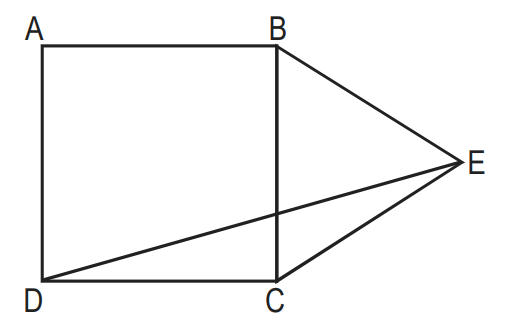
If ABCD is a square and BCE is an equilateral triangle, what is the measure of \( \angle DEC \)?
Question 4, figure 1
  1. A.
    15°
    ✓ Correct
  2. B.
    30°
  3. C.
    20°
  4. D.
    45°
Solution
Let the square side be \(s\). Since \(BCE\) is equilateral, \(\angle BCE=60^\circ\).
In square \(ABCD\), \(\angle DCB=90^\circ\). With \(CE\) outside the square, \(\angle DCE=90^\circ+60^\circ=150^\circ\).
Also \(DC=CE=s\), so triangle \(DCE\) is isosceles. Therefore \(\angle DEC=\frac{180^\circ-150^\circ}{2}=15^\circ\).
Hence, answer is option 1.

Question 5 · MCQ

Instead of a metre scale, a cloth merchant uses a 120 cm scale while buying, but uses an 80 cm scale while selling the same cloth. If he offers a discount of 20% on cash payment, what is his overall profit percentage?
  1. A.
    20%
    ✓ Correct
  2. B.
    25%
  3. C.
    40%
  4. D.
    15%
Solution
Let the nominal price per 100 cm be \(C\).
While buying, the 120 cm scale gives 120 cm for every 100 cm paid, so cost per actual cm = \(\frac{C}{120}\).
While selling, the 80 cm scale gives only 80 cm for every 100 cm charged. After 20% discount, revenue per actual cm = \(0.8 \times \frac{C}{80} = \frac{C}{100}\).
Profit % = \(\frac{\frac{C}{100} - \frac{C}{120}}{\frac{C}{120}} \times 100 = 20%\).
Hence option 1.

The other 54 questions are in the simulator

Sit CAT 1996 with the real exam's timer and interface, then see where your marks went: silly slips, traps, topics that cost you time, and the questions you should have skipped. Start with the free mock test: no payment needed.

Unlock this paper