
Official paper · included in Pro

CAT 1994 Question Paper with Solutions

68 questions in 120 minutes, in three timed sections. Below: how the paper is built, the topics each section tested, and a solved sample from every section. Take the whole paper in the simulator to get your Score Waterfall, Topic ROI Map and Strategic IQ.

Paper structure and topics

VARC

Verbal Ability & Reading Comprehension

24 questions · 24 MCQ · 0 TITA

  • Reading Comprehension · 24

DILR

Data Interpretation & Logical Reasoning

22 questions · 22 MCQ · 0 TITA

  • Data Interpretation · 14
  • Logical Reasoning · 8

QA

Quantitative Ability

22 questions · 22 MCQ · 0 TITA

  • Arithmetic · 8
  • Algebra · 7
  • Geometry · 3
  • Number System · 2
  • Data Sufficiency · 1
  • Modern Math · 1

Sample questions with solutions

15 of the 68 questions: the first passage, the first DILR set and the first QA questions of the paper.

VARC · Verbal Ability & Reading Comprehension

Passage

The communities of ants are sometimes very large, numbering even up to 500, individuals: and it is a lesson to us that no one has ever yet seen quarrel between any two ants belonging to the same community. On the other hand, it must be admitted that they are in hostility not only with most other insects, including ants of different species, but even with those of the same species if belonging to different communities. I have over and over again introduced ants from one of my nests into another nest of the same species; and they were invariably attacked, seized by a leg or an antenna, and dragged out.

It is evident, therefore, that the ants of each community all recognize one another, which is very remarkable. But more than this, I several times divided a nest into two halves and found that even after separation of a year and nine months they recognize one another and were perfectly friendly, while they at once attacked ants from a different nest, although of the same species.

It has been suggested that the ant of each nest have some sign or password by which they recognize one another. To test this I made some of them insensible, first I tried chloroform; but this was fatal to them, and I did not consider the test satisfactory. I decided therefore to intoxicate them. This was less easy than I had expected. None of my ants would voluntarily degrade themselves by getting drunk. However, I got over the difficulty by putting them into whisky for a few moments. I took fifty specimens - - twenty five percent from one nest and twenty five percent from another made them dead drunk, market each with a spot of paint, and put them on a table close to where other ants from one the nests were feeding. The table was surrounded as usual with a moat of water to prevent them from straying. The ants, which were feeding, soon noticed those, which I had made drunk. They seemed quite astonished to find their comrades in such a disgraceful condition, and as much at a loss to know what to do with their drunkards as we were. After a while, however, they carried them all away; the strangers they took to the edge of the moat and dropped into the water, while they bore their friends home into the nest, where by degrees they slept off the effects of the spirits. Thus it is evident that they know their friends even when incapable of giving any sign or password.

Question 1 · MCQ

An appropriate title for this passage might be
  1. A.
    Nature's Mysteries
  2. B.
    Human Qualities in the Insect world
  3. C.
    Drunken Ants
  4. D.
    Communication in Ant Communities
    ✓ Correct
Solution
The passage centres on how ants identify nest-mates and reject outsiders, including the experiment to test whether recognition uses a sign or password. "Communication in Ant Communities" best captures this central theme; the other titles are too broad, too narrow, or off-topic.
Question 2 · MCQ

Attitudes of ants towards strangers of the same species may be categorized as
  1. A.
    indifferent
  2. B.
    curious
  3. C.
    hostile
    ✓ Correct
  4. D.
    passive
Solution
The passage explicitly states that ants from different communities of the same species were "invariably attacked, seized by a leg or an antenna, and dragged out." Therefore their attitude towards strangers is hostile.

Question 3 · MCQ

The author's anecdotes of the inebriated ants would support all the following inductions except the statement that
  1. A.
    ants take unwillingly to intoxicants
  2. B.
    ants aid comrades in distress
  3. C.
    ants have invariable recognition of their community members
  4. D.
    ants recognize their comrades by a mysterious password.
    ✓ Correct
Solution
The drunk-ant experiment showed recognition even when the ants could not give any sign or password, so it does NOT support the idea of recognition by a mysterious password. The other statements do follow: ants resisted alcohol, helped drunken friends home, and recognised community members.

Question 4 · MCQ

According to the passage, chloroform was less successful than alcohol for inhibiting communication because of
  1. A.
    its expense
  2. B.
    its unpredictable side effects
  3. C.
    its unavailability
  4. D.
    its fatality
    ✓ Correct
Solution
The author says he first tried chloroform, "but this was fatal to them." Thus alcohol was more successful because chloroform killed the ants.

Question 5 · MCQ

Although the author is a scientist, his style of writing also exhibits a quality of
  1. A.
    sophistry
  2. B.
    whimsy
    ✓ Correct
  3. C.
    hypocrisy
  4. D.
    tragedy
Solution
The humorous, fanciful phrasing — ants refusing to "voluntarily degrade themselves by getting drunk" and appearing "astonished" at drunken comrades — is whimsy, not sophistry, hypocrisy, or tragedy.

DILR · Data Interpretation & Logical Reasoning

Set

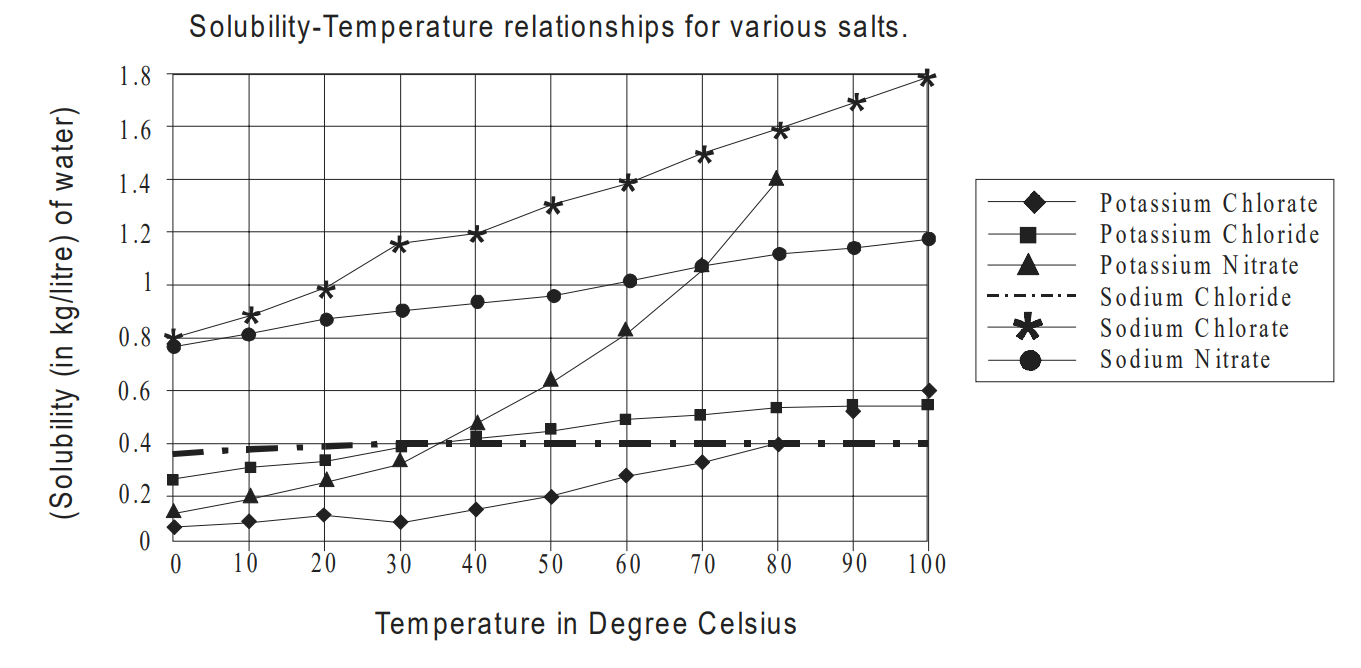
Answer the questions on the basis of the information given below.
Solubility-Temperature relationships for various salts.
[See chart in image]
DILR set, figure 1

Question 1 · MCQ

Which of the following salts has greatest solubility?
  1. A.
    Potassium Chlorate at 80° C.
  2. B.
    Potassium Chloride at 35° C.
  3. C.
    Potassium Nitrate at 39° С.
    ✓ Correct
  4. D.
    Sodium Chloride at 85° C.
Solution
Reading from the solubility chart (approx. g per 100 g water):
KClO₃ at 80°C ≈ 40
KCl at 35°C ≈ 38
KNO₃ at 39°C ≈ 64
NaCl at 85°C ≈ 39

KNO₃ at 39°C has the greatest solubility.
Correct option: 3.

Question 2 · MCQ

Approximately, how many kg of Potassium Nitrate can be dissolved in 10 litres of water at 30°C?
  1. A.
    0.04
  2. B.
    0.4
  3. C.
    4
    ✓ Correct
  4. D.
    0.35
Solution
At 30°C, KNO₃ solubility is about 45 g per 100 g water.
10 L water = 10 kg = 10000 g.
Mass dissolved = (45/100) × 10000 = 4500 g = 4.5 kg.
The closest option is 4 kg.
Correct option: 3.

Question 3 · MCQ

By what percentage is the solubility of Potassium Chlorate in water increased as the water is heated from 30°C to 80°C?.
  1. A.
    100
  2. B.
    200
  3. C.
    250
  4. D.
    300
    ✓ Correct
Solution
KClO₃ solubility at 30°C ≈ 10 g per 100 g water.
KClO₃ solubility at 80°C ≈ 40 g per 100 g water.
Percentage increase = ((40 − 10) / 10) × 100% = 300%.
Correct option: 4.

Question 4 · MCQ

If 1 mole of Potassium Chloride weighs 0.07456 kg, approximately. How many moles of Potassium Chloride can be dissolved in 100 litres of water at 36°C?
  1. A.
    700
  2. B.
    650
  3. C.
    480
  4. D.
    540
    ✓ Correct
Solution
From the solubility graph, KCl at \(36^\circ C\) reads about \(0.40\) kg/L of water.
In 100 L: \(0.40 \times 100 = 40\) kg.
Moles of KCl \(= \frac{40}{0.07456} \approx 536.5\).
The closest option is 540, so the answer is option 4.

Question 5 · MCQ

Which of the salts has greater change in solubility in kg / litre of water between 15°C and 25°C?
  1. A.
    Potassium Chlorate
  2. B.
    Potassium Nitrate
    ✓ Correct
  3. C.
    Sodium Chlorate
  4. D.
    Sodium Nitrate
Solution
Compare the vertical change in solubility from \(15^\circ C\) to \(25^\circ C\) on the graph.
SaltAt 15°C (kg/L)At 25°C (kg/L)Change (kg/L)
Potassium chlorate0.050.090.04
Potassium nitrate0.270.400.13
Sodium chlorate0.921.010.09
Sodium nitrate0.840.920.08
Potassium nitrate has the largest increase, about \(0.13\) kg/L. Hence option 2.

QA · Quantitative Ability

Question 1 · MCQ

The number of votes not cast for the Praja Party increased by 25% in the National General Election over those not cast for it in the previous Assembly Polls, and the Praja Party lost by a majority twice as large as that by which it had won the Assembly Polls. If a total 2,60,000 people voted each time. How many voted for the Praja Party in the Assembly Elections.
  1. A.
    1,10,000
  2. B.
    1,50,000
  3. C.
    1,40,000
    ✓ Correct
  4. D.
    1,20,000
Solution
Let Praja Party votes in Assembly be \(x\).
Total votes each time \(= 260000\).
Votes not for Praja in Assembly \(= 260000 - x\).
Votes not for Praja in National election \(= 1.25(260000 - x)\).
So Praja votes in National election \(= 260000 - 1.25(260000 - x) = 1.25x - 65000\).

Assembly majority while winning: \(x - (260000 - x) = 2x - 260000\).
National majority while losing: \(1.25(260000 - x) - (1.25x - 65000) = 390000 - 2.5x\).

Given: \(390000 - 2.5x = 2(2x - 260000)\).
Solving: \(390000 - 2.5x = 4x - 520000\).
\(6.5x = 910000\).
\(x = 140000\).

Question 2 · MCQ

Are based on the following information:

Ghoshbabu is staying at Ghosh Housing Society, Aghosh Colony, Dighospur, Calcutta. In Ghosh Housing Society 6 persons read daily Ganashakti and 4 read Anand Bazar Patrika; in his colony there is no person who reads both. Total number of persons who read these two newspapers in Aghosh Colony and Dighospur is 52 and 200 respectively. Number of persons who read Ganashakti in Aghosh Colony and Dighospur is 33 and 121 respectively; while the persons who read Anand Bazar Patrika in Aghosh Colony and Dighospur are 32 and 117 respectively.

Number of persons in Dighospur who read only Ganashakti is
  1. A.
    121
  2. B.
    83
    ✓ Correct
  3. C.
    79
  4. D.
    127
Solution
For Dighospur, total persons reading at least one of the two newspapers \(= 200\).
Let the number reading both newspapers be \(x\).
Ganashakti readers \(= 121\), so only Ganashakti readers \(= 121 - x\).
Anand Bazar Patrika readers \(= 117\), so only Anand Bazar Patrika readers \(= 117 - x\).

Total readers:
\((121 - x) + (117 - x) + x = 238 - x = 200\).
So \(x = 38\).

Only Ganashakti readers in Dighospur \(= 121 - 38 = 83\).

Question 3 · MCQ

If \(log_5 log_5 (\sqrt{x+5}+\sqrt{x}) = 0\), find the value of x.
  1. A.
    1
  2. B.
    0
  3. C.
    2
  4. D.
    None of these
    ✓ Correct
Solution
\(\log_5(\log_5(\sqrt{x+5}+\sqrt{x}))=0\) implies \(\log_5(\sqrt{x+5}+\sqrt{x})=1\).
So \(\sqrt{x+5}+\sqrt{x}=5\).
Let \(\sqrt{x+5}=5-\sqrt{x}\). Squaring gives:
\(x+5=25-10\sqrt{x}+x\), hence \(10\sqrt{x}=20\), so \(\sqrt{x}=2\) and \(x=4\).
Check: \(\sqrt{4+5}+\sqrt{4}=3+2=5\).
Since \(x=4\) is not among the listed options 1, 0, or 2, the correct choice is None of these.

Question 4 · MCQ

A right circular cone, a right circular cylinder and a hemisphere, all have the same radius, and the heights of the cone and cylinder equal to their diameters. Then their volumes are proportional, respectively to
  1. A.
    1:3:1
    ✓ Correct
  2. B.
    2:1:3
  3. C.
    3:2:1
  4. D.
    1:2:3
Solution
Let radius be \(r\). Since heights equal diameter, \(h=2r\).
Cone volume \(=\frac{1}{3}\pi r^2(2r)=\frac{2}{3}\pi r^3\).
Cylinder volume \(=\pi r^2(2r)=2\pi r^3\).
Hemisphere volume \(=\frac{2}{3}\pi r^3\).
Ratio \(=\frac{2}{3}\pi r^3 : 2\pi r^3 : \frac{2}{3}\pi r^3 = 1:3:1\).

Question 5 · MCQ

Two towns A and B are 100 km apart. A school is to be built for 100 students of town B and 30 students of Town A. Expenditure on transport is Rs. 1.20 per km per student. If the total expenditure on transport by all 130 students is to be as small as possible, then the school should be built at
  1. A.
    33 km from Town A.
  2. B.
    33 km from Town B
  3. C.
    Town A
  4. D.
    Town B
    ✓ Correct
Solution
Let the school be \(x\) km from A, so it is \(100-x\) km from B.
Total transport cost \(= 1.20[30x + 100(100-x)]\)
\(= 1.20(10000 - 70x)\).
This is decreasing in \(x\), so minimum is at \(x=100\), i.e. Town B.
Hence option 4.

The other 53 questions are in the simulator

Sit CAT 1994 with the real exam's timer and interface, then see where your marks went: silly slips, traps, topics that cost you time, and the questions you should have skipped. Start with the free mock test: no payment needed.

Unlock this paper